The American mall is not disappearing as many would assume. However, a structural change is happening, and now yet another popular chain is trying to adapt by quietly shifting away from traditional malls to open-air centers.
Under my recent extensive retail tracking coverage for TheStreet I reported on how several major mall staples are forcefully optimizing their footprints to protect profit margins.
The examples include Michael Kors (Capri Holdings) that closed 139 stores in three years, Vera Bradley, which quietly shuttered 13 underperforming locations, Tilly’s closed 40 stores, and Fossil Group shut 7, among others.
The traditional American indoor mall thrived in the ’70s, ’80s, and ’90s. In that period, more than 800 new malls were built, according to the International Council of Shopping Centers.
However, starting in the 2000s, the malls saw their first challenges with the rise of online shopping. The 2008 financial crisis hit consumers’ wallets harshly, which directly impacted retail sales.
More recently, the pandemic accelerated this shift, as online shopping became a new habit for many. When big-box stores such as Sears and JCPenney collapsed, they took many smaller retailers with them.
Now, Buckle Inc., a popular specialty fashion retailer with a wide range of premium denim fits and exclusive private-label brands, is joining the group by quietly moving away from traditional malls.
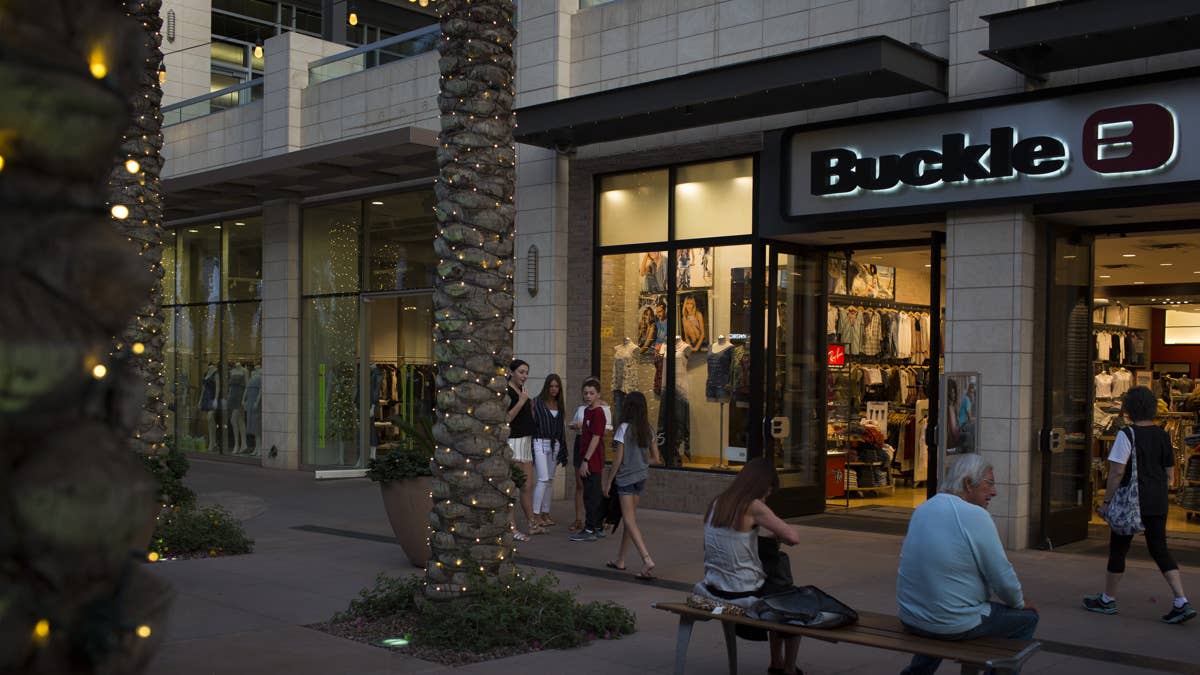
Buckle Inc. quietly shut down 24 stores in 3 years
A 78-year-old mall staple, Buckle Inc. grew from a men’s apparel store into a US specialty retailer. It built its reputation and popularity on premium denim, private-label brands, and personalized in-store styling services
It prides itself on having a primary focus on its mission: “Creating the most enjoyable shopping experience possible for our guests,” as per its LinkedIn official page.
Earlier this year, America’s popular denim retailer reported its first-quarter 2026 financial results revealing a net income of $46.88 million, compared to $35.19 million in the same period of prior year.
Buckle Q1 2026 earnings highlights:
- Net sales were $289 million, an increase of 6.1%.
- Comparable store sales grew 5.1%, while online sales improved 2.8%.
- Gross margin was 46.2%, down 50 basis points.
- SG&A expenses were 25.6% of net sales, due to a $19.1 million litigation settlement.
During the quarter, Buckle opened 3 new stores, remodeled 5 (out of which 4 were relocations) and closed 1 store.
Digging through the company’s official records I found out that over the last three years Buckle closed 24 stores, while simultaneously opening 23 new ones.
According to the company’s 10-K filing with the Securities and Exchange Commission (SEC):
|
Year |
Closed Buckle stores |
Opened Buckle stores |
Total number of running Buckle stores at the end of the year |
|
2016 |
6 |
5 |
467 |
|
2017 |
12 |
2 |
457 |
|
2018 |
7 |
/ |
450 |
|
2019 |
4 |
2 |
448 |
|
2020 |
8 |
3 |
443 |
|
2021 |
4 |
1 |
440 |
|
2022 |
3 |
4 |
441 |
|
2023 |
6 |
9 |
444 |
|
2024 |
11 |
8 |
441 |
|
2025 |
7 |
6 |
440 |
“Over the past ten years, Buckle has opened a total of 40 new stores and closed 68, with the number of openings and closings in a given year being based on local economic conditions and available opportunities. The Company intends to open new stores only when management believes there is a reasonable expectation of satisfactory results,” Buckle states in the SEC filing.
An analysis of the company’s earnings results and closing versus opening stores numbers, doesn’t suggest struggles for the retailer. In fact, the company is only a net down of 1 store in the last three years, suggesting standard operational optimization.
However, its financial documents and earnings call transcript reveal that behind these closure and opening numbers lies an important shift in strategy.
Why has Buckle closed 24 and opened 23 stores in three years?
The numbers show that at the end of each year, Buckle has maintained around 440 stores since 2021, suggesting its total storefront count remains relatively unchanged. Why is the retailer then bothering with the closures and openings, if the overall number is rather constant?
Buckle’s latest earnings results revealed strong results, however, the closures are part of the strategy to keep those numbers thriving. The denim retailer is gradually shifting more of its footprint toward outdoor shopping centers
“In recent years, however, the Company has successfully relocated several of its stores in smaller and middle markets from enclosed malls into power center locations, with continued plans for pursuing more such relocation opportunities in the future,” the company stated in 10-K filing with the SEC.
During the company’s Q4 2025 earnings call, The Buckle Chief Financial Officer, Thomas B. Heacock said, “Current plans for fiscal 2026 include the opening of 12 to 14 new stores and completing 12 to 14 full remodel projects, with at least half of the planned remodels being relocations into new outdoor centers.”
Buckle’s documents reveal that the focus on outdoor centers started years ago. According to the company 10-K filing for the year ended February 1, 2025, “Over the past several fiscal years, the Company has also developed updated storefront designs that enhance the exterior visibility for stores relocating from enclosed mall locations to outdoor power centers and lifestyle centers.”
As of January 31, 2026, the Company operated 440 retail stores in 42 states throughout the United States under the names “Buckle” and “Buckle Youth.”
Related: Outdoors retailer closing 91 stores in Chapter 11 bankruptcy
The new reality of shopping malls
April 2026 mall traffic grew year over year across all formats — “an impressive performance given the already strong comparison base from April 2025,” according toPlacer.ai.
Still, there’s an important divide between types of malls: indoor, open-air, and outlet, as well as mall tiers. More recent data from Placer.ai reveals that “all three mall formats saw year-over-year (YoY) visitation growth in H1 2026, with open-air shopping centers leading at +4.7%, followed by indoor malls (+1.9%) and outlet malls (+1.0%).”
A report by Cushman & Wakefield citing Green Street data provides more insights, showing that top-tier malls maintain a healthy 95% occupancy rate, while lower C-rated properties languish at just 72%.
While the traditional mall footprint is declining across the United States, various types of open-air centers appear to be taking their places. For example, the US has more than 68,000 strip centers from coast to coast, according to 2024 data from CRE WorldWide.
At the same time, June 2025 data shows that there are roughly 950 large, enclosed malls across the country, down from 1,100 in 2018, as reported by the New York Times.
Projections indicate that up to 87% of large shopping malls may close over 10 years, according to data from Capital One Shopping.
The numbers suggest that consumers are no longer enjoying slow browsing through large enclosed spaces, but when they visit, they tend to make shorter, more focused under 30-minute trips, according to Placer.ai.
As traditional malls no longer represent a place to be, to spend time with friends and browse from store to store, the retailers renting expensive spaces are feeling the impact, and waiting for their leases to expire.
To adapt to this huge shift in consumer behavior, some of them, like the Buckle, are just relocating to places with higher foot traffic potential, while others are also heavily investing in their online presence and offering.
The question is, why are consumers favoring open-air centers?
“Especially in a post-pandemic world, many consumers gravitate toward open-air shopping environments. Outdoor plazas, patios, and breezeways provide fresh air and a sense of safety that enclosed malls often lack,” writes Lindsey Halter, a Certified Commercial Investment Member, for Carolina Retail Expert.
Consumers prefer open-air centers because they provide a calming, stress-free environment with natural sunlight and open space, allowing them to leisurely combine shopping with dining, wellness, and social connection, according to Fashion Week Online.
Buckle’s 78 years long history and focus on experience
Buckle offers a wide selection of casual apparel including denims, other casual bottoms, tops, sportswear, outerwear, accessories, and footwear. It all started back in 1948 with a single store in downtown Kearney. Over the decades, the business grew nationwide, spreading across 42 states.
What makes Buckle different from other retailers is the focus on the experience according to the company’s official web page.
Buckle emphasizes personalized attention to its customers and provides customer services such as free hemming, free gift-packaging, the Buckle private label credit card, and a guest loyalty program.
“Our goal: to be our guests’ favorite specialty store providing the best possible experience. At Buckle, it has always been about the experience. An experience that is predicated on a commitment to excellence in all areas of our business and is made possible by our passionate pursuit of continual learning and evolution.”
Buckle opened its first mall-based location in 1977, and in 2022 it reached a record $1.3 billion in sales.
The company focuses on offering a mix of brand name and private brand items. Shoppers can buy clothes both in physical retail stores and online through its website.
Buckle’s brands include:
- Women
BKE by BuckleGimmicks
Buckle Black
Willow & Root
- Men
BKE by BuckleOutpost Makers
Departwest
Buckle Black
- Youth
BKE YouthLab Valley
Departwest
Buckle Black
Source: Buckle