Within three miles of my house, I have two Publix stores, an Aldi, a Fresh Market, a Target with a full grocery section, a Walmart, and a BJ‘s Wholesale under construction. There’s a Sprouts a little further away, as well as multiple Dollar General locations and a locally owned farmer’s market-style store.
Like most Americans, I can also have groceries delivered by Amazon, or use Instacart or Uber Eats to order from all of the above, and a few stores an even greater distance away.
And while some of the country suffers from the opposite problem — food deserts with no grocery chains — most have more choices.
Many Americans live within a few miles of multiple grocery stores, meaning many households have several competing options nearby, according to data from the U.S. Department of Agriculture.
That creates a very competitive market, which can force chains like Grocery Outlet to regularly make changes to its portfolio.
Grocery Outlet identified failing stores
Grocery Outlet shared its decision to close a number of underperforming stores during its fourth-quarter earnings call.
“Following a rigorous analysis of the fleet, we identified 36 stores in the network that we concluded did not have a viable path to sustained profitability regardless of the operational support we could provide. We’ve made the difficult decision to close 36 locations, 24 of which are located in the East, representing roughly 30% of that region’s fleet,” CEO Jason Potter said.
The chain blamed the closures on its own choices.
“We are not fully exiting any state, and we believe we have a meaningful opportunity to grow in the East over the long term. However, it’s clear now that we expanded too quickly, and these closures are a direct correction,” he added.
The chain has completed the 36 closures, and Potter is confident the decision to close will help the brand.
“These closures are now complete and have improved fleet quality and will strengthen the earnings profile of the business over time,” he said during the Q1 earnings call.
Grocery Outlet has a location strategy
Grocery Outlet has a location challenge that sounds somewhat contradictory.
“I want to go where the people are,” Pat Barber, VP of Real Estate at Grocery Outlet, told attendees at a GlobeSt. Net Lease conference in Los Angeles. “Everyone buys food; we want to be centrally located. And equally important is the level of competition — my favorite sites are the ones that don’t have any. I can’t stand competition.”
He shared that the balance between population and competition directly dictates how a store will perform.
More Retail:
- Struggling women’s clothing retailer shutters 171 stores
- Retail giant launches first new home brand in 5 years
- Discount retail giant wins as shoppers change how they spend
“In Apple Valley (north of Victorville, Calif.), there are three competitors in the entire market,” he said. “And in Pacific Beach, in the San Diego area, the average sales per square foot is $25 per square foot per week. That’s $1,000 a foot. In supermarkets, that’s unheard of. In my career, $18 per square foot is the highest I’ve seen.”
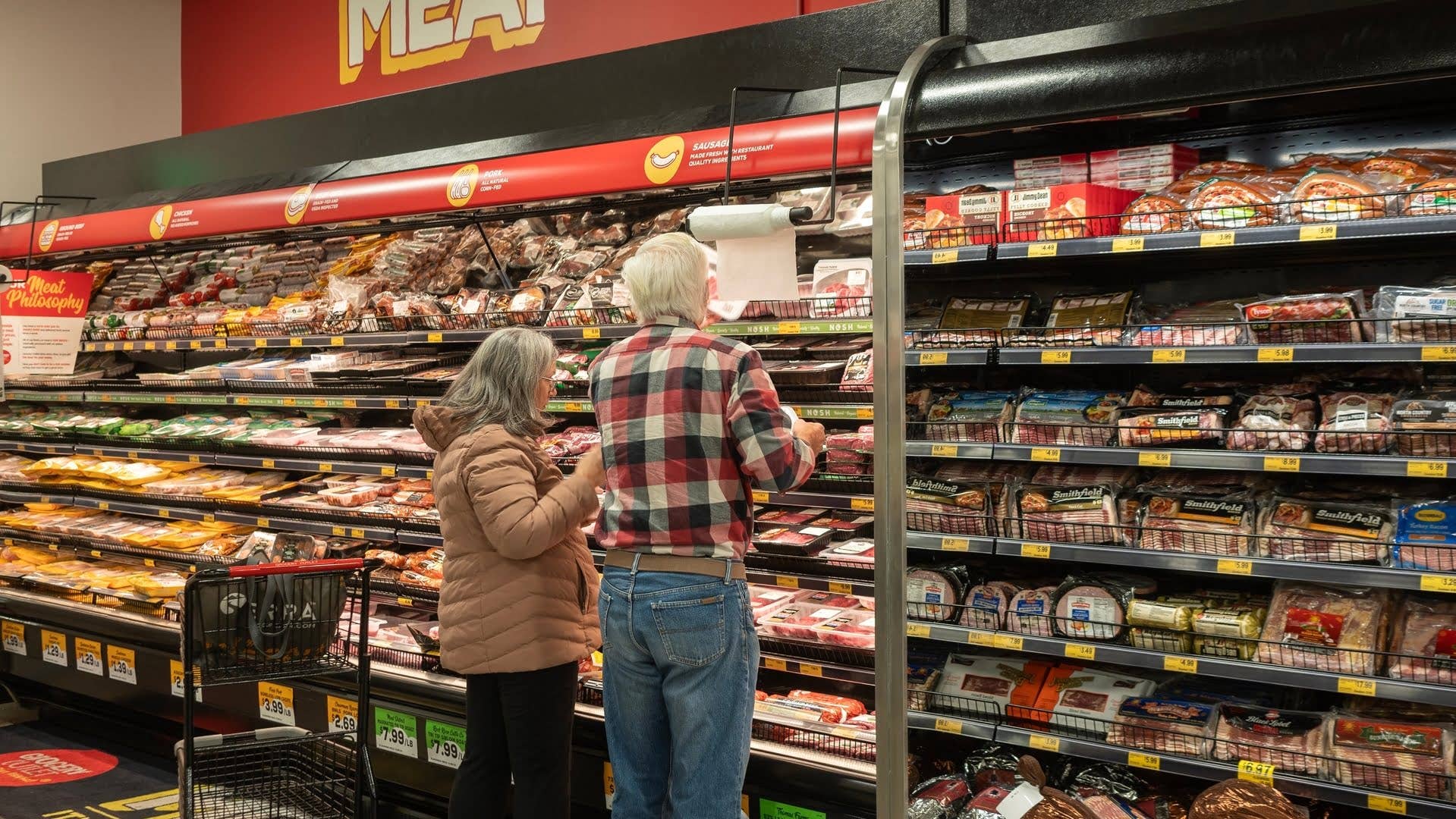
Grocery Outlet is not a traditional big-box grocery chain. Instead, its stores average 16,000 square feet, and 60-75% of new stores are in existing retail spaces.
“There’s obviously a lot less construction going on,” Barber said. “In the markets we are looking in, existing space is at a premium; rents are higher, and that means more pressure on those of us who are growing.”
Shutterstock
Grocery Outlet faces aggressive competitors
Although Grocery Outlet has 80 years of history, it faces intense competition from growing chains using a similar model. Aldi, which plans to open 180 more locations in 2026, is one example.
“With its increased footprint, by the end of 2026, ALDI will operate a total store count of nearly 2,800, pushing it closer to its goal of 3,200 stores by the end of 2028. The growth plans are the company’s answer to sustained demand for its simple, affordable shopping experience,” the company said in a press release.
After the closures, Grocery Outlet operates just over 500 locations. The chain is also facing competition from full-size grocery chains investing in lower prices.
Kroger CEO Gregory Foran made a commitment to lower prices during his chain’s first-quarter earnings call.
“We have opportunities to strengthen our price position and make it simpler. Customers are being more deliberate with their spending and at times, shopping us selectively. We’re getting too many promotional trips and not enough of the full basket,” he said.
Foran also acknowledged how competitive the grocery space has become.
“Customers today are shopping across more channels with more of their spend going outside of traditional grocery,” he added.
As larger grocery chains continue emphasizing lower prices and low-cost rivals expand their footprint, Grocery Outlet has focused on managing its store portfolio.
That’s something Potter has emphasized as a key priority.
“As I mentioned earlier, we continue to drive our key strategic objectives as we work to restore comp performance. Among our most important objectives are optimizing the store base and improving our returns,” he said during the Q1 earnings call.