For Federal Reserve policymakers, the Iran War creates a familiar but uncomfortable dilemma: inflation risks driven by energy shocks at the same time economic growth may be weakening.
If oil prices remain elevated and supply disruptions persist, Fed officials could find themselves with few viable options: holding interest rates higher to contain prices even as the job market softens.
The updated forecasts or “dot plot” released after the March 17-18 meeting of the Federal Open Market Committee may offer the clearest signal yet of how top Fed officials expect to navigate the economic conflict across the Middle East.
Hotter core PCE inflation and weaker GDP growth has revived worries about a stagflationary mix of slowing growth and persistent price pressures, which in turn has raised concerns of interest-rate hikes in 2026.
The Market Probability Tracker from the Federal Reserve Bank of Atlanta is showing a 19.82 probability of a 25 basis pointrate hike later this year — a sharp contrast from the FOMC December “dot plot” which showed a median forecast of two 25 basis point cuts in 2026.
“The Fed is leaning toward policy ease. That’s the big picture,” Vincent Reinhart, a former senior Fed adviser who is now chief economist at BNY Investments told The Wall Street Journal March 17.
“But they’re not going to cut rates until they’re sure inflation is durably lower,’’ Reinhart said.
What the Fed dual mandate requires for jobs, prices
The Fed’s dual congressional mandate requires it to balance full employment and price stability.
- Lower interest rates support hiring but can fuel inflation.
- Higher rates cool prices but can weaken the job market.
The two goals often conflict, operate on different timelines and are influenced by unpredictable global events like pandemics and wars.
More Federal Reserve:
The CME Group FedWatch Tool reports an over 99% probability that the FOMC will hold rates steady March 19. It has also pushed out the likelihood of the next Fed rate cut of 25 basis points to December to only 41%.
FOMC paused rate cuts in January
The FOMC voted 10-2 to hold interest rates steady at 3.50% to 3.75% in January after three continuous cuts of 25 basis points in its last three meetings of 2025.
Those cuts were based on data showing increasing weakening in the labor market and cooling inflation, although still sticky and tariff-laced.
Fed Chair Jerome Powell told reporters after the December meeting that the economy was settling into a neutral range.
A neutral range for economists means monetary policy is neither stimulating nor restricting economic growth.
It was the FOMC’s first pause since July 2025.
As I reported following the December meeting, Powell hinted that the Fed had now done enough to bolster the threat to employment while leaving rates high enough to continue weighing on price pressures.
“A world where job creation is negative, I think we need to watch that situation really carefully, and make sure we’re not pushing down on job creation” with monetary policy, he said.
Federal Reserve Bank of New York via FRED®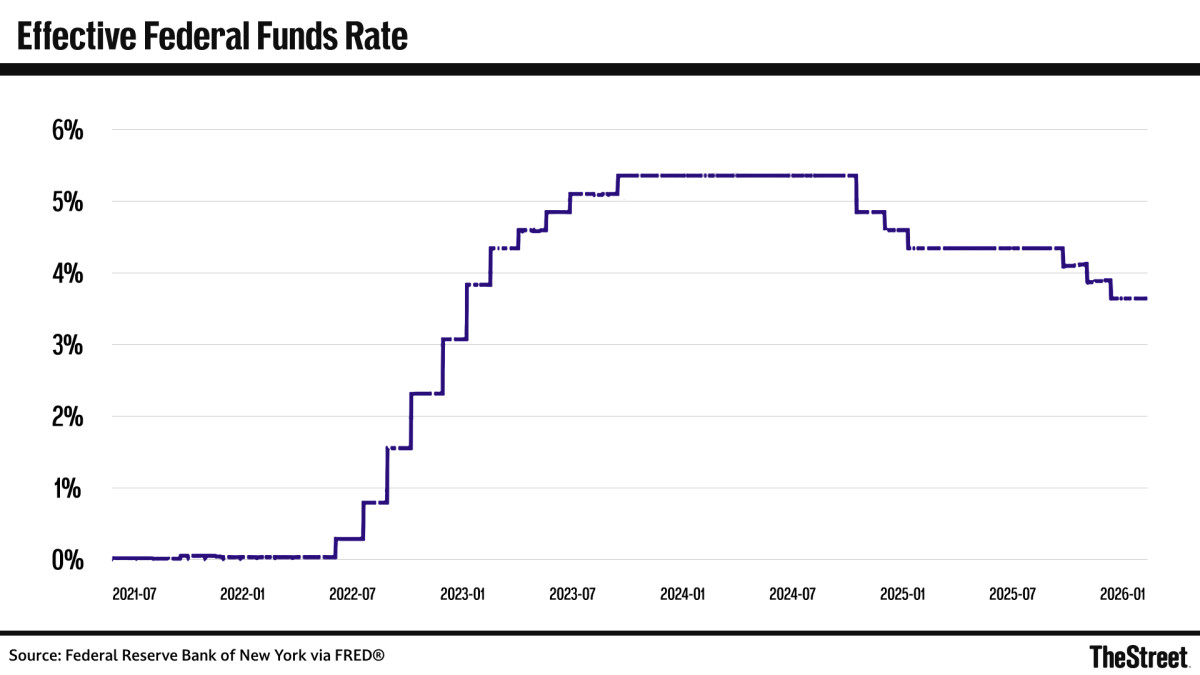
Fed to release latest “dot plot” this week
The Fed’s “Summary of Economic Projections” provides its estimates of inflation, unemployment, and economic output, in addition to estimates of interest rates that officials see as most appropriate policy over a three-year horizon.
The interest rate estimates, also known as the Fed’s “dot plot,” are closely watched on Wall Street for insight into the central bank’s thinking and plans.
The SEP is a quarterly report from all 19 Fed officials, including the 12 voting members of the FOMC.
It measures several key economic variables including:
- Real Gross Domestic Product Growth. Recently revised GDP came in at 0.7% for Q4 2025, a sharp slowdown from 4.4% growth in Q3 2025.
- Unemployment Rate. This was recently reported higher than expected at 4.4% following a disappointing February payroll report.
- Inflation. Includes both projections for Personal Consumption Expenditures (PCE) inflation and core PCE inflation excluding food and energy. January PCE came in at 2.9% year-over-year, above the Fed’s 2% annual target.
“Small businesses are entering this FOMC meeting in a holding pattern,’’ Andy Bregenzer, Head of U.S. Regional and Small Business Banking and Co-Head of Commercial Bank at TD Bank, told TheStreet. “After two years of elevated borrowing costs, many entrepreneurs have adapted, but the reality is that higher interest rates continue to influence how and when they invest in growth.’’
Bregenzer said small business owners will be listening closely for signals about the policy path ahead.
“They remain cautiously optimistic and ready to take advantage of opportunities,’’ he said.
The Fed makes data-driven decisions
The Fed uses government and private data sources to drive monetary policy decisions, a rear-view mirror approach often criticized as being too restrictive.
Those critics, including Treasury Secretary Scott Bessent and former Fed Governor Kevin Warsh, Trump’s nominee to be the next Fed chair, advocate use of more advanced models including AI to set interest rates.
How the Federal Funds Rate affects you
The benchmark Federal Funds Rate impacts nearly all Americans.
That’s because it guides interest rates for auto and student loans, home-equity loans and credit cards.
It also impacts the 10-year Treasury bond which in turn affects mortgage rates in the stagnant housing market.
Related: Former Fed insiders issue stark warning on U.S. economy
Billions of dollars in taxpayer money — primarily from individual tax returns and payroll taxes — pay the interest on the nation’s $38.9 trillion debt.
For consumers, a delayed rate cut could mean higher borrowing costs during an affordability crisis causing many Americans to scramble to pay energy, grocery, shelter and healthcare bills in a “low-hire, low-fire” labor market.
Fed faced risks to both sides of its mandate prior to Iran War
Even before the outbreak of the Iran War, the Fed faced a dilemma from worrisome risks to both sides of its congressional mandate: jobs and inflation.
Prior to the release of the latest inflation and GDP figures for January and February, Fed officials displayed a divisive outlook on 2026 interest-rate cuts.
- Some top Fed officials, including Cleveland Fed President Beth Hammack, said the annual rate of inflation is still too high to support cutting rates in the short term.
- Chicago Fed President Austan Goolsbee said additional rate cuts are possible this year if inflation tamed.
- Fed Governor Stephen Miran called for four cuts of 25 basis points in 2026 to support the labor market and stimulate productivity.
- Fed Governor Christopher Waller cited risks to both sides of the Fed’s mandate and said it would be a “coin toss” as to whether he would vote for a rate pause this month.
Trump continued to criticize the Fed and Powell for not lowering rates to 1% or lower, posting March 12 on TruthSocial:
“Where is the Federal Reserve Chairman, Jerome ‘Too Late’ Powell, today? He should be dropping Interest Rates, IMMEDIATELY, not waiting for the next meeting!”
Traders, analysts revise 2026 rate-cut outlooks
Traders fear the war in Iran will drive up inflation and drag down the job market, threatening both sides of the Fed’s mandate.
- Goldman Sachs pushed back its forecast for the central bank’s rate cuts, and now expects 25 basis-point cuts in September and December, citing rising inflation risks linked to the Iran War. Goldman previously projected the easing cycle to begin in June, followed by another reduction in September.
- High Frequency Economics Chief Economist Carl Weinberg offered a more hawkish approach, saying the Fed should consider a rate hike at its March 17-18 meeting to push back oil-shock inflation rising — by his outlook — to 3.5% by summer.
“You’ve got so much uncertainty, and you’ve got these cross currents that basically point in different directions in terms of the appropriate stance for monetary policy, so there’s a really good case for sitting tight and waiting to see what the dominant forces are in terms of the labor market and inflation,” Karen Dynan, a professor at Harvard who was the chief economist at the Treasury Department during the Obama administration, told The New York Times March 17.
Related: Looming Fed meeting shifts bets for 2026 interest-rate cuts