Jensen Huang walked off the GTC stage on Monday having just projected at least $1 trillion in chip revenue through 2027. Wall Street analysts spent Tuesday calling it a floor, not a ceiling. And Nvidia (NVDA) stock sat there, barely moving, trading right where it was before the whole thing started.
That disconnect tells you something important about where the Nvidia story stands right now.
The bull case is not in dispute. What analysts are now zeroing in on is the next battle Nvidia has to win, one it has never had to fight before. Training AI models was the first war. Inference, running those models at scale in the real world, is the next one. And unlike training, inference has real competition.
Why inference changes everything
For three years, Nvidia owned AI because it owned training. Its market share in AI training chips sits at roughly 90%, and that position remains largely intact heading into 2026.
But the industry is shifting fast. As AI moves from the lab into production, the workload that matters most is changing. Inference is where the bulk of future compute demand will land. And it has a fundamentally different economics profile than training.
Inference requires lower peak performance but much higher volume, and it operates on tighter margins. That makes it an easier target for cheaper alternatives. AMD‘s MI400, Amazon’s Trainium3, and Google’s TPU are all positioning themselves as lower-cost options for inference workloads, aiming at hyperscalers under intense pressure to cut the cost per AI token.
What Nvidia unveiled at GTC to fight back
Huang addressed this directly. Nvidia unveiled Dynamo, an intelligent inference engine that dynamically routes workloads across GPUs, ASICs, and CPUs depending on which is most efficient. The company also confirmed that Vera Rubin is in full production and on track for a second-half 2026 ramp, per Nvidia.
More Nvidia:
- Nvidia stock gets major reality check on ‘$100B’ number
- Nvidia CEO delivers blunt 7-word rebuttal on software stocks
- Bank of America resets Nvidia price target after earnings
The Rubin platform delivers a 10x reduction in inference token costs compared to Blackwell, which would make the economics of AI deployment substantially cheaper for every company running models at scale.
Wolfe Research analyst Chris Caso called the Rubin ramp the key catalyst. He noted that Rubin delivers a 5x inference improvement over Blackwell and that Nvidia’s updated outlook implies at least $40 billion in upside to current consensus revenue estimates for calendar year 2026, per Investing.com.
“Blackwell is now ramping fully, and Rubin is on time for 2H26 ramp,” Caso wrote, adding that resumed H200 shipments to China could add further upside beyond that figure.
Where the major analysts stand
Bank of America’s Vivek Arya reaffirmed his Buy rating and $300 price target after the keynote. BofA sees more than $1 trillion in data center sales visibility for 2025 through 2027, up from a prior estimate of $500 billion through 2026.
Goldman Sachs, also maintaining a Buy with a $250 target, called the $1 trillion figure something that “can help resolve investor concerns around peak CapEx in 2026,” per Investing.com. Citi and JPMorgan both reaffirmed $300 targets.
Wolfe Research reiterated its Outperform rating with a $275 price target post-GTC, noting the revenue disclosure suggests meaningful upside to 2027 estimates. Wells Fargo, at $265, said Nvidia’s updated order visibility simply “beats the bogey.”
Where analysts stand post-GTC
- Bank of America: Buy, $300 target, $1 trillion-plus data center visibility confirmed
- Goldman Sachs: Buy, $250 target, called $1 trillion outlook “above the Street”
- Wolfe Research: Outperform, $275 target, $40 billion upside to CY26 consensus
- Citi: Buy, $300 target, tens of billions in additional upside not yet in estimates
- JPMorgan: Buy, $300 target, $50-70 billion upside to 2026-2027 data center consensus
- Wells Fargo: Overweight, $265 target, order visibility beats expectations
Why the stock barely moved
Despite the bullish analyst chorus, NVDA has traded in a narrow $180-$190 range for months. The muted reaction to GTC continues a pattern. After Nvidia’s October 2025 GTC event, the stock fell 2% the following day.
Nagle/Bloomberg via Getty Images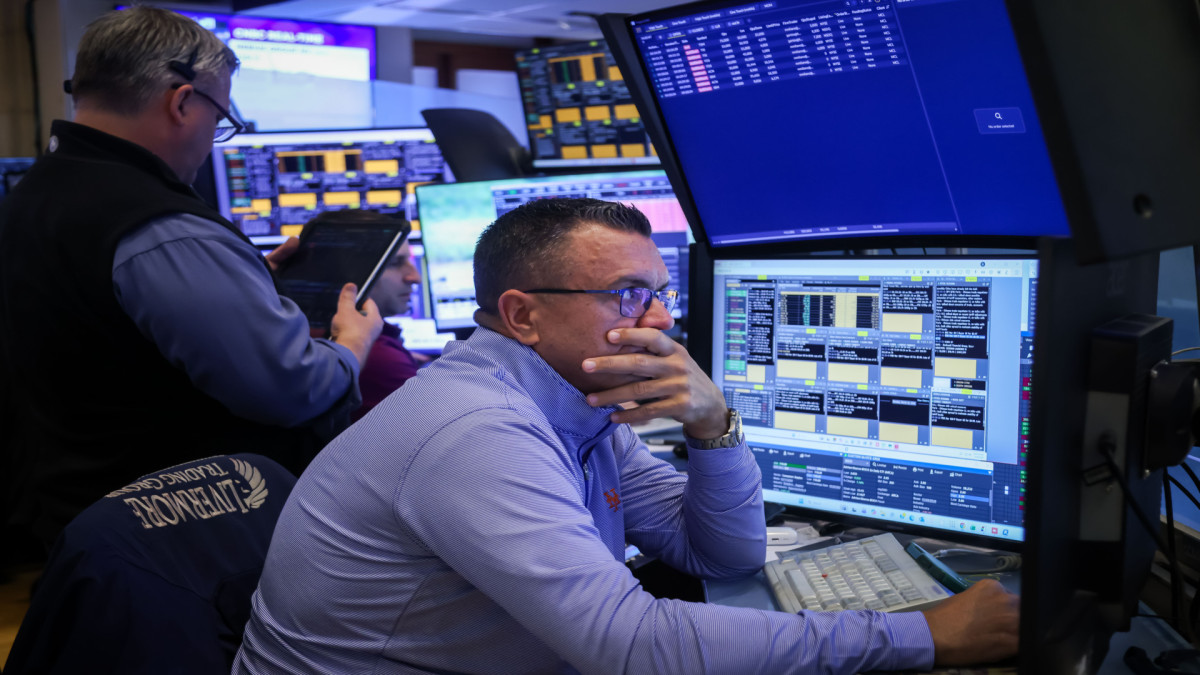
The issue is timing. Much of the upside analysts are projecting is backloaded into the second half of 2026, with Rubin not meaningfully contributing to revenue until late in the year.
There is also the China wildcard. Nvidia’s Q1 guidance of $78 billion explicitly excludes China data center revenue, following the export restrictions that forced a $4.5 billion H20 charge earlier in 2025. Analysts estimate resumed China sales could add $10 billion to $15 billion to calendar year 2026 revenue, but that depends entirely on policy decisions outside Nvidia’s control.
The execution risk is real
Nvidia is trading at roughly 38 times trailing earnings, a significant premium to the broader semiconductor sector. At that valuation, execution risk leaves almost no room for error
Any stumble in the Rubin ramp, further China restrictions, or meaningful inference share loss could compress the stock sharply. Amazon, Google, and Microsoft are all deploying more custom silicon for inference workloads, which could limit Nvidia’s addressable market even as the overall inference opportunity grows.
Nvidia’s counter is Dynamo, designed to act as a software routing layer on top of heterogeneous infrastructure, keeping Nvidia relevant even when a competitor’s hardware is in the rack. Whether that strategy holds as custom silicon matures is the question investors are waiting to see answered.
The consensus on Wall Street is clear. The roadmap is credible. The $1 trillion target is real. The stock will follow when the revenue does.