IBM‘s striped logo is one of the world’s most iconic visual designs. Created in 1972 by Paul Rand, the “father of graphic design,” this simple yet powerful wordmark has outlasted 10 U.S. presidents and 13 bear markets, not to mention the company’s own evolution from a mainframe computing giant into a hybrid cloud and AI leader.
Rand’s distinctly modernist style, which often resembled cut paper collages, changed the way corporate America looked. Not only was he responsible for IBM’s most recognizable visual identity — Rand also created logos for UPS, ABC, Ford, and Morningstar. These symbols stood the test of time and became synonymous with quality and trust.
But IBM’s logo wasn’t created in a vacuum. It was tied to decades of corporate reinvention, powered by emerging technologies the company itself helped pioneer.
IBM even refers to its brand identities as a visual history of its “shifting ambitions” and evolving product lineup.

IBM, Public domain, via Wikimedia Commons
1915: A nod to Art Nouveau
IBM’s logo didn’t always look like it does now, because IBM wasn’t always known as IBM.
In 1911, financier Charles Ranlett Flint founded the Computing-Tabulating-Recording Company, or C-T-R, which was actually the merger of three data-processing companies: The Computing Scale Company of America, The Tabulating Machine Company, and The International Time Recording Company.
With its black stylized letters set inside a circle, C-T-R’s logo aligns with the highly organic nature of the Art Nouveau period. The stylized lettering almost looks like wrought iron, a popular architectural material of the era.
Related: What does IBM do? Inside its AI, cloud & consulting business
OgilvyOne, Public domain, via Wikimedia Commons
1924: IBM’s first logo
Admiring whom he believed to be a “born salesman,” in 1914, Flint hired Thomas J. Watson Sr. to be the company’s first CEO, despite Watson’s felony conviction for monopolizing the cash register market (his conviction was later overturned).
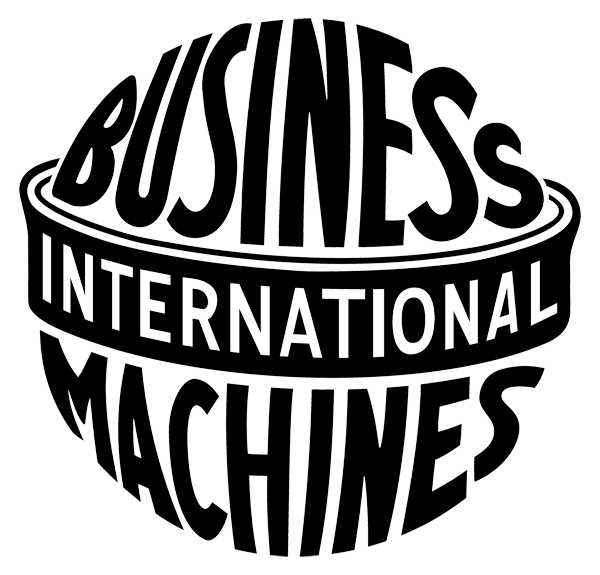
Watson’s extreme work ethic and visionary leadership doubled C-T-R’s revenues within a short period, and the business expanded internationally. Watson renamed the company International Business Machines, or IBM, in 1924; naturally, a new logo was needed.
The new design featured the company’s name in a sans-serif font, with its Art Deco-styled letters wrapping around the shape of a globe. According to IBM, this new look “expressed an affinity and admiration for modernity and machines—values that aligned with IBM’s vision.”
1947: An even more streamlined look
Since “International Business Machines” is somewhat of a mouthful, the company used its acronym basically from the get-go, and its next visual incarnation encapsulated that.
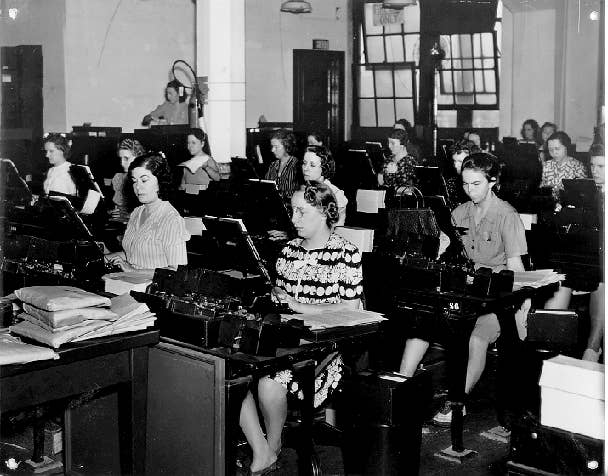
Through the 20s and 30s, IBM became the leading manufacturer of tabulating machines, securing a major contract with the U.S. government under the Social Security Act and providing equipment to track records for 26 million workers.
Photographer not credited, Public domain, via Wikimedia Commons
After World War II, IBM began commercializing its electronic data processing systems, opening a new market for what would eventually become its computer mainframes.
At the same time, the company also rolled out a new logo using the “machine age” Beton Bold font. It was a bold and industrial look (“Beton” actually means “concrete” in German), yet one that ultimately proved unmemorable.
It needed something to enliven it — and only Paul Rand knew how.
Related: IBM’s stock split history: Why Big Blue stopped splitting shares
Paul Rand, Public domain, via Wikimedia Commons
1956 & 1972: Paul Rand rolls out his iconic designs
In 1956, Thomas J. Watson Jr. took over the business from his ailing father. The younger Watson avidly believed that the power of design could help a product reach its full potential. In fact, he coined the phrase “good design is good business.”
So Watson Jr. hired Rand and tasked him to create a logo that would “herald a new era of IBM while also communicating continuity.” Rand replaced the dated Beton Bold font with City Medium and, in the process, created a fresher, more modern visual identity that still felt grounded.
There were a few unconventional elements, the company notes: The “B” actually has square contours while the serifs of the “M” are not symmetrical.
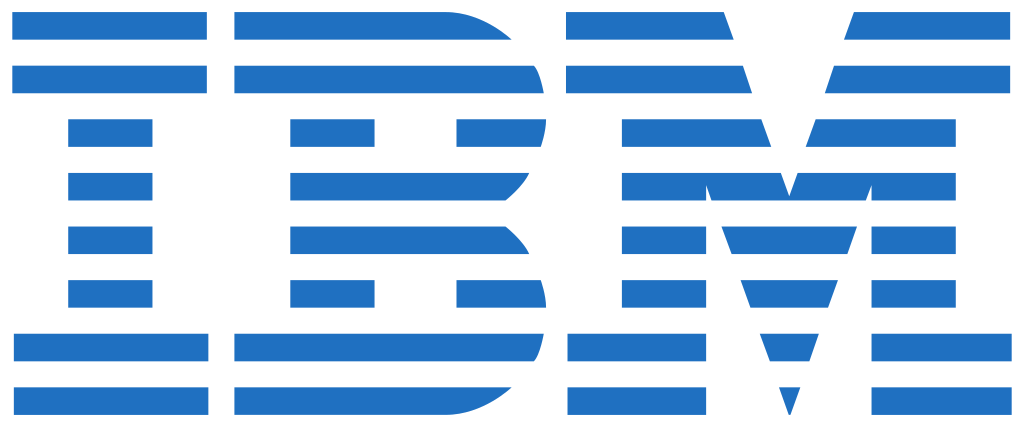
In 1972, Rand further refined the logo by introducing the “8 bar” horizontal stripes. This made the logo appear lighter and more dynamic — it became an instant hit.
Rand also added color. “IBM Blue” (Pantone PMS 2718C), as it came to be known, simultaneously conveyed strength and professionalism and spawned one of IBM’s most endearing monikers: Big Blue.
Dow company histories:
- History of Apple: Company timeline and facts
- History of Coca-Cola: Timeline, facts & milestones
- History of Nike: Company timeline and facts
During this period, IBM invented groundbreaking technology, including the floppy disk and an early form of the ATM. It also began selling its hardware and software individually (instead of bundled, a common practice at the time), and offering IT services to implement and maintain its technology in corporate locations worldwide.
By the end of the decade, IBM was the world’s largest tech company, and its logo has remained largely unchanged for more than 50 years.
Paul Rand, Public domain, via Wikimedia Commons
Bonus: Rand’s 1981 ‘Rebus’ logo
“Although the design has fundamentally remained constant in recent decades,” IBM notes, “tweaks in color, imagery, and context have been employed at various times to signal growth and change.”
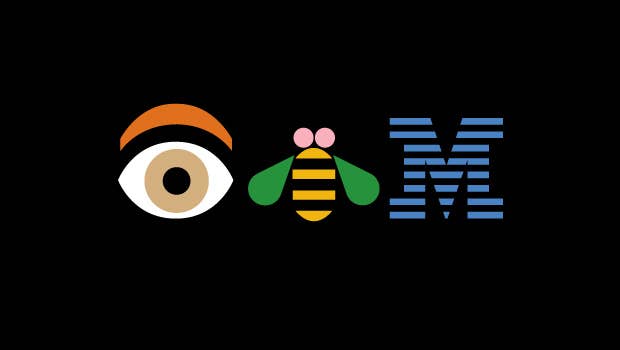
One such “remix” is Rand’s “Rebus” poster, created to celebrate IBM’s “THINK” campaign in 1981. It featured visual puns that spelled out the “I” and the “B” of the company’s logo.
Rand had a famously witty and human aesthetic, and once stated that “without play, there is no experimentation.”
So even when he was working on something as serious as a corporate logo, he made sure to introduce elements of color and lightness.
The “Rebus” poster became an instant classic and now belongs in the permanent collection of the Museum of Modern Art in New York City.
Related: Is IBM a good investment in 2026? Its buy-and-hold prospects explained