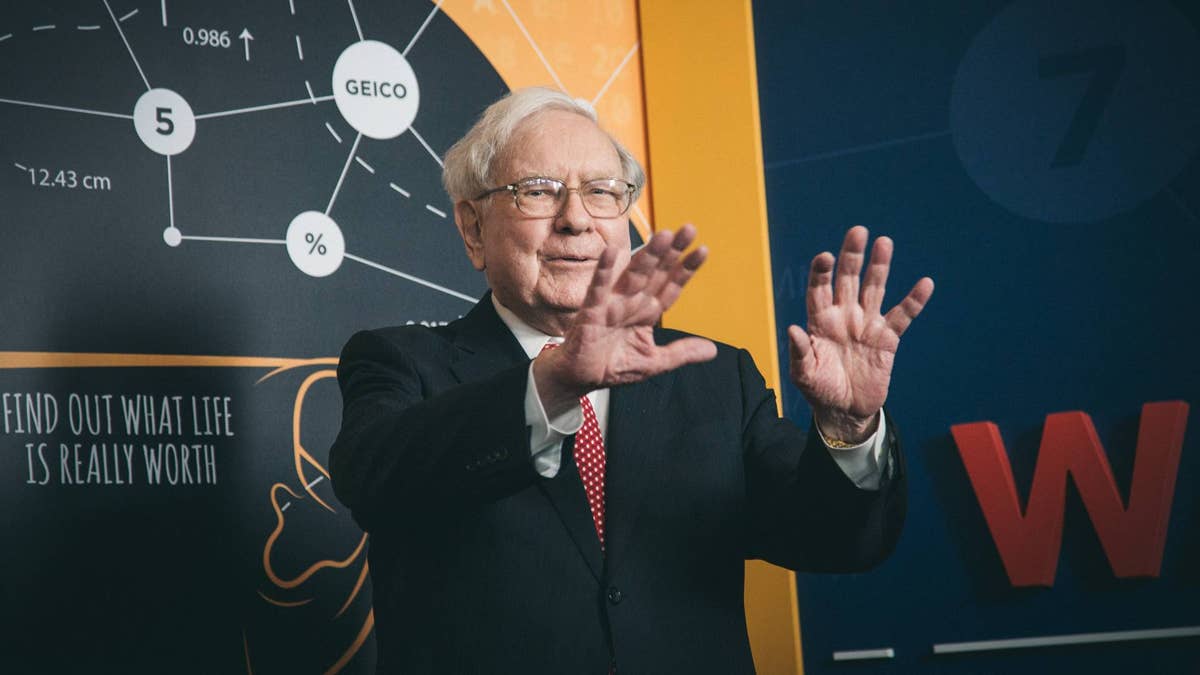
For six decades, Warren Buffett wrote a letter to Berkshire Hathaway shareholders before the company’s annual gathering in Omaha. On May 2, tens of thousands of investors will file into that same arena, but for the first time in the company’s history, the 95-year-old will not be sitting in the CEO’s chair.
Buffett stepped down as chief executive at the end of last year and is not scheduled to speak at this year’s meeting, according to Berkshire’s published agenda. He remains the company’s chairman and its largest shareholder, holding roughly 30% of the voting interest and 13.7% of the economic interest, as disclosed in the company’s 2026 proxy statement.
That silence makes his final letters to shareholders more than a historical reading. The warnings inside them land with striking relevance in a market shaped by speculation, geopolitical disruption, and the kind of frenzy Buffett spent his career cautioning against.
Buffett’s casino warning looks prophetic heading into 2026
In his 2023 shareholder letter, Buffett devoted an entire passage to what he described as the market’s growing resemblance to a gambling floor. Markets exhibit far more speculative behavior than they did when he started investing, and the mechanisms feeding that speculation have moved directly into people’s homes, he wrote, according to Fortune.
Wall Street profits most not when clients build wealth but when trading volume spikes to frenzied levels, Buffett cautioned in that letter. Anything marketable during those periods of excess will be marketed aggressively, not by everyone, but always by someone, he warned.
“For whatever reasons, markets now exhibit far more casino-like behavior than they did when I was young,” said Warren Buffett, Former CEO of Berkshire Hathaway.
That observation, written well before prediction markets began shaping Wall Street sentiment, reads like a direct assessment of the current landscape. His successor, Greg Abel, acknowledged the gravity of what he inherited in his own first letter to shareholders in February 2026.
Buffett is arguably the greatest investor of all time, with generations benefiting from his investment acumen, Abel wrote, as reported by Fortune. Abel disclosed that Buffett objected to the praise but acknowledged that everyone knows it to be true.
The “duck lesson” every investor needs to hear in a bull market
One of Buffett’s most memorable analogies came from his 1997 letter, and it speaks directly to a trap many investors fall into after years of rising stock prices. In a bull market, one must avoid the error of a duck that boasts after a rainstorm, mistaking rising water for its own paddling skill, Buffett wrote, as Fortune recounted.
That analogy captures a persistent danger for retail investors who entered the market during the post-pandemic surge and may attribute their gains to personal strategy rather than broader market forces. When the S&P 500 delivered double-digit returns for three consecutive years through 2025, it was easy to feel like a skilled paddler.
More Warren Buffett:
- One of Warren Buffett’s dividend stocks is key to reopening Strait of Hormuz
- Greg Abel sends Berkshire investors a powerful new signal
- Warren Buffett’s Berkshire warns Americans on housing market
Buffett’s approach to Coca-Cola illustrates the patience behind that philosophy. Berkshire spent roughly $1.3 billion acquiring 400 million shares starting in the late 1980s, Fortune reported. That position is now worth more than $31 billion, a return earned not through market timing but through decades of holding a strong business through recessions, crashes, and every kind of volatility.
The duck analogy also carries an implicit warning about what happens when conditions reverse. Investors who mistake a rising tide for personal genius rarely build the discipline needed to hold steady during a downturn, and even more rarely have the conviction to buy when prices fall.
Buffett himself has always treated market declines not as threats but as opportunities, deploying capital when others panic and sitting on cash when others chase momentum. That willingness to act against the crowd is the real skill the duck never learns, because the duck never had to question whether the water would keep rising.
Buffett’s long bet on America still carries a quiet caution
In one of his final letters, Buffett credited what he called the American Tailwind for much of Berkshire’s success and said the company hopes and expects to pay much more in taxes over the next decade because it owes the country nothing less, Fortune noted.
The tailwind has been becalmed from time to time, Buffett acknowledged, signaling that the nation’s economic momentum is not guaranteed to remain constant. He said he had been investing for 80 years and had never found a moment when a long-term bet against America made sense.
Greg Abel’s Berkshire begins its first chapter without the Oracle
Buffett’s departure does not leave a gap, but it redirects attention to the principles he repeated for decades. His final letters, set against today’s speculative surges, rising leverage, and fast-moving narratives, read less like reflections and more like a framework for what is already happening.
The casino analogy, the duck parable, and his emphasis on patience all make the same point. Markets reward behavior that looks skillful in the moment but breaks down over time. With Greg Abel now leading Berkshire’s operations, the transition tests whether those ideas hold without the person behind them.
Berkshire’s scale and structure point to continuity, but the market environment does not, which creates the gap. Buffett’s letters do not forecast specific outcomes, but they describe patterns that repeat when optimism runs high and caution fades.
Related: Warren Buffett has stark message for investors on stock market