For most of automotive history, the headlight was a solved problem. Two beams, a switch, maybe a fancy lens.
Then the rest of the world stopped treating the front of a car as just a place to put lights. Europe got matrix beams that paint around oncoming traffic. Japan got laser headlamps that throw light a quarter mile down the road. America got an updated rulebook — finally, in 2022.
The U.S. only finalized a rule allowing adaptive driving beam headlights, the kind that automatically dim parts of the high beam to spare oncoming drivers, in February 2022, “more than a year and a half ahead of schedule,” according to the National Highway Traffic Safety Administration. That decision came nine years after Toyota first petitioned for the technology.
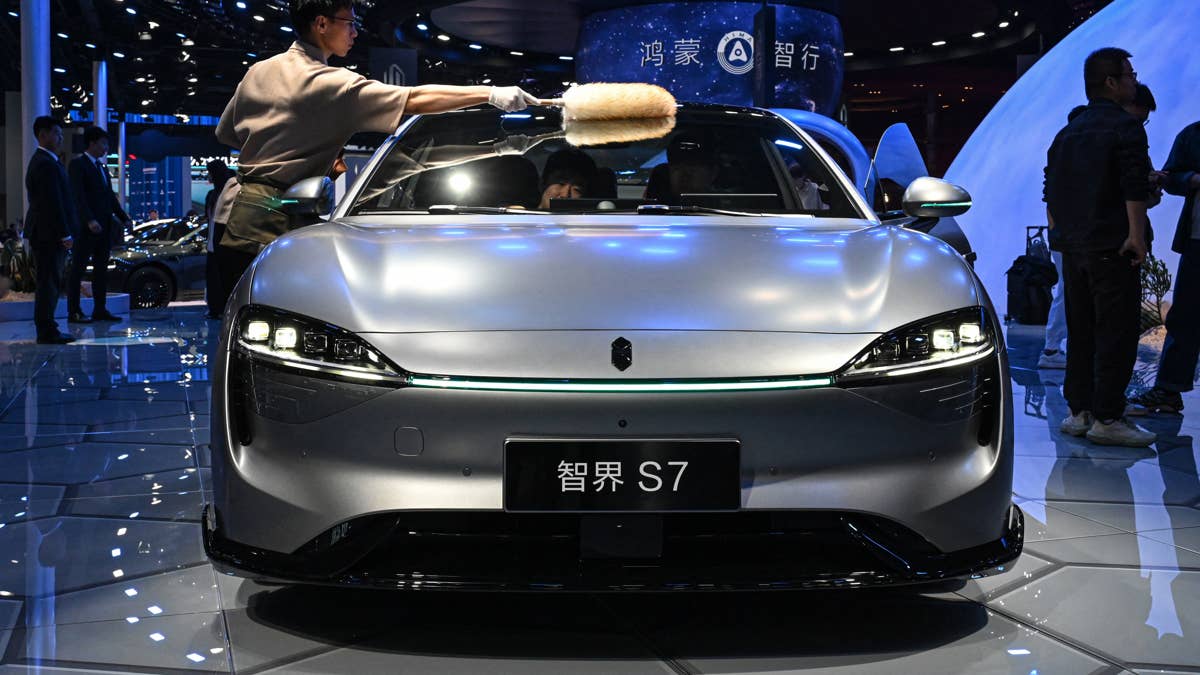
By the time U.S. regulators caught up, automakers across the Pacific had already moved on. At the Beijing Auto Show (April 24-May 3), Huawei demonstrated headlights that can project a full-color movie onto the wall in front of a parked car, like a private drive-in theater.
What Huawei’s XPixel headlights actually do
Huawei’s XPixel system is not entirely new. Earlier monochrome versions have been on the road in China for about three years, with vehicles such as the Stelato S9 already using them, according to InsideEVs. What changed at the Beijing Auto Show is the addition of full-color projection, turning the front of a car into something close to a portable cinema.
The demos showed more than entertainment. The system ties directly into driver-assistance software, drawing a guided lane-change path on the road or signaling pedestrians when it is safe to cross. Huawei has even shown the lights projecting hopscotch grids for kids playing near a parked car.
Related: Tesla’s biggest Chinese rival just got hit by an ugly reality
The full-color version will debut on the Aito M9 sport-utility, with the upcoming Qijing GT7 shooting brake and Luxeed V9 minivan close behind.
For an American driver, none of this is hitting your local Ford (F) or Chevy lot any time soon. The U.S. effectively bans the import of Chinese-made passenger EVs through tariffs of more than 100%, so the cars carrying this hardware are not available here. The system is also tightly licensed by Huawei to local Chinese OEMs, which makes copying it without a deep partnership difficult.
When I read the InsideEVs writeup and watched a clip of the demo, what struck me was not the gimmick. It was the timing. The same week U.S. regulators were still working through follow-up petitions on the 2022 adaptive headlight rule, the Beijing show was treating projection-capable headlights as a near-term option on a sport-utility you can already buy.
How China pulled ahead in EV technology
Headlight tricks are easy to mock as gimmicks. They sit on top of a much bigger story, though. China spent the last decade building an end-to-end EV stack that is now delivering vehicles to market faster and cheaper than anything coming out of Detroit.
For investors, the punchline is uncomfortable. The world’s biggest auto market is being won by companies American buyers cannot easily own and American workers do not build for.
China’s EV dominance by the numbers
- Chinese firms produced 62% of the world’s EVs and 77% of EV batteries as of 2022, according to the Information Technology and Innovation Foundation.
- Chinese EV companies bring new models to market 30% faster than legacy American, European, and Japanese carmakers, the Information Technology and Innovation Foundation notes.
- Chinese automakers operate with a 30% cost advantage and 40-50% less development investment per vehicle than peers, according to AlixPartners.
Canada signed a deal in January 2026 to slash its tariff on Chinese-made EVs from 100% to 6.1%, according to Electrek, opening another market where U.S. brands now compete head-on with cars they would never face in their home dealerships.
Ford CEO Jim Farley has been the loudest voice in Detroit warning about all of this. “Manufacturing is the heart and soul of our country,” Farley said on Fox & Friends. He has repeatedly described the matchup as a fight Americans cannot win on a level playing field.
Farley has even imported a Xiaomi SU7 from Shanghai for personal evaluation, calling its makers a juggernaut and acknowledging on “CBS News Sunday Morning” that Chinese rivals already offer better in-car technology than do U.S. brands.
What the headlight tech gap means for U.S. drivers and investors
For an American shopper, none of this turns into a showroom decision tomorrow.
Tariffs of more than 100% effectively keep Chinese EVs off U.S. lots, and the headlight rule that finally opened the door to adaptive beams in 2022 is still working through follow-up petitions filed by automakers and lighting suppliers.
More Automotive:
- Hyundai admits deadly defect caused more injuries than previously known
- Consumer Reports names 5 popular EVs with the best real-world range
- Uber targets 50,000 robotaxis in major Rivian, Nvidia deals
The longer the technology gap widens, though, the more it shows up in your wallet in less obvious ways. American auto stocks are competing globally against rivals with a structural cost advantage.
My quick check of the latest sales figures, as reported by Bloomberg, shows BYD (BYDDY) shipped roughly 4.6 million vehicles in 2025, while Ford’s global wholesales fell to about 4.4 million. A Chinese company that cannot legally sell a passenger car in the U.S. just passed the company that invented the assembly line.
For long-term investors, the question is whether tariffs are buying enough time. Ben Nelmes, executive director of UK think tank New Automotive, told CBS News that “China is miles ahead of the rest of the world” on EV innovation, warning that protectionism could leave Western automakers further behind once the wall comes down.
For the next-car shopper, the math is simpler. A future Ford F-150 Lightning will not project a movie on your garage door any time soon. It will, eventually, get adaptive beams that drivers in Germany and China have had for years. Until U.S. automakers close the broader feature gap, the question for anyone shopping or saving toward an EV is whether to wait, buy what is available, or rethink the brand entirely.
Either way, the cost of the wait is real. Every year the gap widens, U.S. brands have to either lift R&D spending, which dents the margins shareholders care about, or eat market-share losses overseas, which dents the long-term earnings story those same shareholders pay for in their 401(k)s and index funds.
The headlight news is not really about headlights. It is about who writes the next decade of automotive innovation. Right now, Beijing has the better script.
Related: Chinese EV giant sends a bold message straight to the US