AMD just posted its strongest quarter as an AI company. The stock surged nearly 18% on the day. And one analyst responded by nearly doubling his price target.
The move from Bernstein is not a routine post-earnings trim. It is a fundamental reassessment of what AMD is worth and where it is heading.
What Bernstein changed on AMD
Bernstein upgraded Advanced Micro Devices to Outperform from Market Perform on May 6, raising its price target to $525 from $265. The $260 increase in the target is the largest single-note move on AMD from any major firm in recent memory.
The firm’s note described AMD’s Q1 results as “very good,” with data center, client, and gaming all coming in above expectations, according to TipRanks. Bernstein said the shares “probably go up from here even after the run,” a notably direct statement from a sell-side note.
More Wall Street
On earnings power, Bernstein now sees AMD delivering more than $14 in EPS in 2027 and said approaching $20 in 2028 “feels plausible assuming the AI boom continues,” TipRanks noted. Those estimates are what anchor the $525 target.
The earnings results that triggered the move
AMD reported Q1 2026 revenue of $10.253 billion on May 5, up 37.85% year-over-year, with non-GAAP EPS of $1.37 versus the $1.28 consensus, according to Investing.com. The stock surged 17.46% on the day of the report, Investing.com confirmed.
The standout segment was data center. AMD’s data center business delivered $5.775 billion in revenue, up 57% year-over-year. That is the division powering AMD’s AI infrastructure narrative and the primary driver of Bernstein’s revised view. Client and gaming revenue also beat, coming in at $3.61 billion, up 23% year-over-year, according to Investing.com.
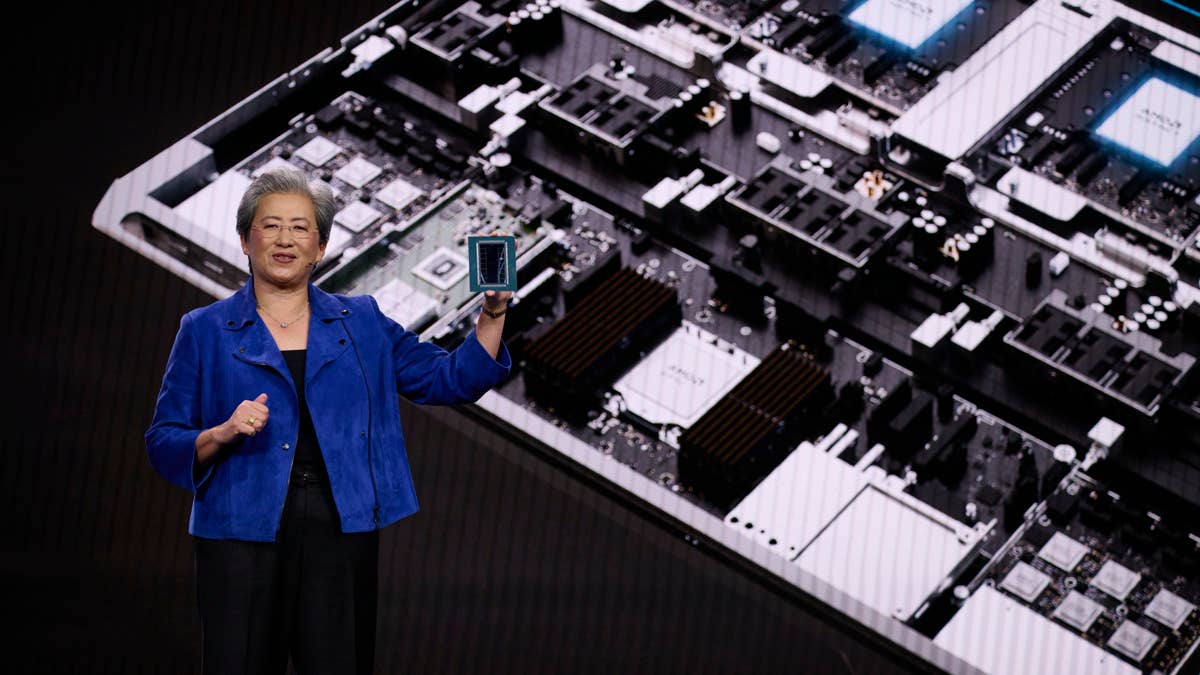
Q2 guidance of approximately $11.2 billion also cleared the $10.5 billion consensus estimate compiled by Bloomberg, Investing.com noted. CEO Lisa Su said AI agents and CPU demand are ramping faster than expected, reinforcing the thesis that AMD’s combined CPU and GPU portfolio can capture a meaningful share of AI infrastructure spending, according to 247 Wall Street.
Why the valuation story changed so dramatically
The price target move from $265 to $525 is not just a bigger number. It reflects a complete change in how Bernstein is categorizing AMD.
The draft note implies Bernstein moved from applying a roughly 20x multiple on forward earnings to approximately 35x its 2027 EPS estimate of $14+. That shift says the firm is no longer treating AMD as a cyclical semiconductor company that should trade at a modest multiple. It is now treating AMD as a high-growth AI infrastructure company that deserves to trade in line with the premium names in that space.
That reframing is what makes the call significant beyond the target itself. A multiple expansion of that magnitude signals a change in conviction, not just a change in estimates. Bernstein is effectively saying AMD has crossed a threshold from “challenger” to “incumbent” in the AI compute market.
Bennett/Getty Images
Where the broader analyst community stands
Bernstein’s $525 is aggressive but not isolated. The broader analyst community moved meaningfully after the quarter. KeyBanc holds the highest target on the Street at $530, with Barclays and Cantor Fitzgerald both at $500. TD Cowen also set a $500 target on May 6. Bank of America raised its target to $450, according to Benzinga.
Related: Goldman Sachs sets jaw-dropping AMD stock price target after earnings
On the bearish end, Citigroup maintains a target of $248, the lowest on the Street, Benzinga noted. That spread from $248 to $530 captures how divided analysts remain on AMD’s ability to sustain its AI growth rate and whether the current valuation is already pricing in too much of the upside.
Key figures from AMD’s Q1 2026 results and the Bernstein upgrade:
- Bernstein upgrade: Market Perform to Outperform, price target $525 from $265, May 6, according to Benzinga
- Q1 2026 revenue: $10.253 billion, up 37.85% year-over-year; non-GAAP EPS $1.37 vs $1.28 estimate, according to Investing.com
- Data center revenue: $5.775 billion, up 57% year-over-year, Investing.com confirmed
- Q2 2026 revenue guidance: approximately $11.2 billion vs $10.5 billion consensus, Investing.com noted
- AMD stock move on May 5: surged 17.46% on the day of earnings, according to 247 Wall Street
- Bernstein 2027 EPS estimate: more than $14; 2028 EPS approaching $20 “feels plausible assuming the AI boom continues,” according to TipRanks
- Highest Street target: KeyBanc at $530; lowest: Citigroup at $248, according to Benzinga
- Notable risk flagged: rising memory and component costs could pressure client and gaming margins in future quarters, according to Investing.com
The risk Bernstein is not ignoring
AMD flagged one meaningful headwind alongside the strong results: rising memory and component costs, particularly in the client and gaming segment. The company acknowledged this could create some margin pressure in future quarters, Investing.com noted.
That caveat matters because it introduces a potential gap between strong top-line growth and the margin expansion investors are implicitly expecting at a 35x forward multiple. AMD needs not just revenue growth but earnings quality to justify Bernstein’s revised framework.
The other risk is concentration. AMD secured favorable TSMC capacity allocations for its AI and server chip roadmap, which eased a major execution concern, according to 247 Wall Street. But the company still depends heavily on TSMC for its most advanced nodes. Any disruption to that relationship or to TSMC’s capacity would reintroduce supply risk into a stock now priced for near-perfect execution.
What the Bernstein call signals about the AI trade
Beyond AMD specifically, the Bernstein upgrade is a signal about where analyst conviction on AI is heading. Firms are increasingly willing to apply premium multiples to companies that can show real AI revenue traction, not just AI-adjacent positioning.
AMD has now demonstrated that traction. Data center revenue of $5.775 billion growing 57% year-over-year is not a headline number. It is evidence of embedded demand from hyperscalers and cloud customers making real purchase commitments. That kind of revenue visibility is what the market has been waiting for AMD to show, and Bernstein has decided the evidence is now sufficient to rerate the stock accordingly.
At $525, the target demands continued execution. But the message from Bernstein is that after years of AMD being the challenger, the company has entered a phase where the growth is real, the customers are committed, and the multiple expansion may just be getting started.