Earlier on May 12, I wrote about SanDisk (SNDK) hitting 80 relative strength index, or RSI, one of the most extreme overbought readings in the stock market. The AI memory trade, I noted, was running at a pace that rarely ends quietly. Then Micron (MU) showed up with its own flashing signal too.
RSI on Micron reached 85 on May 11, deep into overbought territory. Then May 12 brought the pullback. MU fell 6.84% in trading as of writing, retreating to an RSI of approximately 74, while the broader tech sector declined 2.63%.
Even after the pullback, the stock is still up 159.71% year to date and 704.76% over the past year, according to Yahoo Finance.
It has posted gains in most parts of April, and more than doubled since the end of March, from as low as $311 on 31st March to $818 high recorded on May 11.
The question I keep coming back to is the same one I asked about SanDisk: when a stock with this kind of RSI reading finally pulls back, is it a warning or a buying opportunity in one of the most structurally powerful demand cycles in semiconductor history?
Why Micron’s stock has surged 700% in a year
The RSI doesn’t exist in isolation. It reflects a business that has undergone a genuinely historic transformation.
In its fiscal second quarter of 2026, Micron set records across every major financial metric, according to the company’s March 18 earnings release:
- Revenue of $23.86 billion, up from $8.05 billion in the same period last year
- GAAP net income of $13.79 billion, or $12.07 per diluted share
- Operating cash flow of $11.90 billion
- The board approved a 30% increase in the quarterly dividend
Source: Micron Technology, Inc. second quarter 2026 results
For fiscal Q3 2026, Micron guided for revenue of $33.5 billion and gross margins of approximately 81%, with diluted EPS of $19.15 on a non-GAAP basis.
My crunching of the sequential revenue trajectory – from $8.05 billion a year ago to $33.5 billion guided for next quarter – is a number that is almost difficult to process. This is not a cyclical recovery. It is a structural step-change in Micron’s revenue base.
Related: Micron stock sends a strong signal amid chip shortage
The drivers are specific and well-documented. Micron’s entire HBM production for 2026 is reportedly sold out, as is much of 2027, according to Investing.com. AI accelerators require High-Bandwidth Memory at scale, and Micron is one of only three companies in the world that can supply it at volume.
NAND manufacturing capacity for 2026 is essentially sold out, according to Forbes. D.A. Davidson maintained its Buy rating with a $1,000 price target, according to TheStreet.
What RSI 85 actually signals, and the honest case for both sides
The Relative Strength Index (RSI) measures momentum, not value. A RSI of 85 says that buying pressure has been overwhelming selling pressure for an extended period. It does not say the stock is wrong. It says the stock is running fast.
The bull case on a high RSI reading for Micron is straightforward. In genuine supercycles, momentum indicators stay elevated far longer than skeptics expect. “KV caching” – a technique AI language models use to store temporary data during inference – is creating new demand for high-end NAND on top of the HBM shortage.
More Tech Stocks:
- Morgan Stanley sets jaw-dropping Micron price target after event
- Nvidia’s China chip problem isn’t what most investors think
- Quantum Computing makes $110 million move nobody saw coming
Management at Micron described memory as “a strategic asset” for AI customers, not a commodity input. Supply is not expected to catch up until late 2027 or 2028, according to industry forecasts.
The bear case is equally honest. Today’s 6.84% drop is a reminder that stocks with RSI readings in the 80s can correct sharply and quickly when momentum shifts. Micron is investing over $25 billion in capital expenditure in 2026, according to The Motley Fool.
That’s a capacity that will eventually arrive and alter the supply picture. Memory cycles historically turn faster than bulls expect. And at current prices, any guidance miss or macro-driven demand softening would be punished severely.
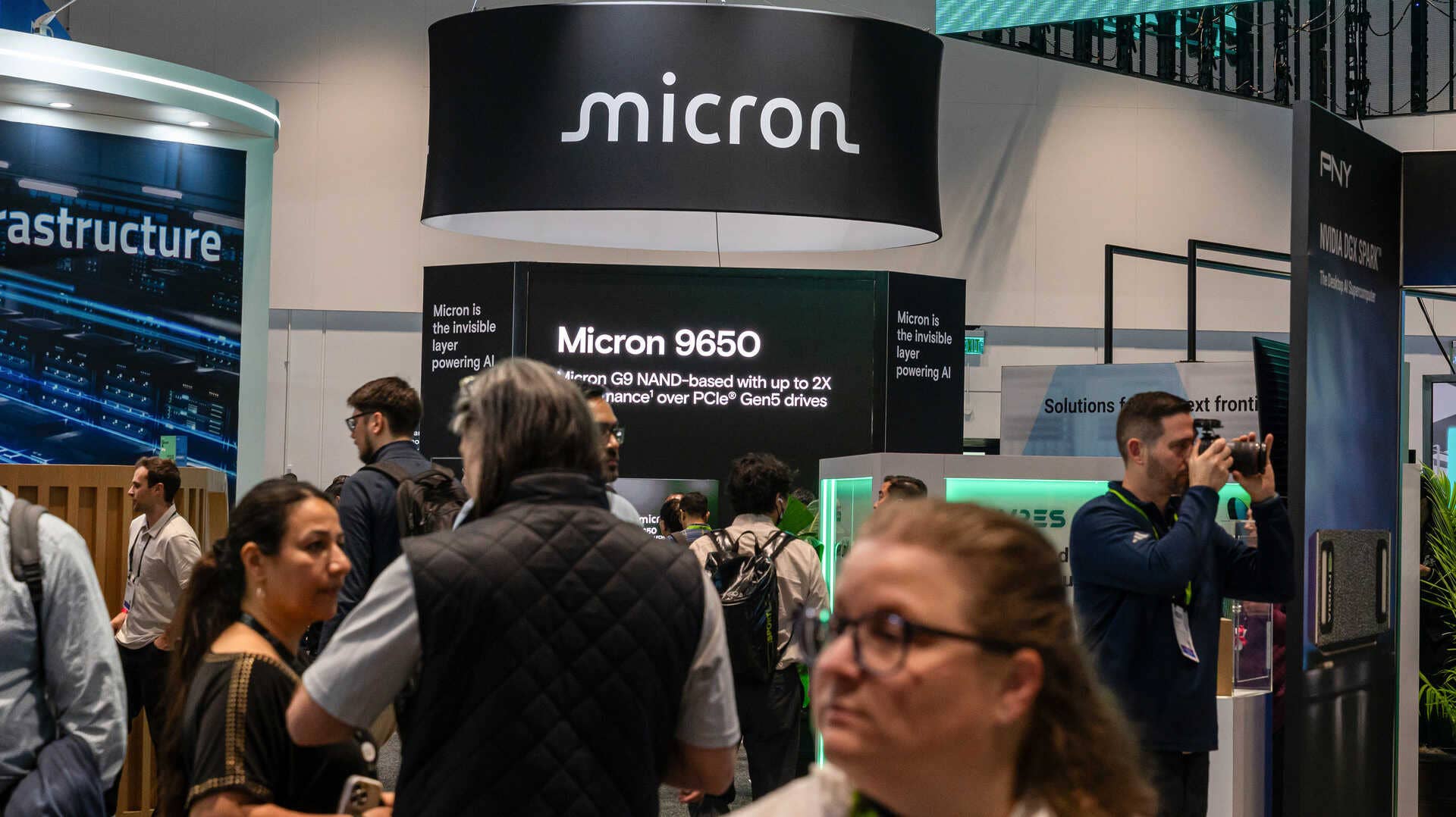
Micron’s newest product signals the next frontier of AI memory demand
Whatever the short-term RSI story, Micron is making moves that suggest management believes the long cycle has significant runway ahead.
On May 12, the same day the stock pulled back, Micron announced it had sampled a 256GB DDR5 server module to key ecosystem partners, built on its leading-edge 1-gamma technology capable of speeds up to 9,200 megatransfers per second. That is more than 40% faster than modules currently in volume production, according to Micron‘s announcement.
Related: Sandisk flashes investors uncommon technical signal
The module uses 3D stacking techniques and delivers more than 40% lower operating power versus two 128GB modules, directly addressing the energy efficiency demands of next-generation AI data centers. A single module replacing two is the kind of product that hyperscalers building at $175 billion-plus annual capex rates find genuinely valuable.
CEO Sanjay Mehrotra framed the company’s position without equivocation. “In the AI era, memory has become a strategic asset for our customers,” Mehrotra said. “We expect significant records again in fiscal Q3.”
What the May 12 pullback means for investors
May 12’s 6.84% decline is profit-taking, not a fundamental deterioration. The RSI retreating from 85 to approximately 74 is the kind of natural release valve that extended momentum runs require.
For investors already holding MU at lower cost basis levels, this session is noise inside a historically powerful fundamental story.
For new money considering entry at current levels, with the daily RSI still at 74 and the stock up 700% in a year, the honest framing is that you are entering a genuine supercycle with real structural demand, at a price that reflects a great deal of that reality already. The AI memory trade is not over. But the easy part of it probably is.
Related: Apple CEO has stark message for Micron stock investors