If you’ve been named durable power of attorney for financial matters for someone, one question may eventually arise: Can you make gifts on that person’s behalf — including gifts to yourself?
That issue recently surfaced in a Massachusetts court case involving a multimillion-dollar estate, family conflict, and questions about whether agents under a power of attorney exceeded their authority.
In this interview, elder law attorney Harry Margolis, author of “Get Your Ducks in a Row,” explained how gifting powers work, why state law matters, and what families should review in their power of attorney documents now.
Below is a transcript of the interview with Margolis, edited for brevity and clarity.
What a power of attorney can authorize
Robert Powell: An interesting question, yes?
Harry Margolis: Yeah. And the answer, as always, is: It depends.
First, it depends on what the power of attorney says. I’m going to tell you really what the law is in Massachusetts, which I know well. It could differ a little in other states, but it’s probably pretty similar everywhere.
The first thing is: What does the power of attorney say? Does it include a specific gifting power? If it doesn’t, most states would probably say you can’t make a gift under a power of attorney.
But if it does, then you have to look at the gifting power itself and ask: What does it authorize? You can do what it says, but sometimes it’s not clear.
Why gifting language matters
Harry Margolis: One thing we see often, which I think is a mistake in powers of attorney, is that they restrict gifts to the annual gift tax limit, which is relatively small.
That could be a problem because you may want to make larger gifts for different purposes. You might want to do it for estate tax planning. You may want to do it for Medicaid planning. If you have that restriction, it could create problems.
So it’s better if that limitation is not in the power of attorney.
Kira auf der Heide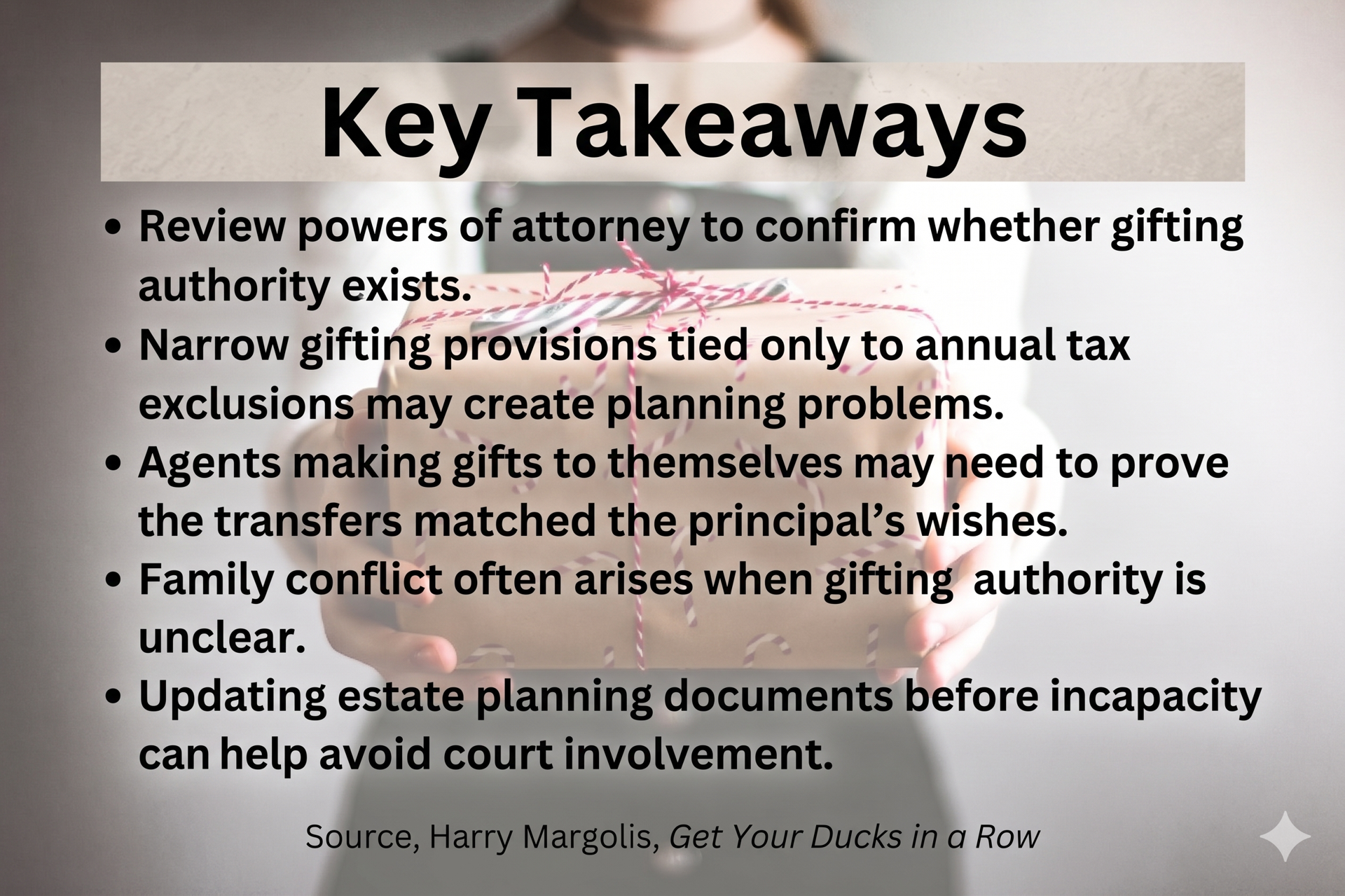
The Massachusetts case involving a $5 million transfer
Harry Margolis: There was an interesting recent Massachusetts case where this came up. The question was really: Can you make gifts to yourself?
The case is called Ferne v. Baker. The mother in the case, Frances, had a very large estate — about $37 million. She had three children: two sons and a daughter. The sons had one father and the daughter had another father, so they were half-siblings.
It was a fractious family. There was a lot of discord.
Ultimately, when Frances died, her estate was split equally among the three children. But the daughter, Tracy, discovered that prior to her mother’s death, her brothers — who were agents under their mother’s power of attorney — had made gifts to themselves totaling more than $5 million.
She challenged it.
The court ultimately sided with the brothers because the power of attorney did not limit them from making gifts to themselves. It didn’t say they couldn’t do that.
When agents can make gifts to themselves
Harry Margolis: The brothers were able to prove that the gifts were consistent with what their mother would have wanted.
During the years before her death, she had Alzheimer’s disease and they had been visiting her several times a week in the nursing home. Over about seven years, the daughter had visited once.
At that point, the sons were closely involved with their mother and the daughter was not.
The gifts were also made during a period when there was concern about changes in tax law. The transfers helped protect assets from estate taxation. Apparently, the mother also did not like paying taxes.
So they were able to establish that the gifts were consistent with her donative intent.
The court said the brothers had the burden of proof. If they hadn’t had evidence to support their position, they might have lost. But the judge believed their testimony.
The case was approved at the trial court level and later upheld by the Massachusetts Appeals Court.
Potential liability for agents
Robert Powell: My understanding is that had the case gone the other way, there could have been civil or even criminal penalties or charges.
Harry Margolis: Probably not criminal in this case. They probably just would have had to return the money.
Again, everything depends on the facts. If it’s clear theft, there could be criminal elder abuse cases where the power is really misused.
But this was a case where they were caring for their mother and the gifts were done for tax-planning purposes. They weren’t siphoning off the money and living off it.
Why some states require explicit authority
Robert Powell: Some states follow the Uniform Power of Attorney Act, which treats gifts as a “hot power.” Is that a term of art?
Harry Margolis: I think what you often see on state power of attorney forms is a checklist of powers you can give to your agent. You’ll usually find gifting authority there.
Robert Powell: So in that case, it would almost require an explicit opt-in instruction allowing the agent to make gifts?
Harry Margolis: Right. Or to make gifts to the agent themselves.
If you have a checklist of powers and you don’t check off gifting authority, the implication is that you didn’t want to give that power to the agent.
Why broader gifting powers may matter
Robert Powell: If the language is explicit and there’s a history of gifting, you’re probably okay. Otherwise, it could be a red flag for family members or others interested in the money.
Harry Margolis: Exactly.
Robert Powell: Should people amend their power of attorney if the gifting language isn’t explicit?
Harry Margolis: Yes. People should review their powers of attorney.
If the document doesn’t include a gifting power, or if it limits gifts to the annual gift tax exclusion, they should seriously consider signing a new power of attorney with broader gifting authority.
Should agents seek court approval?
Robert Powell: If the document is silent on gifts, an agent could avoid making the gift or possibly seek court approval before making it. Is that worth considering?
Harry Margolis: You could do that, but one reason for having a power of attorney is to avoid going to court.
If you go to court, you may need to become appointed conservator or guardian, depending on the state. Then you may need a second court petition asking permission to make the transfer.
That’s a long, drawn-out, and expensive process.