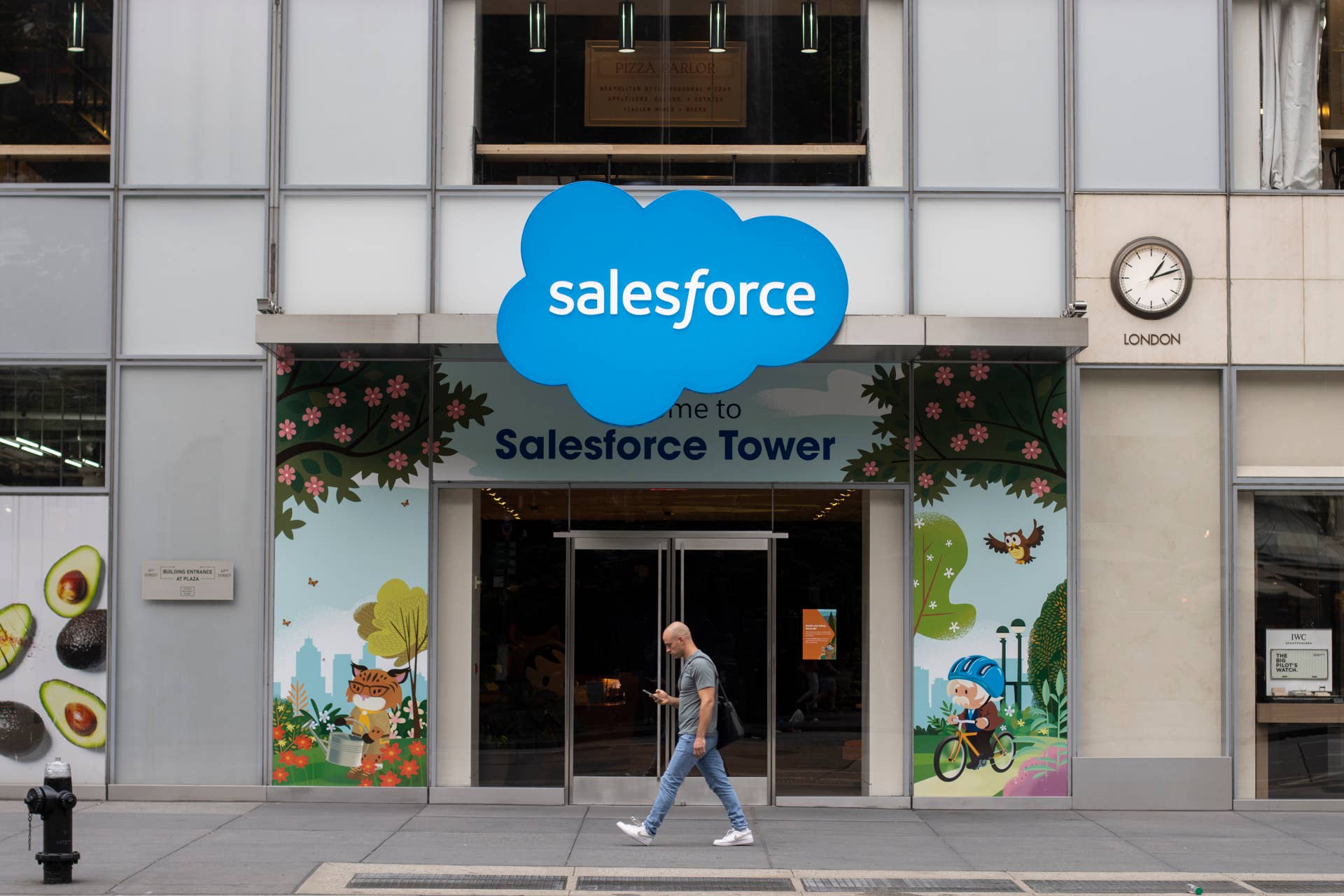
Salesforce (NYSE: CRM) just picked up one of the more unusual analyst calls of 2026, and it landed at a price the market wasn’t ready for.
Bank of America analyst Tal Liani reinstated coverage of Salesforce on May 18 with an Underperform rating and a $160 price target, Yahoo Finance reports.
The stock closed Friday near $179, so Liani is calling for roughly 8% more downside even after a brutal year.
For a stock that still carries an average 12-month price target of $268.05, per Investing.com, that’s a sharp break from consensus.
It also lands at a delicate moment. Salesforce reports fiscal Q1 2027 earnings on May 27, giving the bear thesis a quick test against fresh numbers.
What Bank of America is telling Salesforce investors
Liani’s note builds the bear case on three specific concerns, not vague AI worry.
The three pillars of the BofA bear case:
- Muted net new customer additions.
- Limited upsell potential, since most Fortune 500 companies are already on the platform.
- An “underwhelming” monetization pathway for Salesforce’s AI products, including Agentforce.
The $160 price target works out to 9x estimated 2027 enterprise value to free cash flow, a multiple that sits below the broader software peer average.
Enterprise value to free cash flow simply measures what an investor pays for every dollar of cash the business actually generates, and a lower multiple signals the analyst expects slower growth ahead.
Liani’s framing matters here. He still calls Salesforce “a deeply entrenched platform,” yet argues the company is moving from a high-growth platform to a mature cash generator, with revenue growth stabilizing near 10% annually.
How Agentforce traction fits the bear thesis
The deeper concern in Bank of America’s note centers on pricing architecture, which means how Salesforce charges customers in the first place.
Salesforce was built on per-seat subscriptions, where companies pay based on the number of employees logging in.
The fear is that AI agents replace seats rather than add to them, compressing the very revenue model that built Salesforce into a $170 billion company.
Related: BofA revisits Block stock price target after earnings
CEO Marc Benioff is leaning into the AI shift anyway. On the All-In podcast in mid-May, Benioff said Salesforce will spend roughly $300 million on Anthropic tokens in 2026, mostly for coding, AOL reports.
Agentforce by the numbers:
- Roughly $800 million in annual recurring revenue (ARR)
- 29,000 Agentforce deals closed in the first 15 months
- Combined Agentforce and Data 360 ARR (including Informatica) topping $2.9 billion, up more than 200% year over year
Source: Salesforce FY26 Q4 earnings release
Salesforce closed fiscal 2026 with $41.5 billion in revenue, up 10% year over year, per the company’s investor relations release, and guided fiscal 2027 revenue to $45.8 billion to $46.2 billion.
For a company that once grew above 20% annually, holding at 10% is the slowdown bears have been warning about.
How CRM stock stacks up against the broader market
The damage to CRM in 2026 is hard to overstate.
Salesforce stock is down roughly 33% year to date, sitting at $179.69 against a 52-week high of $289.90 and a 52-week low of $163.52, according to Investing.com.
Compare that to the broader tape:
- CRM YTD: down approximately 33%
- S&P 500: trading near 7,400 with modest YTD gains, per FRED
- iShares Expanded Tech-Software ETF (IGV) in Q1 2026: down more than 24% in a single quarter, the steepest plunge since Q4 2008
The pain isn’t just Salesforce. The entire software sector got repriced after Anthropic’s Claude Cowork launch in February sparked the so-called “SaaSpocalypse” trade, Benzinga reports.
ServiceNow (NYSE: NOW) is also down roughly 41% year to date, as the same fear plays out across the enterprise software sector.
Where institutional money is split on Salesforce
Sentiment is fracturing among large investors, and that split is telling.
Starboard Value exited its Salesforce position in Q1 2026, even after pressing the company on capital allocation through 2025.
On the other side, DNB Asset Management raised its stake by 25%, and Michael Burry, the investor who called the 2008 housing collapse, disclosed a new CRM position in April, treating the sell-off as fear-driven rather than fundamentals-driven.
More Salesforce:
- Does Salesforce pay a dividend? Its yield and payouts explained
- Michael Burry plans to buy Salesforce stock at a discount
- Goldman Sachs resets price target for Dow 30 Salesforce dividend stock
The bull case has weight. Salesforce carries $72.4 billion in total remaining performance obligations, which represents contracted revenue not yet recognized.
The company also returned more than $14 billion to shareholders in fiscal 2026 through dividends and buybacks, roughly 99% of free cash flow.
What needs to happen for CRM stock to recover
Bank of America’s call doesn’t end the Salesforce story, yet it raises the bar that management must clear to win back a growth premium.
Four things that must happen for the bullish CRM thesis to hold:
- Agentforce ARR needs to keep compounding. The product has to outrun seat-pricing compression rather than simply replace it dollar-for-dollar.
- Net new customer additions have to stop being “muted.” Existing-customer expansion is great, but pure growth needs new logos.
- Hybrid pricing has to work. Salesforce needs to demonstrate that consumption-based AI billing can scale alongside the seat model without cannibalizing it.
- Operating margins need to hold above 30%. Margin compression would confirm Bank of America’s “mature cash generator” thesis.
The May 27 earnings report is the next checkpoint, and Agentforce ARR growth is the single number that will move the stock the most.
What this means for your portfolio
For long-term Salesforce holders, Bank of America’s downgrade is a useful pressure test, not a sell signal.
The stock trades at a forward P/E of about 14x, which already prices in significant skepticism. The risk is that 14x still isn’t cheap enough if AI agents really do compress the seat-license model the way bears fear.
A reasonable approach for prudent investors:
- Treat current price levels as a starting point for a position, not a backup-the-truck moment
- Watch the May 27 earnings call closely for Agentforce ARR trajectory and net new customer adds
- Recognize that a $160 print, if it happens, would mark fresh 52-week lows and likely shake out remaining weak hands
For investors who don’t already own CRM, the case for waiting is stronger than the case for chasing. The next earnings report will tell you whether Bank of America was early, or right.
Related: BofA and Goldman Sachs reset Marvell stock price targets