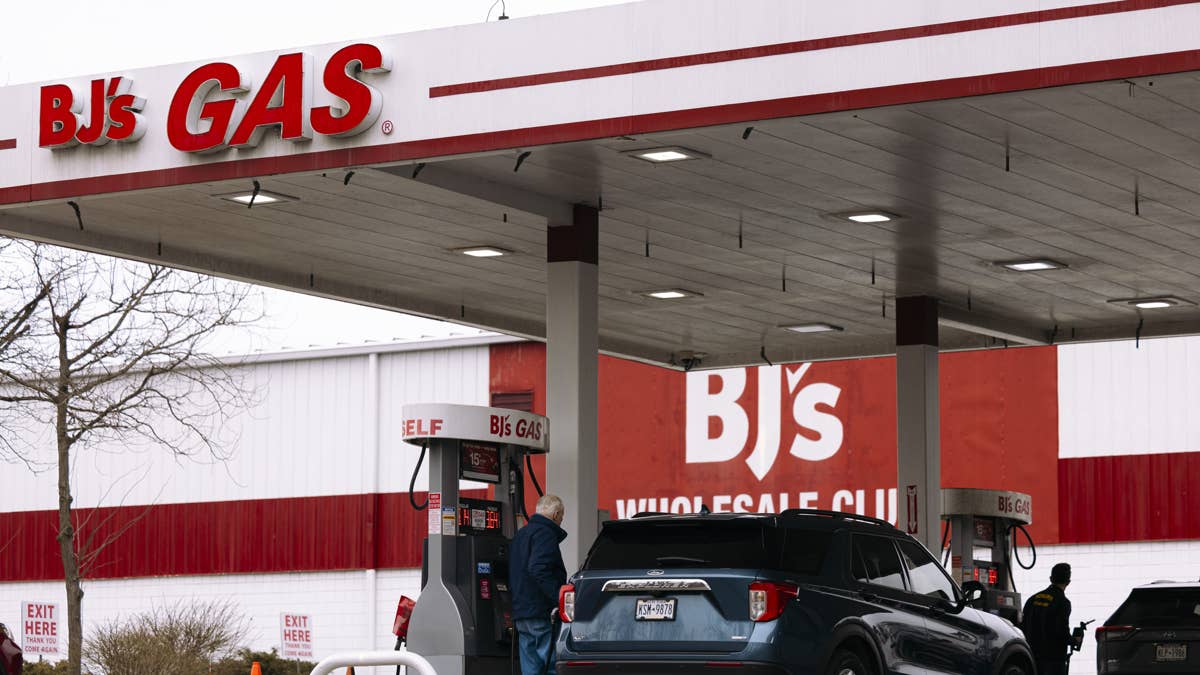
BJ’s Wholesale is seeing a ripple effect from economic pressure that has boosted its gas business in recent months.
However, its retail business continues to face challenges as demand grows unevenly. In response, the company’s CEO is planning significant in-store changes that could affect how customers shop.
In the first quarter of 2026, BJ’s comparable club sales increased by 6.3% year over year, which includes gasoline sales, the company’s latest earnings report revealed. Gas was the main driver of this growth; without it, comparable club sales rose only 1.5% year over year.
Data from a recent Placer.ai report revealed that visits to BJ’s gas stations, which offer discounted fuel, gradually increased over the past two months as gas prices rose. For example, during the week of March 9, BJ’s gas station visits spiked by 17.2% year over year, and for the week of April 6, visits rose by a whopping 21.7%.
Gas prices began to inflate following the U.S. and Israel’s attack on Iran in late February. Currently, gas prices nationwide are averaging about $4.52 per gallon, according to recent data from the American Automobile Association (AAA). A month ago, the average gas price was $4.03 per gallon.
In the report, Placer.ai content writer Ezra Carmel wrote that “competitively priced fuel is a meaningful traffic driver during periods of elevated gas prices – reinforcing the value proposition of warehouse club memberships.”
“If fuel prices remain high, members may be more inclined to consolidate shopping trips around fuel fill-ups, potentially boosting both gas station traffic and in-club spending,” he added.
BJ’s plans significant move as customer base shifts
During an earnings call on May 22, BJ’s Wholesale CEO Bob Eddy said that in April alone, members spent $143 million more at the company’s gas stations than they did a year ago.
“Gas prices increased dramatically during the quarter, putting additional pressure on member wallets,” said Eddy. “By the end of Q1, retail gas prices were up nearly 50% compared to the start of the quarter. In that environment, our role was clear: to help take care of our members by delivering value.”
Despite this growth in gas sales, Eddy warned that club members are continuing to pull back on spending in discretionary categories, as sales growth in these areas remained flat during the quarter.
Related: BJ’s Wholesale makes bold move to lure more shoppers
“While the consumer in the broadest sense has been resilient in the face of continuing challenges, we continue to see a more pressured environment for the lower-income households,” he said.
Eddy said that “the vast majority” of BJ’s comparable sales growth during the quarter was driven by higher-income members who “remain engaged” and consistently shop in stores.
In response to elevated spending by higher-income members, Eddy said that BJ’s plans to introduce more higher-priced items at its locations to ensure it has “the right assortment for the folks that are spending.”
“We want to take our assortment upmarket a little bit in the good, better, best construct,” he said. “We have too much in the good level, and we need more better and best.”
“We’ve seen a resilient consumer, but as you look under the covers, there’s considerable pressure on the lower-income consumers, and the middle-income consumers are trading sideways a bit, and the only real growth is from the affluent customers,” he added. “We want to make sure that we are where the money is and bringing the right products to those folks.”
BJ’s vows to pass savings back to customers
Despite this upcoming in-store change, Eddy said that BJ’s will also double down on returning tariff refunds to members through pricing, since they remain financially pressured.
This is a change the company initiated during the first quarter, leading to a roughly 0.5 point of deflation in its retail pricing. The move comes after it rolled out price increases in its stores last year due to tariffs.
Two areas where BJ’s is considering using these funds to lower prices are gas (if demand drops) and eggs, as inflation remains elevated.
More Retail:
- Target sees unexpected shift in customer behavior
- Publix faces consumer boycott threat after store policy change
- Ross Stores CEO eyes a change that could drive away shoppers
“Any source of gain that we can come up with, we will always try and give it back to our members so that they reward us in the future,” said Eddy.
It is vital for BJ’s to continue investing in members who are strapped for cash, as more consumers nationwide are taking extra measures to save money.
According to a recent A&M Consumer and Retail Group survey, this includes shoppers switching brands and giving more of their business to retailers that offer lower prices.
How U.S. consumers are saving money on groceries:
- Roughly 61% of consumers are making fewer grocery trips to cut costs.
- Also, 50% to 60% are switching to lower-priced retailers in search of more affordable pricing.
- Additionally, 35% plan to purchase less-expensive brands in stores amid financial pressures.
Source: A&M Consumer and Retail Group
Chad Lusk, managing director at A&M Consumer and Retail Group, said in a press release that “consumers are re-orienting the importance of brand in their decision-making, and loyalty is waning.”
As BJ’s plans to adjust its in-store prices and assortment, it expects comparable club sales, excluding gasoline sales, to increase 2% to 3% year over year in fiscal year 2026.
“We factored everything into our outlook that we know today,” said BJ’s Wholesale Chief Financial Officer Laura Felice during the earnings call. “We’re certainly watching the tariff environment that’s continually moving.”
Related: Publix faces consumer boycott threat after store policy change