When the people building something stand next to the people warning about it, that usually means everyone in the room is worried about the same thing.
For most of the past three years, the artificial intelligence conversation has split cleanly into two camps.
The builders keep raising bigger funding rounds and shipping bigger models. The critics keep arguing the technology is moving faster than anyone can govern. The market has mostly sided with the builders, and the price action has rewarded that bet.
Nvidia (NVDA) crossed $5 trillion in market value last fall. Microsoft (MSFT), Alphabet (GOOGL), and Meta (META) have committed hundreds of billions to AI data centers and chips. Private valuations for the frontier labs building the underlying models have gone vertical, with one company alone now reportedly chasing a $900 billion mark.
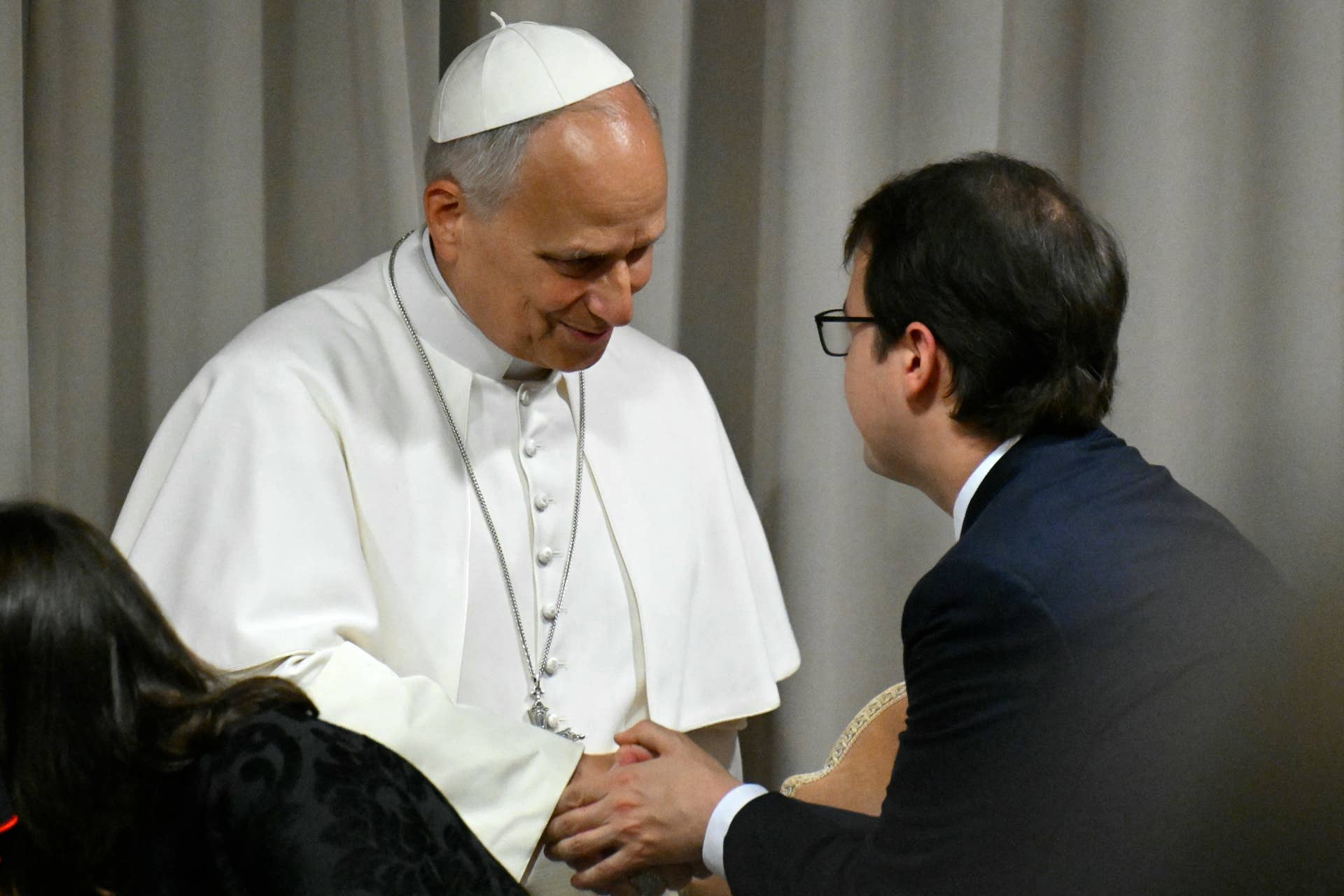
That tidy split fell apart on Monday, May 25, inside the Vatican’s Synod Hall, when Pope Leo XIV released his first encyclical, titled “Magnifica Humanitas.”
Standing beside him was Chris Olah, the Canadian co-founder of Anthropic, the company behind the Claude AI model. They were not there to disagree.
What Pope Leo XIV’s encyclical actually says about AI
In a 42,000-word document, Pope Leo XIV called for the “disarming” of artificial intelligence and warned of a “race for ever more powerful algorithms and larger datasets, driven by the desire to secure geopolitical or commercial dominance,” according to CBS News.
He urged governments to slow the development of AI systems, warning that they spread misinformation, prioritize conflict, and risk leading the world down a path of unending war, reported CBC News.
Related: Anthropic just landed one of the biggest deals in AI
In my analysis, the language matters more than the religion. An encyclical is the most authoritative form of papal teaching, sent to every bishop in the Roman Catholic Church, which counts roughly 1.4 billion members worldwide.
This one, “Magnifica Humanitas,” or “Magnificent Humanity,” is the first major encyclical written explicitly about generative AI.
Pope Francis, Leo’s predecessor, released four encyclicals across a 12-year papacy, according to NBC News. Leo released this one inside his first year, which signals how urgently the Vatican sees the issue.
The document does not name any single company. It does not need to. The Vatican invited the co-founder of a leading frontier AI lab to share the stage, then sat him beside Durham University Professor of Catholic Social Thought and Practice Anna Rowlands, according to CBS News.
The image traveled faster than the text.
Why the Anthropic co-founder stood beside the Pope at the unveiling
Olah did not play defense. In a response published on Anthropic’s website and delivered in person at the Vatican, he conceded that “every frontier AI lab, including Anthropic, operates inside a set of incentives and constraints that can sometimes conflict with doing the right thing.”
AI could displace human labor “at very large scale,” and “supporting those displaced will be a moral imperative of historic proportions,” he also told the audience.
“We keep finding things that are mysterious, even unsettling,” Olah said of the AI systems his own company is building, a comment that should land harder for market readers, regardless of their religious beliefs.
When I ran the numbers against Anthropic’s recent funding history, the contrast became obvious.
- Anthropic’s run-rate revenue grew from roughly $9 billion at the end of 2025 to more than $30 billion by April 2026, Sacra noted.
- The company closed a $30 billion Series G round on Feb. 12, 2026, at a $380 billion post-money valuation, according to Sacra.
- Anthropic is now reportedly in talks to raise more than $30 billion at a $900 billion valuation, which would surpass OpenAI as the most valuable private AI company, Bloomberg confirmed.
A man whose company has roughly quintupled in private valuation inside one year just stood beside the Pope and called the work “unsettling.”
That is not a defensive crouch. It’s a public hedge from inside the industry.
What this warning from Anthropic’s Olah means for AI investors, your portfolio
For the everyday investor, the practical question is simple. If the Pope and an Anthropic co-founder agree on the risk, what changes?
In my read, two things shift right away.
More AI:
- Micron sits at the center of a red-hot chip rally
- IBM CEO sends blunt message on AI and quantum computing
- Anthropic CEO makes shocking admission about AI
First, the regulatory clock starts ticking faster. Leo called for “disarming” AI and urged governments to slow development, CBC News reported. The Vatican does not write national laws. It shapes the moral framework legislatures use to justify them.
Catholic-influenced legislatures across Europe and Latin America now have explicit moral cover to push tighter AI standards, which raises compliance costs for every company in the AI stack, from chipmakers like Nvidia to the frontier labs themselves.
Second, the labor displacement story is no longer fringe. When the co-founder of a company worth at least $380 billion tells you out loud that supporting displaced workers will be a “moral imperative of historic proportions,” the question for retirement-account investors flips.
It’s no longer a question of whether disruption is coming. It is now a matter of which jobs in your household get hit first, and which sectors you want underweighted before that happens. Bubble fears have already been showing up in fund-manager portfolios.
Anthropic has also drawn a public line on military use. The company has refused to allow Claude to be used for lethal autonomous warfare without human oversight or for mass surveillance of Americans, which has put it in litigation with Pentagon officials, CBC News indicated.
That stance matters for valuation math. Defense contracts are some of the most reliable cash flows in technology. A frontier AI lab turning that money down at a near-trillion-dollar valuation tells you the rest of the industry will eventually have to answer the same question, likely under tighter rules.
For now, the AI trade still works. Nvidia, Microsoft, and Alphabet keep printing earnings. Anthropic is reportedly headed toward an IPO as soon as October 2026, Sacra noted.
May 25’s Vatican event is the kind of moment that does not move stocks the same day, but reshapes the conversation around them. A pope and a frontier AI lab co-founder just stood at the same podium and said, in different words, the same thing: Slow down.
When the people building the technology start agreeing with the people warning about it, the smart move for your portfolio is to listen before the rules catch up.