Cathie Wood has never been shy about making big bets on names that most of Wall Street hasn’t fully figured out yet.
According to data from StockCircle:
- Wood’s firm, ARK Invest, first bought Roku back in the fourth quarter of 2019.
- Since then, she has bought the stock 14 more times and sold it on 14 occasions, according to data from StockCircle.
- The average buy price across those trades is roughly $131 per share, similar to the current trading price.
As of the most recent data, Wood owns 3.82 million shares worth approximately $497 million.
That makes Roku (ROKU) her sixth-largest holding, representing 3.27% of her equity portfolio.
So what does Wood see in a stock still sitting 73% below its all-time high?
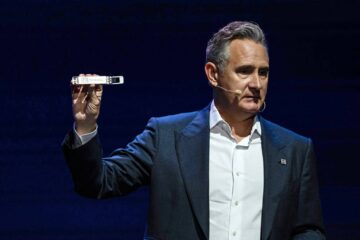
A recent conference appearance by Roku’s chief financial officer, Dan Jedda, offers some answers.
Roku is now a monetization machine
Three years ago, Roku was largely a hardware story. It was built around scale, not profit.
The company had around 80 million streaming households when Jedda joined in May 2023. Today, that number has crossed 100 million.
But the more meaningful shift is what Roku has done with that audience.
Roku opened its platform to third-party demand-side platforms (DSPs), which are the automated systems that big brands and agencies use to buy digital advertising.
Fund manager buys and sells
- Cathie Wood buys $2.5 million of tumbling megacap stock
- Warren Buffett dumped 77% of Amazon to buy surging media stock
- Cathie Wood buys $11 million of tumbling megacap tech stock
Before this pivot, Roku required all programmatic advertisers to use its own DSP. That was limiting by design but damaging in practice.
Now, Roku works with all the major DSPs. That includes a high-profile deal with Amazon, which lets advertisers match Roku’s first-party viewer data with Amazon’s shopping data inside a privacy-safe environment.
Jedda called the Amazon deal “a major unlock,” and the numbers seem to back that up.
Advertising gross margins have climbed to just over 60%, up 450 basis points year over year.
That margin improvement matters because it directly addresses one of investors’ biggest fears: that working with outside DSPs would erode Roku’s profitability.
Roku’s subscription business is key
Until recently, Roku didn’t break out its advertising and subscription revenues separately.
When it finally did, many people were surprised by how large and fast-growing the subscription segment had become.
Jedda was blunt about why the disclosure was overdue, as investors didn’t understand how significant the subscription business was.
Jedda stated:
“We are constantly asking ourselves how can we give our investors and potential investors the information to understand our company, but also not give out too much competitive information.”
The segment has gross margins just above 40%, which are lower than those of the ad business.
However, it is a steadily growing revenue stream that Jedda describes as “annuity-like.”
Premium subscriptions, where Roku embeds partner content throughout the user interface and drives traffic directly to those apps, are the main growth engine here.
Roku also owns two subscription products. It acquired Frndly and built Howdy from scratch. Howdy, a low-cost, ad-free streaming service, has already expanded to Amazon’s platform and into Mexico.
Mexico is a useful case study for Roku’s international ambitions more broadly. The company has nearly as many streaming households there as in the United States.
Roku’s path to $1 billion in free cash flow
Roku operates a business that is extraordinarily light on capital spending.
Jedda said CapEx runs in the “single-digit millions,” which means nearly all of Roku’s earnings flow directly into free cash flow.
Related: Cathie Wood sells $16M of surging semiconductor stock
Roku also carries roughly $1.2 billion in net operating losses (NOLs) on its balance sheet, which will shield it from cash taxes for the next couple of years as it turns profitable.
That means free cash flow will actually exceed EBITDA (earnings before interest, taxes, depreciation, and amortization) in the near term.
Jedda has publicly committed to reaching $1 billion in annual free cash flow by 2028, and he suggested it could come sooner.
Analysts tracking Roku forecast free cash flow to expand from $478.44 million in 2025 to $1.78 billion in 2030.
If the tech stock is priced at 22x forward FCF, which is similar to the current multiple, it could double within the next four years.
Roku is already using excess cash to buy back shares. The first quarter of 2026 marked the first time in the company’s history that shares outstanding declined sequentially.
For Wood, it is the kind of inflection point ARK tends to bet on early and hold through the noise.
Whether the stock gets back to its 2021 peak near $480 is anyone’s guess. But the business Roku is building today looks very different from the one that earned that valuation, and arguably more durable.