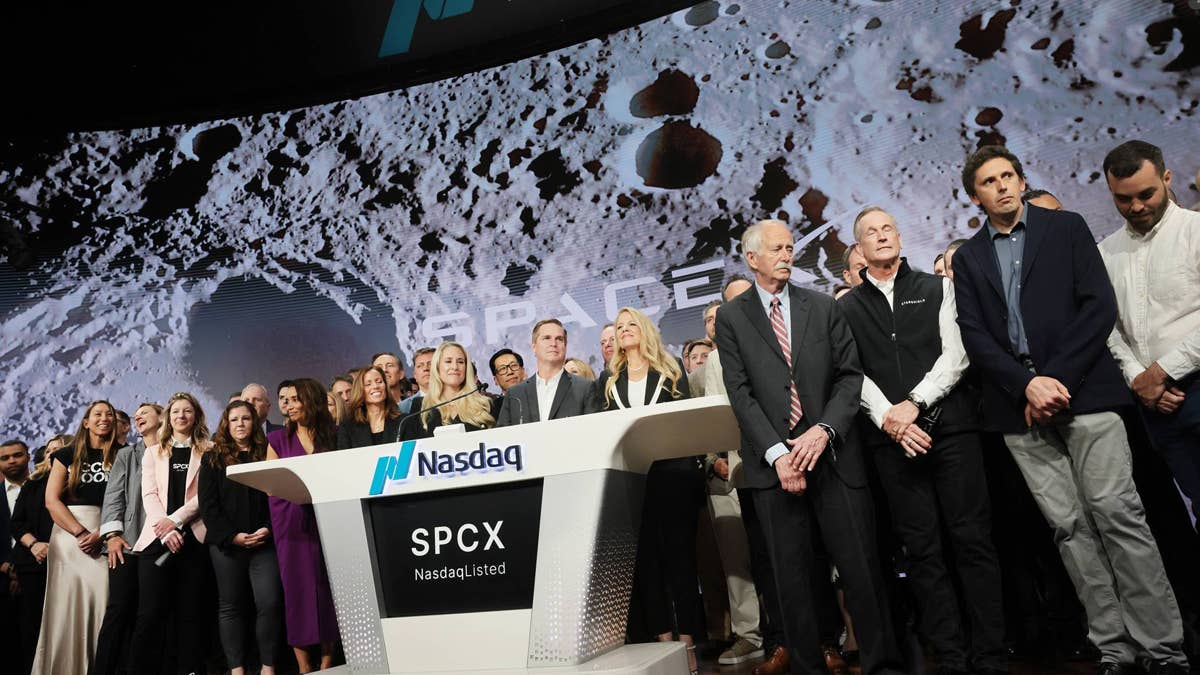
SpaceX debuted on Nasdaq on June 12 in what became the largest initial public offering in Wall Street history. The company raised $75 billion by selling 555.6 million shares at $135 each, surpassing Saudi Aramco’s $29.4 billion 2019 record, CNBC reported.
Shares opened at $150, peaked at $176.52 during intraday trading, and closed at $161.11, delivering a 19.34% first-day gain, according to CNN.
For the millions holding index funds in their retirement accounts, one question has surfaced: How much is SpaceX about to add to your portfolio?
Vanguard, which oversees the largest collection of index funds in the world, published its response two days before SpaceX shares began trading.
The firm’s June 10 report laid out a methodical breakdown of how its exchange-traded funds would incorporate SpaceX, prioritizing process over enthusiasm.
Vanguard expects SpaceX to carry a weight of 1% or less in affected ETFs
Four widely held Vanguard equity ETFs are directly affected by the SpaceX listing, and each one follows a different inclusion schedule based on its underlying index.
The Vanguard Total Stock Market ETF (VTI), Total World Stock ETF (VT), and Extended Market ETF (VXF) track indexes that fast-track large IPOs.
SpaceX is expected to enter those three funds after the close of the fifth trading day following the listing, the firm noted.
The Vanguard S&P 500 ETF (VOO) faces a longer wait because the S&P 500 retained its profitability requirement for new additions.
SpaceX recorded a first-quarter 2026 net loss of $4.28 billion, on top of a $4.94 billion full-year loss in 2025, according to its SEC filing.
Those results disqualify the stock from the S&P 500 for approximately 12 months under the index’s existing standards, Vanguard confirmed.
Float-adjusted rules keep the initial SpaceX allocation modest
Even for the funds adding SpaceX within days of the debut, Vanguard said the portfolio impact will remain small for a specific structural reason.
SpaceX closed its debut session at a market value above $2 trillion, but only about 5% of the company’s outstanding shares are publicly traded at this stage.
Index providers calculate a stock’s weight using only publicly available shares, not the restricted holdings held by founders, employees, and major institutional backers.
That mechanical filter limits how much of any single IPO a diversified index fund can hold during its earliest weeks of public trading.
More Vanguard:
- Vanguard names 401(k) oversights that hurt your retirement
- Vanguard drops playbook on retirement income
- Vanguard warns workers losing thousands in 401(k)s
Vanguard said portfolio weights across the affected ETFs are expected to be 1% or less, which limits turnover costs and tax consequences for fund shareholders.
The firm added that SpaceX’s weight in these indexes would grow organically as lockup periods expire and insiders begin selling restricted shares over the following months.
“Fifty years ago, indexing offered investors a simple proposition: participate in the growth of markets without needing to outguess them.
“That proposition still holds,” Rodney Comegys, chief investment officer of Vanguard Capital Management and head of global equity, said in the report.
Index providers take different paths on SpaceX inclusion speed
Morningstar’s U.S. Indexes, FTSE, and Russell all now allow mega-cap companies into their benchmarks as early as five trading days after listing, the firm noted.
The Nasdaq-100 takes a more cautious approach, requiring 15 trading days for companies ranked among the top 40 by market capitalization.
S&P Dow Jones Indices confirmed on June 4 that it would maintain its flagship index’s profitability and seasoning requirements and declined to fast-track SpaceX.
Tejas Dessai, director of thematic research at Global X, offered Kiplinger more insight on fast-entry rules.
Fast-entry rules are important because they allow rules-based passive ETFs to keep pace with the market.
The divergence among providers means two investors holding different index funds may see SpaceX appear in their portfolios weeks or months apart.
That staggered approach to inclusion reduces the pressure that concentrated forced buying from passive funds can create around high-profile listings.
SpaceX’s financial profile underscores the value of passive guardrails
SpaceX generated $18.67 billion in revenue during 2025, with first-quarter 2026 sales climbing 15% to $4.69 billion, the company disclosed in its prospectus.
The Starlink satellite internet service accounts for the bulk of that revenue and remains the company’s only profitable operating segment, the filing indicated.
The AI segment, which combines xAI and X (formerly Twitter) following an all-stock merger completed Feb. 2, 2026, posted a $2.47 billion operating loss in the first quarter, the largest contributor to SpaceX’s consolidated losses, SpaceX disclosed in its S-1 filing.
First-quarter capital expenditures reached $10.1 billion, with $7.7 billion directed toward AI infrastructure alone, the S-1 showed.
“Investing in an IPO process can be highly speculative, and it’s really difficult to determine the path of an IPO on a given day,” Rodney Comegys, chief investment officer and head of global equity for Vanguard Capital Management, told NPR.
Comegys added that participating in SpaceX’s IPO purely as a speculative bet “is really not the best way to do long-term investing.”
Vanguard’s process-first approach extends beyond SpaceX
Vanguard noted that SpaceX is not the only mega-cap listing on the horizon, with both Anthropic and OpenAI expected to pursue large-scale offerings of their own.
The same float-adjusted, rules-based framework will govern how each of those companies enters passive index portfolios when the time comes, the firm indicated.
For passive investors holding Vanguard’s total stock market or total world funds, the mechanics of indexing remove the need for any individual decision about these listings, the firm indicated.
The rules determine when SpaceX enters, the float determines how much weight the stock carries, and the process plays out mechanically, a reflection of what Vanguard describes as letting “markets, not hype, settle the outcomes.”
Related: SpaceX IPO creates a tough call for small investors