Luxury department stores are built on more than expensive handbags, designer shoes, and polished sales floors.
They depend on trust.
Shoppers expect the right products to be available, brands expect to be paid, and stores need enough experienced employees to deliver the kind of service that makes a high-end purchase feel worth it.
This has made the past year difficult for Saks Global.
The company behind Saks Fifth Avenue, Neiman Marcus, and Bergdorf Goodman, names often used interchangeably with luxury, officially began the Chapter 11 bankruptcy process in January.
The issues arose after a challenging stretch that included liquidity problems, missed payments, store closures, and deep layoffs.
Now the luxury retailer is trying to turn the page under a new name.
Saks Global exits Chapter 11 as Exemplar Luxury Group
Saks Global announced June 26 that it has successfully emerged from Chapter 11 bankruptcy as Exemplar Luxury Group (ELG), a new luxury collective that includes Neiman Marcus, Saks Fifth Avenue, and Bergdorf Goodman.
The company said the restructuring leaves it with a much stronger balance sheet, including a nearly 75% reduction in debt, around $500 million in exit financing, sufficient liquidity, and support from its capital partners and key stakeholders.
More Retail:
- Struggling women’s clothing retailer shutters 171 stores
- Retail giant launches first new home brand in 5 years
- Discount retail giant wins as shoppers change how they spend
The exit is a major milestone for one of the best-known names in U.S. luxury retail. But it also shows how much the company had to shrink and simplify to get there.
The company’s new board includes representatives from Pentwater Capital Management and Bracebridge Capital, two firms that played key roles in the restructuring.
And with this change, the company is now positioning itself as a more focused luxury retail business built around three major banners: Neiman Marcus, Saks Fifth Avenue, and Bergdorf Goodman.
CEO Geoffroy van Raemdonck said the new name reflects the company’s effort to set a higher standard for luxury retail across its brands.
“This pivotal moment reinforces the enduring strength of our business, our luxury banners, and our team as we look ahead to a bright future guided by our relentless devotion to our customers,” said Geoffroy van Raemdonck, CEO, Exemplar Luxury Group.
Under a new banner, the company will focus on long-term profitable growth, stronger brand relationships, personalized customer experiences, and an integrated retail model that includes stores, e-commerce, and remote selling services.
That strategy matters because luxury department stores are no longer just competing on product selection. They are competing on service, exclusivity, convenience, and customer relationships.
For shoppers, that could mean a stronger push toward curated assortments, better inventory, more personalized service, and tighter connections between online shopping and in-store experiences.
Part of this change is Saks’ strategic cut from its eCommerce partnership with early investor Amazon, to maintain exclusivity by not selling on a mass platform, according to Reuters.
For vendors, the bankruptcy exit may be even more important.
Saks’ financial strain had raised concerns about payments, inventory, and confidence among brand partners.
A cleaner balance sheet may help the company rebuild those relationships, especially with luxury brands that depend on tight control over distribution and customer experience.
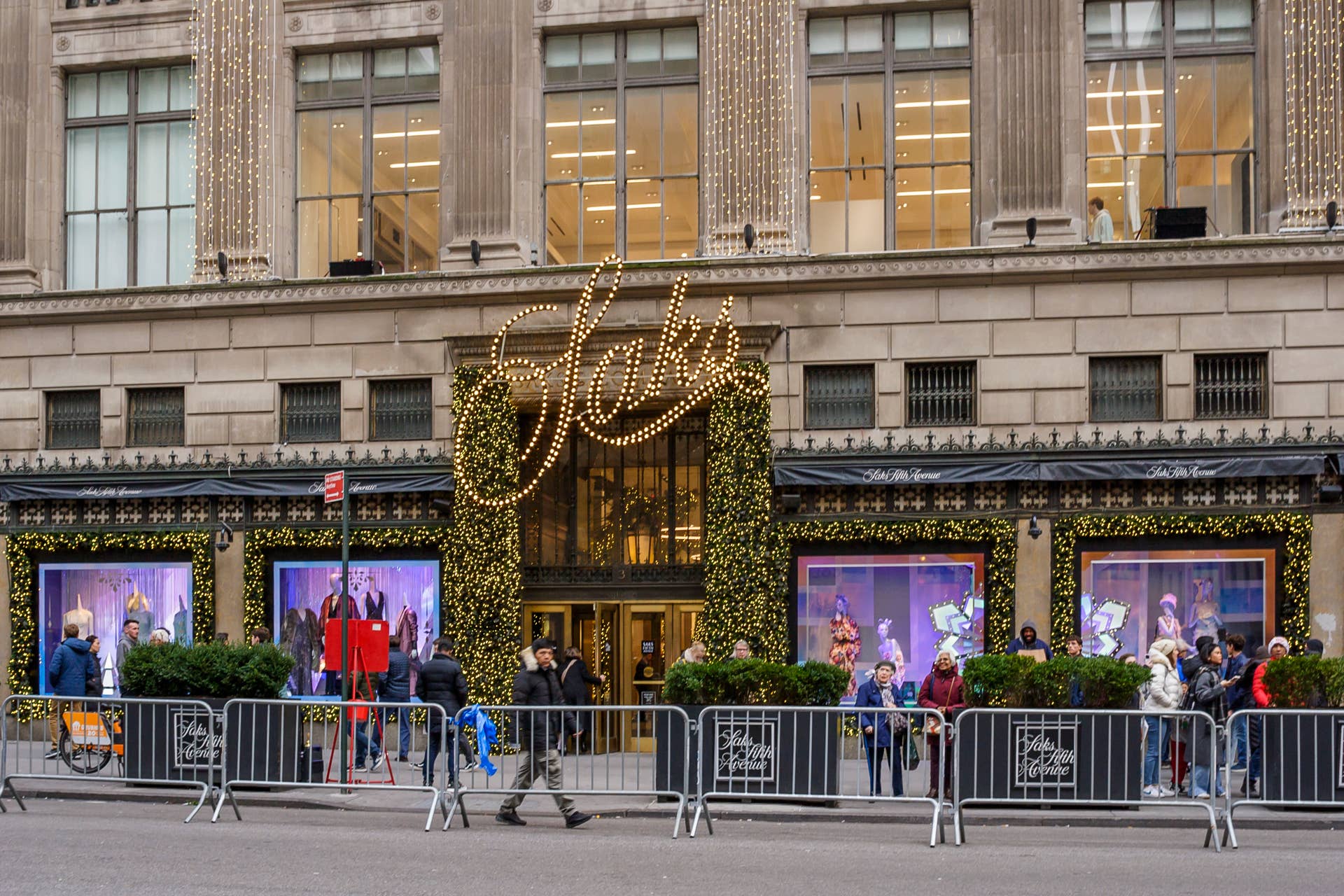
Saks reset followed closures and deep job cuts
The emergence from bankruptcy also followed a painful restructuring.
TheStreet previously reported that Saks Global planned to cut about 16% of its corporate staff, or roughly 640 jobs, as it neared a bankruptcy exit.
Those cuts came after more than 1,200 earlier layoffs tied to store and facility closures.
In March, WARN filings showed 1,226 job cuts tied to Saks store and facility closures across 12 locations, including a major reduction at a Pottsville, Penn., facility that accounted for 435 employees.
Other affected locations included stores or operations in Missouri, Maryland, North Carolina, Nevada, Ohio, Florida, Virginia, Illinois, and California.
Those cuts show that Saks’ bankruptcy restructuring was not just a financial move. It also reshaped the company’s physical footprint and workforce.
Saks also moved to streamline parts of its business, including much of its off-price operation, as it refocuses on luxury and full-price selling.
That shift may help the company protect its high-end image, but it also reflects a tougher reality for department stores.
Retailers are being forced to decide which locations, formats, and customer groups are worth investing in as shoppers become more selective.
Saks sets ambitious post-bankruptcy goals
Saks Global had already cleared a major hurdle earlier this month when the U.S. Bankruptcy Court for the Southern District of Texas approved its reorganization plan.
At the time, the company said the plan would allow it to exit Chapter 11 with debt reduced by nearly 75% and enough liquidity to support operations and invest in the future.
The company also laid out long-term financial goals.
ELG said its plan is to help the business accelerate sales growth, focus on full-price selling, and generate $9 billion in total gross merchandise value by fiscal 2030.
It also aims to reach double-digit adjusted EBITDA by then.
That gives Exemplar Luxury Group a clearer target as it tries to rebuild after bankruptcy.
The company’s new board, Pentwater Capital Management and Bracebridge Capital, will each have two representatives on the seven-person board.
Van Raemdonck will also serve on the board, along with two independent directors: former Ulta Beauty CEO Dave Kimbell and former Moët Hennessy Global CEO Philippe Schaus.
The new structure gives the company a chance to reset, but the challenge is still significant.
Exemplar Luxury Group must now prove that fewer stores, a smaller corporate team, and a cleaner balance sheet can translate into stronger luxury retail growth.
Luxury shoppers are changing fast
The timing of Saks’ reset matters because the luxury market is no longer moving in a straight line.
The Bain & Company report said global luxury spending reached €1.443 trillion in 2025 and is expected to stabilize in 2026, even as brands deal with economic volatility, geopolitical pressure and changing consumer habits.
Personal luxury goods spending dipped in 2025 but is expected to grow again this year, the report said.
The firm expects that market to rise 2% to 4% in 2026, reaching €365 billion to €373 billion under its base case.
The U.S. is one of the brighter spots. Bain said luxury spending in the Americas is rising, with younger shoppers and upper-middle-class households helping broaden the market.
But the report also points to a tougher reality for retailers such as Exemplar Luxury Group.
Luxury shoppers are becoming more selective. Bain said experiences are outpacing tangible goods, while many shoppers are checking the secondhand market before buying new and using artificial intelligence throughout the shopping journey.
That makes Saks’ next chapter about more than debt reduction.
The company now has to prove that Saks Fifth Avenue, Neiman Marcus, and Bergdorf Goodman can remain relevant to shoppers who want more personalized service, stronger value, better digital tools, and a clearer reason to buy.
For customers, the big question is whether the bankruptcy exit leads to a better shopping experience.
For workers and communities affected by closures, the reset has already come at a cost.
For Saks, Neiman Marcus, and Bergdorf Goodman, the next test is whether a new name, lower debt, and new ownership can restore trust in a luxury market where shoppers still want high-end goods, but are becoming much harder to impress.
Related: 89-year-old Home Depot rival closes its hardware business