Big companies almost never admit a mistake out loud. When the admission comes, it rarely arrives in words. It arrives in money.
For three decades, the auto industry’s money moved in one direction. The North American Free Trade Agreement, and later the United States-Mexico-Canada Agreement (USMCA), made Mexico the default answer to a question every manufacturer asks: where can we build this cheaper?
Every major automaker took that deal at some point. Toyota Motor Corp. (TM) took it too, and the company that turned patient, decades-ahead planning into a management philosophy does not make these calls lightly. When Toyota decides a factory belongs somewhere, it has usually gamed out the next 20 years, not the next quarter.
Which is what makes this week different. Five years ago, Toyota pulled production of one of America’s best-loved vehicles out of San Antonio and sent it south. On July 6, the company said it will spend $3.6 billion to bring it back home.
The vehicle is the Tacoma pickup. And the reversal says as much about Washington as it does about trucks.
Why Toyota moved the Tacoma out of Texas
The Tacoma has been the best-selling midsize pickup in America for 21 straight years, and it posted 274,638 U.S. sales in 2025, its best year ever, according to Toyota. Chevrolet’s Colorado, the distant runner-up, sold fewer than half as many.
The truck has been on American roads since 1995, and its reputation for outlasting its owners’ loans is the closest thing the industry has to a license for printing money.
San Antonio built the truck for years alongside the full-size Tundra. But Toyota wanted its Texas campus focused on the Tundra and the Sequoia SUV, and Mexico offered lower labor costs plus tariff-free access to American buyers under the USMCA.
Related: Toyota is working on a fix for its giant $4.3 billion problem
The company rolled its last Texas-built Tacomas in 2021 and consolidated production at its Guanajuato and Baja California plants, according to the San Antonio Report.
On paper, the move worked. Freed from sharing a line with the Tundra, the Tacoma finally had the capacity to meet demand, and sales jumped 42% last year alone.
I lined that timeline up against the sales chart, and the irony is hard to miss. Toyota perfected the Tacoma’s formula, watched demand explode, and did it all while the truck’s assembly lines sat on the wrong side of a border that Washington was busy turning into a toll booth.
Inside Toyota’s $3.6B Tacoma reversal
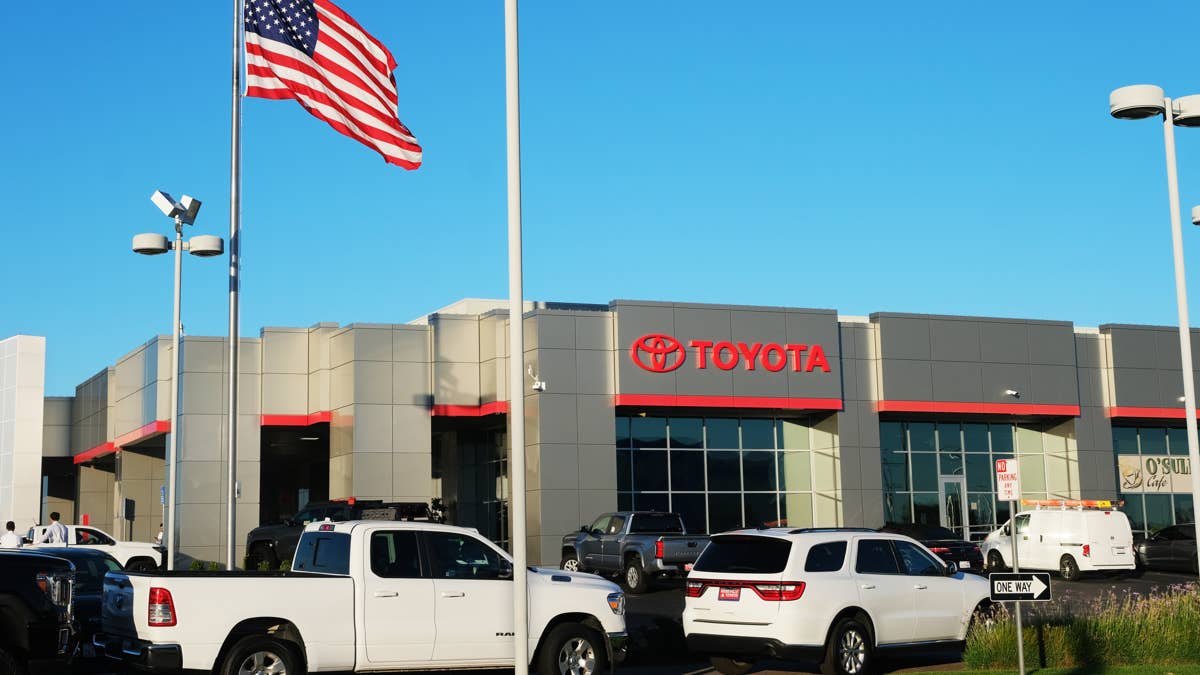
Toyota will build a second vehicle assembly line on its existing 2,000-acre San Antonio campus, adding 2.5 million square feet and doubling the plant’s size by 2030. The expansion creates 2,000 jobs and shifts Tacoma production from Baja California back to Texas over roughly four years.
The expansion is about “deepening our commitment to American manufacturing,” Toyota Motor North America CEO Ted Ogawa said in the company’s press release.
The scale of the project stands out even by Toyota’s standards:
- The new line lifts the plant’s annual production capacity by 150,000 units, reported CBS News.
- Total investment in the San Antonio campus reaches $8.3 billion since ground broke in 2003, per Toyota’s press release.
- A separate $531 million rear axle facility on the same campus begins production this fall, according to CNBC.
- Texas, Bexar County, and the city of San Antonio assembled an incentive package worth at least $303 million to land the project, per the San Antonio Report.
Toyota is not abandoning Mexico entirely. Some Tacoma production continues at the Guanajuato plant, and the company says it remains committed to operations across the U.S., Canada, and Mexico.
Once the new line opens, the plant’s workforce grows to roughly 6,000 people, and every truck Toyota sells under its own badge in the U.S. pickup segment, Tundra, Sequoia, and Tacoma, will roll out of one Texas zip code.
The trade math behind Toyota’s U-turn
The timing is the tell. On July 1, the first mandatory six-year review of the USMCA ended without an extension, and as a result “the USMCA is not renewed,” according to the U.S. Trade Representative. The pact stays in force for now, but it faces annual reviews through 2036, which is a polite way of saying nobody can bank on it.
Five days later, Toyota announced the San Antonio expansion. Automakers have been shifting production stateside “as President Trump raises tariffs on automobiles,” reported CBS News, and Japanese imports already carry a 15% U.S. auto tariff that Tokyo negotiated down from 27.5% last year.
More Automotive:
- BMW’s new SUV is built for an uncertain future
- The U.S. may never sell 17.6 million cars again
- BofA sees Ford chasing a market far bigger than EVs
Toyota saw this coming. In November, the company pledged as much as $10 billion to American manufacturing over five years, a commitment that followed a streak of surging U.S. sales and output, TheStreet reported. San Antonio is the largest single expression of that pledge so far.
My read of the state incentive filings adds a wrinkle most coverage skipped. The 2,000 new hires arrive in waves, 320 workers in 2028, 1,440 in 2029, and 240 in 2030, and Toyota must pay at least $32.46 an hour under its agreement with the city, per the San Antonio Report.
That is a reshoring deal with a wage floor attached, which is not how these arrangements usually read.
What Toyota’s Texas bet means for truck buyers
Nothing changes at the dealership tomorrow. The transition runs about four years, and Tacomas will keep arriving from Mexico while the Texas line goes up.
The longer game is where the money is. A Tacoma built in San Antonio is a Tacoma insulated from whatever happens to the USMCA, to tariff rates, or to the trade talks scheduled to resume in Mexico City the week of July 20. Toyota is paying $3.6 billion so the price of its best-selling truck no longer depends on a treaty.
That matters for a vehicle whose buyers are famously loyal and famously price-sensitive. Tariff costs on Mexican-built vehicles either eat an automaker’s margin or land on the window sticker, and no company wants to test how much a Tacoma customer will absorb before walking across the street to a Colorado.
There is a quieter capacity story here too. Hybrids made up nearly half of Toyota’s U.S. sales last year, and the company says the new facility is built around flexible manufacturing, which gives it room to chase that demand wherever it moves next.
Toyota will not be the last automaker to run this math. With the USMCA now living review to review, every vehicle program in Mexico has become a bet on paperwork.
I expect more announcements like this one before the annual review cycle plays out, because the cheapest plant in North America is no longer the one with the lowest wages. It is the one on the right side of the border.