Legendary investor and now-retired CEO of Berkshire Hathaway (BRK.A, BRK.B), Warren Buffett, spent decades teaching investors that knowing what to sidestep is probably as important as finding what to buy.
The Oracle of Omaha zeroed in on businesses with predictable demand, durable pricing power, strong cash flow, and advantages built to survive economic cycles.
Technology was typically something outside of his comfort zone. The concern was never that the technology lacked value, but that the level of disruption was so extreme that long-term outcomes were tougher to forecast.
“If we have a strength, it is in recognizing when we are operating well within our circle of competence,” Buffett wrote in Berkshire’s 1999 shareholder letter.
That caution actually made Berkshire’s much-talked-about Apple investment remarkable, although Buffett viewed the iPhone maker mainly as a powerful consumer brand.
His latest revelation goes further.
Though the poor guy is trying to enjoy retirement, CNBC was not about to let that happen. Its scoop revealed that Buffett personally initiated a position many investors had assumed came from Berkshire’s new leadership.
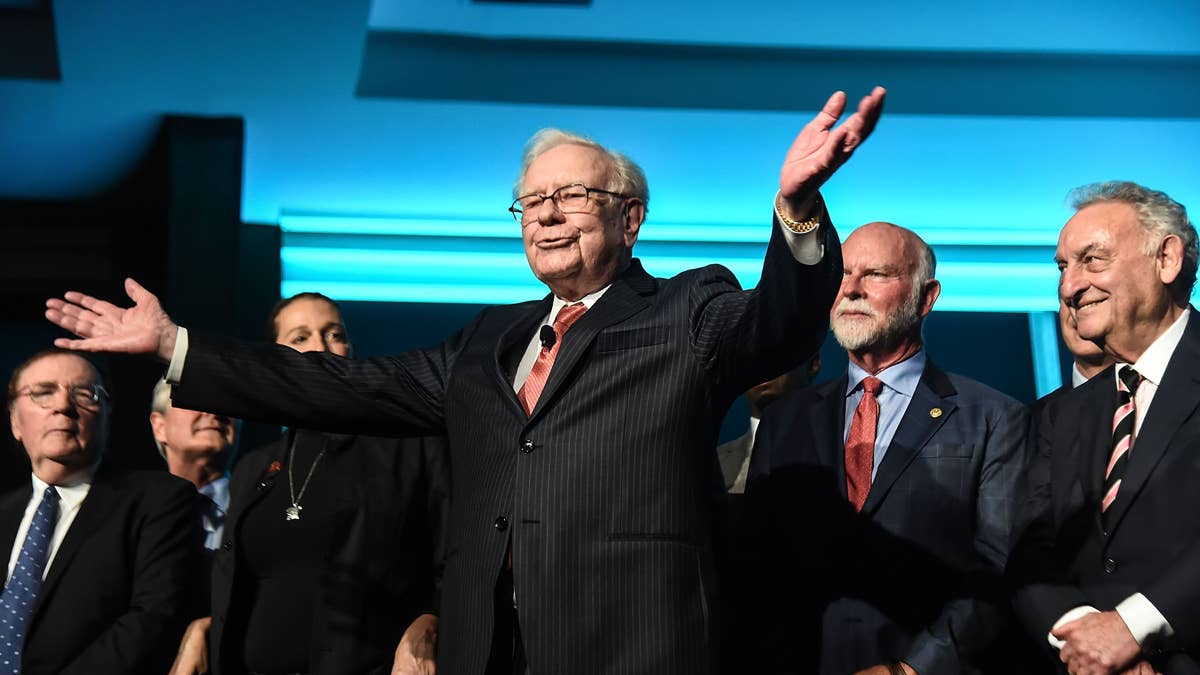
Daniel Zuchnik/WireImage
Buffett reveals Alphabet was his call
Warren Buffett ended speculation that Berkshire’s growing stake in Google’s parent company, Alphabet (GOOGL), was mainly current CEO Greg Abel’s attempt to reshape the company’s portfolio.
More Tech:
- Microsoft may be done making Xbox cheap
- IBM handed two major wins within 24 hours
- SpaceX’s 32% crash may force Musk into radical move
“I normally wouldn’t give you an answer on something like that,” Buffett told CNBC, before confirming that he initiated the investment. Still, he stressed that Abel is now “the decider” and that neither man makes major moves that the other opposes.
The stake, which Berkshire began building in Q3 2025, has grown to more than $31 billion following a recent $10 billion private purchase.
Buffett framed the decision through the same lens that has effectively guided Berkshire over the years: buy a strong business on sensible terms and let its economics compound.
“The important thing is to buy a good business,” Buffett said, defining that as one capable of earning high returns on capital over an extended period.
Alphabet’s tremendous AI spending has switched up its financial profile, but Buffett sees endurance behind the rising capital requirements. He said the company is “more likely to be a winner” than 90% or 95% of what Wall Street promotes.
Yet Buffett stopped short of calling Alphabet Berkshire’s best business. “I don’t like it as well as at least four or five other businesses that we own,” he said.
The investment, therefore, feels a lot like Buffett applying his principles to a company once considered outside his comfort zone.
His final test was characteristically simple: “It’s not a question of whether it was wonderful yesterday. It’s the question, how long is it going to be wonderful?”
Alphabet quickly becomes a major Berkshire holding
According to Reuters, Berkshire Hathaway began building its position in Alphabet, Google’s parent company, during Q3 2025.
It disclosed 17.85 million Alphabet shares as of Sept. 30, a stake valued at about $4.93 billion when it was revealed in November.
The investment grew at a breathtaking pace. Morningstar reported that Berkshire bought another 36.4 million Class A shares and established a 3.6 million-share Class C position during Q1 2026.
Moreover, Berkshire’s SEC filing shows it held roughly 57.8 million Alphabet shares, valued at approximately $16.6 billion as of March 31. Based on the filing values, Alphabet is Berkshire’s sixth-largest U.S.-listed stock holding, representing about 6.3% of its $263.1 billion 13F portfolio.
Morningstar notes that Berkshire’s broader stock portfolio, including foreign investments excluded from its 13F, was worth $312.6 billion. Within technology, Alphabet ranked second only to Apple, which remained Berkshire’s largest overall holding at roughly $57.4 billion.
Later, Bloomberg reported that Berkshire’s publicly traded stake in Alphabet had jumped to approximately $21 billion by July 14. Berkshire also committed another $10 billion through a private placement, bringing its combined Alphabet exposure to roughly $31 billion.
Alphabet’s economics fit Berkshire, but AI tests the thesis
A massive bet on Alphabet stock looks rather unconventional alongside Coca-Cola, American Express, and BNSF, but its economics resemble those of what Berkshire Hathaway traditionally buys.
What Berkshire’s looking at as per its latest shareholder letter are understandable businesses with durable advantages, long-term prospects, owner-minded management, and enough conviction to justify concentrated, patient ownership.
To be fair, Alphabet delivers much of that.
In Q1, the company posted sales that shot up 22% to $109.9 billion, and its operating margin expanded to 36.1%.
Search revenue grew 19%, while Google Cloud revenue surged 63% to $20 billion, and operating income reached $6.6 billion. Moreover, the tech giant also held $126.8 billion of cash and marketable securities.
However, the strain that AI is putting on its business is immense.
Alphabet generated $45.8 billion in operating cash during the quarter but spent $35.7 billion on property and equipment, resulting in $10.1 billion in free cash flow. Moreover, like many of its Big Tech peers, it has raised its 2026 capital spending guidance to $180 billion to $190 billion.
Buffett’s broader view of AI, though, remains cautious.
He described the technology as offering tremendous potential for both good and harm and warned that it could accelerate fraud. Yet he told CNBC that hyperscalers now have little choice but to spend heavily.
On top of that, Morningstar reports that Berkshire’s balance sheet limits the cost of being early. Its insurance and other businesses held $373.5 billion in cash and Treasury bills as of March 31, versus $305.7 billion in equity and fixed-income securities. Berkshire says that cash is dry powder, not exactly a retreat from investing.
Related: Microsoft CEO adds fuel to Palantir CEO’s AI warning