In any competitive market, there comes a time when the field thins out. When that happens, of course, the strongest players quietly start doing the math.
That moment is slowly arriving for T-Mobile US Inc. (TMUS). In the span of a few weeks, two of its rivals have made moves that could reshape the wireless landscape in ways that directly benefit the Un-carrier. One filed for bankruptcy. The other is selling off hundreds of stores.
T-Mobile CEO Srini Gopalan called Q1 2026 “a strong start to the year” in a company statement.
And that was before either development fully played out. Now, with fewer competitors fighting for the same customers, the question isn’t whether T-Mobile has an opportunity but how large that opportunity turns out to be.
Dish Wireless bankruptcy ends Project Genesis and shrinks T-Mobile’s competition
The first domino fell on June 30, according to TheStreet. Dish Wireless and its parent, Dish DBS, filed for Chapter 11 bankruptcy protection, according to court filings reviewed on PacerMonitor.
The trigger was a delayed spectrum sale to AT&T — a $23 billion deal covering Dish’s 3.45 gigahertz and 600 megahertz airwaves. That left EchoStar unable to meet roughly $2 billion in senior secured notes that came due July 1, according to Reuters.
The bankruptcy eliminates Project Genesis, the flat-rate wireless plan Dish launched in 2022 to compete directly with T-Mobile (TMUS), AT&T (T), and Verizon (VZ). Customers had been promised a $30-per-month unlimited phone plan and a $20-per-month hotspot plan for life. Service ends Aug. 31, according to TheStreet.
More T-Mobile:
- T-Mobile puts new limits on 2 wireless offers for customers
- Top wireless stock remains Wall Street favorite amid space risk
- T-Mobile faces backlash over new customer support restriction
“Holders of more than 88% of DISH DBS’s secured and unsecured notes have signed the (restructuring support agreement) and have agreed to support the Plan,” EchoStar said in a company statement.
Under the plan, Dish Wireless winds down as a network operator. Boost Mobile and Gen Mobile prepaid brands continue operating. DISH TV and Sling TV are not part of the filing.
I think the practical effect for T-Mobile is this. The U.S. wireless market now has three primary national carriers instead of four — T-Mobile, AT&T, and Verizon.
With one competitor willing to undercut on prices, analysts say the remaining players have more room to adjust rates without triggering a race to the bottom.
Verizon’s 274-store retreat hands T-Mobile a retail opening it didn’t have to create
The second development landed almost simultaneously.
Verizon announced plans to sell 274 company-owned retail locations to franchise operators and eliminate roughly 500 corporate positions, affecting approximately 3,000 workers nationwide, according to TheStreet.
The restructuring follows more than 13,000 layoffs Verizon executed last year as it battles intensifying competition on price and network quality. Verizon is not closing these stores. No, it is converting them from corporate-run to franchise-operated. That distinction matters, but it still creates a window for T-Mobile.
Related: Comcast targets frustrated T-Mobile customers with free offer
Here’s why. Franchised or authorized retailer locations historically face higher employee turnover, inconsistent promotional execution, and variable customer service standards compared to corporate-run stores.
The transition period, when staff are changing, training is incomplete, and branding consistency dips, is exactly when customers are most likely to reconsider their carrier.
Also Read: T-Mobile US Inc. Latest News and Stories
Here is what else I found. T-Mobile added more than one million net postpaid subscribers in recent quarters, according to company data, compared to Verizon’s far more modest growth.
A disrupted retail footprint at a key competitor gives T-Mobile’s corporate stores and its T-Life app ecosystem a chance to intercept that foot traffic directly.
T-Mobile also tends to move aggressively during rival restructurings, offering device buyouts and plan discounts timed to when competitor customers feel the most uncertainty.
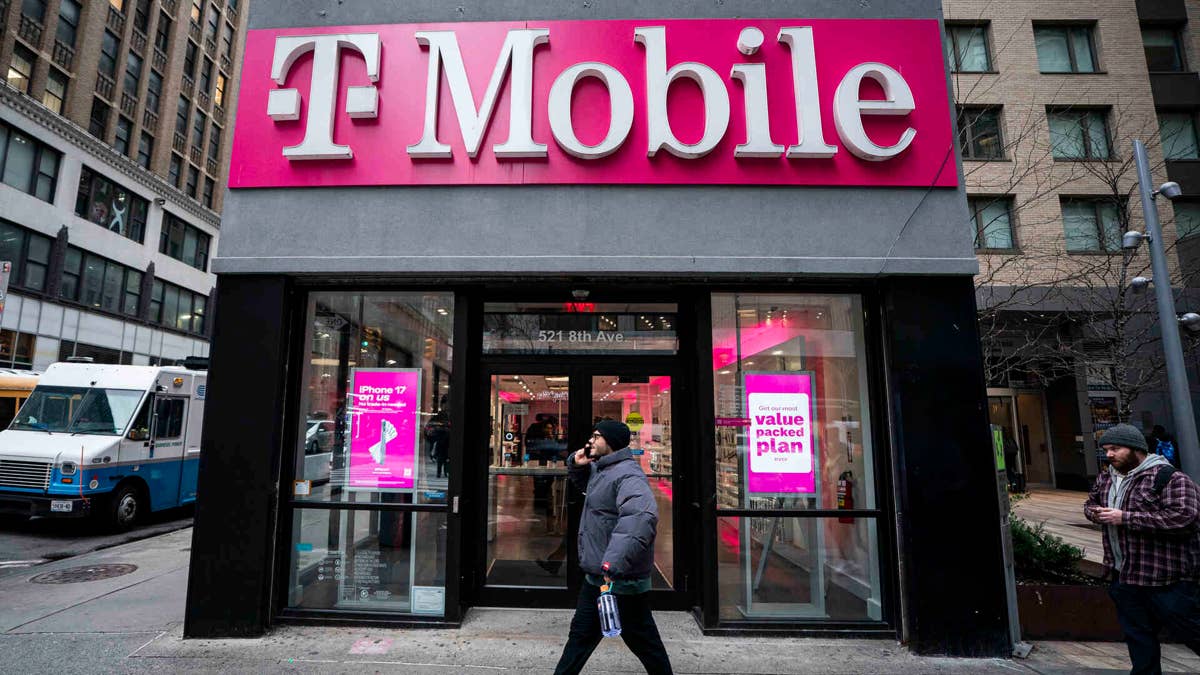
T-Mobile Q1 2026 earnings show the machine is already running at full speed
Before either of these competitive shifts materialized, T-Mobile was already posting strong numbers.
According to a company statement, key Q1 2026 numbers I noticed included:
- Total service revenues of $18.8 billion, up 11% year-over-year (YoY)
- Postpaid service revenues of $15.6 billion, up 15% YoY
- Core adjusted earnings before interest, taxes, depreciation, and amortization (EBITDA) of $9.2 billion, up 12% YoY
- Adjusted free cash flow of $4.6 billion, up 5% YoY
- Postpaid net accounts of 34.44 million, with 217,000 net additions in the quarter
The company returned $6.0 billion to shareholders in Q1 alone — $4.9 billion in buybacks and $1.1 billion in dividends — and subsequently raised its 2026 total return authorization to a maximum of $18.2 billion, according to a Verizon statement.
But net income dipped about 15% to $2.5 billion. That decline was driven by $476 million in merger-related costs tied to the UScellular integration. It’s a one-time drag, though, not a structural one.
TMUS stock trails the market this year, but the competitive setup is shifting
But there’s a little tension in the T-Mobile story right now. Despite the strong fundamentals and improving competitive position, TMUS shares are down about 4.25% year-to-date as of July 17, according to Yahoo Finance.
That number is trailing the S&P 500‘s roughly 8.94% gain over the same stretch. Over one year, the stock is down approximately 13.64%, compared to the index’s roughly 18.43% return.
Related: T-Mobile shuts down a 35-year-old wireless service
That underperformance is notable, yes. But it also creates an interesting setup. My review of the data suggests the market has been pricing T-Mobile more as a mature utility than as a growth platform actively taking share from weakening rivals.
The Dish bankruptcy and Verizon’s franchise shift is highly likely to change that calculus. A three-player national wireless market gives the remaining carriers more pricing power.
T-Mobile, with the largest 5G network and faster fixed wireless home internet speeds than any peer, according to Ookla data cited in the company’s Q1 report, enters that dynamic from a position of strength.
TMUS shares will reflect that opportunity in the months ahead, depending on how quickly customers in transition land on T-Mobile’s doorstep. The door is open, and the foot traffic is coming.
Related: T-Mobile retires several cheaper wireless plans for customers