After quietly shrinking its retail footprint over the past year, one of the nation’s largest office supply chains is set to close more stores in August, extending its ongoing effort to adapt to changing consumer demand.
As online shopping grows in popularity and digital tools replace many paper-based workflows, retailers focused on workplace products have been forced to rethink their physical footprints. Rising operating costs and an uncertain economic environment have only accelerated that shift.
Founded in 1986 in Brighton, Massachusetts, Staples grew into one of the country’s largest providers of office supplies, expanding to more than 900 U.S. stores.
Today, however, demand for traditional workplace essentials has weakened as consumers and businesses increasingly rely on digital tools and online purchasing.
Staples is closing more stores
Staples will close two locations across two states in August 2026, according to local reports by the Santa Barbara News-Press and Greater Long Island.
The affected stores are:
- Goleta, California: 7015 Market Pl Dr, closing after more than 27 years.
- Levittown, New York: 2981-2991 Hempstead Tpke, closing after more than 15 years.
The Goleta closure marks the end of Staples’ presence in Santa Barbara County, while the Levittown shutdown leaves the Long Island suburb without a Staples store. Despite the closures, Staples still operates approximately 114 locations in California and 64 in New York.
Recent Staples store closures
The latest closures continue Staples’ broader consolidation strategy.
According to ScrapeHero, Staples’ U.S. store count declined from 929 locations in October 2025 to 916 by January 2026, a net decrease of 13 stores in just four months.
Store shutdowns have continued throughout 2026, according to Usearch data, including:
- Astoria, New York: 24-41 31st St
- Bayside, New York: 209-34 Northern Blvd
- Waterville, Maine: 40 Waterville Commons Dr
- Frederick, Maryland: 5557 Urbana Pike
- Chicopee, Massachusetts: 591 Memorial Dr
- Whitehall Square, Pennsylvania: 2180 MacArthur Rd
Those closures are part of a long-running effort to streamline Staples’ store network as the office supplies market undergoes structural change.
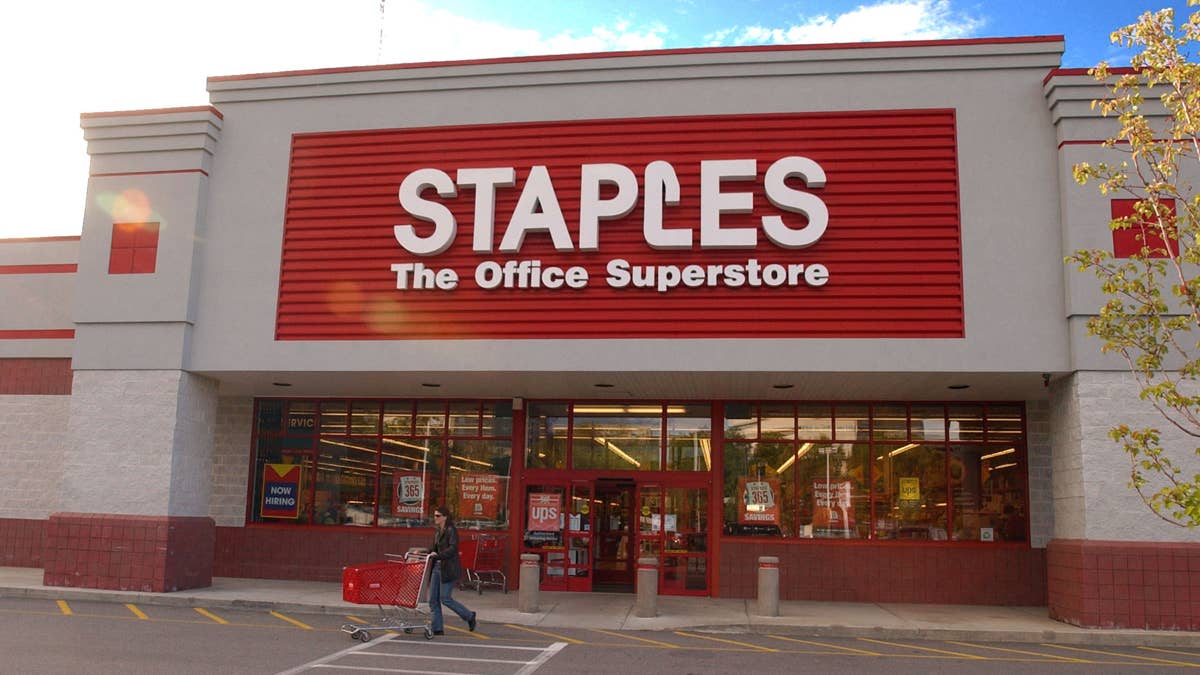
Why Staples is closing stores
Staples’ challenges have been building for more than a decade as consumer purchasing habits shifted away from traditional office supplies and toward digital solutions and online shopping.
Former Staples CEO Ron Sargent acknowledged as early as 2014 that customers were buying fewer office products while increasingly shopping online, making it harder for stores to generate higher-margin add-on sales, according to reporting by The Motley Fool’s Dan Caplinger.
The company responded by announcing plans to close about 225 stores by 2015 as part of a cost-cutting effort expected to save $500 million.
That same year, Staples attempted to acquire Office Depot, but federal regulators blocked the merger over antitrust concerns. Following the failed deal, the company increasingly shifted its focus from traditional retail stores to business-to-business services.
The company’s transformation accelerated in 2017 when private equity firm Sycamore Partners acquired Staples for $6.9 billion. The buyout was heavily debt-financed and followed by a $5.4 billion refinancing in 2019.
The firm’s management has since faced scrutiny. Sycamore Partners paid itself a $1 billion dividend shortly after the acquisition, allowing the firm to recover roughly 80% of its initial investment in less than two years, according to Bloomberg.
While Staples’ ownership structure has changed significantly over the past decade, the company is also navigating broader shifts that continue to reshape demand across the office supplies industry.
A changing office supplies market
Staples’ shrinking retail footprint reflects broader changes affecting office supply retailers nationwide, where demand for traditional products has softened as digital workflows and e-commerce continue to reshape purchasing habits.
Circana projects the U.S. office supplies market will generate $11.1 billion in sales in 2026, representing a modest 0.1% decline, while unit sales are expected to fall 2.8%.
The research firm expects the industry to continue “rightsizing” through 2028 as growth remains concentrated in select product categories.
“E-commerce continues to gain share, hybrid work trends are shifting some commercial purchases into retail channels, and third-party marketplaces are expanding their influence,” said Circana Executive Director and Consumer Technology Industry Analyst Ben Arnold. “Investments in technology and AI are diverting traditional office supplies budgets.”
According to WifiTalents, online purchasing now accounts for 28% of industry revenue, while mobile apps generate 72% of business-to-business orders, highlighting how shopping behavior continues to move away from traditional brick-and-mortar stores.
IBISWorld also expects continued pressure on the sector as retailers contend with declining demand, digitalization, and intense competition. The firm projects industry revenue will total $20.9 billion in 2025, down 1.8% from the previous year, extending a five-year compound annual growth rate of -4.0%.
Here’s some of my previous coverage of store closures:
- Popular beverage chain closing multiple locations nationwide
- Major grocery chain resumes store closures in 2026
- Convenience store giant sells stores, exits market
Despite the long-term headwinds, Arnold said the industry still has areas of resilience.
“Current shifting dynamics are fundamentally reshaping both retail and commercial demand for office supplies,” said Arnold. “While digital adoption continues to accelerate, there remains strong interest in tactile, creative, and analog solutions. The essential role of office supplies — particularly during key seasonal moments — continues to support the industry’s resilience.”
As the office supplies market continues to evolve, Staples appears poised to further refine its store network while investing in commercial services and digital channels that are expected to play a larger role in its long-term growth.