“Are you saying that a lot of this kind of really expensive fine art is a scam?” I asked him in a recent podcast interview.
“Yes,” Chougar said, flatly.
“Why?”
“Because the gallerist and many artists understand this,” he said. “People like to be unique and they want unique things. They want to have beautiful art. But when the artist is creating a lot and produced in China as industrial stuff, we are in manufacturer and industry. We’re not on the wall. Really handmade artworks, they make a lot. And the galleries are communicating, oh, you will see the price will grow, but it will never grow because it’s so cheap. It’s in plastic and so much, there is no value behind that. And that’s the main scam of the artwork now. Sorry guys. Sorry the artist, sorry the galleries. But I need to tell the truth.”
What the numbers say about art prices
The market data tells a more specific version of that story. The global art market shrank 12% in 2024 to $57.5 billion and edged up only 4% to $59.6 billion in 2025, according to the Art Basel and UBS Global Art Market Report compiled by economist Clare McAndrew. Growth, where it exists, is concentrated at the very top: Knight Frank’s 2025 Wealth Report found broad art values fell 18.3% over the year while blue-chip works priced above $10 million rose 4%. The market is also lopsided by artist, with roughly 11% of artists generating 58% of dealer sales, per the Art Basel and UBS data. In other words, the “price will grow” promise Chougar describes holds mainly for a narrow tier of trophy works, not the mass-produced pieces he dismisses.
Chougar calls himself “a mix of artist, musician and also businessman,” and, more colorfully, “a cultural spy” who says he’s been invited into “many hidden world.” He’s shown work at Art Basel Miami, exhibited in Ibiza, and says his client list runs through people who run banks and monetary systems. On one trip to Miami, his team left an entire body of new work behind in New York; he says he painted a replacement set overnight and sold it the next day for thousands of dollars.
Asked how much of the market is really about speculation rather than appreciation, he didn’t hedge: “Most of the art collector are really crazy and also really smart. They understood that the artworks can travel through the borders very easily. It’s a financial tool. When you are taking only the dimension of finance, you can invest, you can speculate, and it’s also a key for money laundering, the tax and many other dimensions that most of the citizens around the world didn’t understand.”
That’s a claim about the industry’s plumbing, not a confession. When I followed up and asked directly whether his own clients buy art with dirty money, Chougar didn’t answer it. “Okay, can I, how many? Question right here. How many of them do you need to name? Do your work. Let’s call the FBI or Interpol directly,” he said, laughing it off. “We don’t need an answer on that.”
Chougar isn’t the only one making that argument. A 2020 Senate investigation found the high-value art market an attractive vehicle for laundering and sanctions evasion, and found the major auction houses’ voluntary compliance checks generally vetted the dealer in a sale, not the actual buyer behind the money. The $25 billion U.S. art market is still one of the only major markets exempt from the Bank Secrecy Act, though a bipartisan Art Market Integrity Act introduced last year would change that. “The art market is an ideal playing ground for money laundering,” Thomas Christ, a board member of the Basel Institute on Governance, told the IMF’s Finance & Development magazine in 2019, calling for “clear transparency, where you got the money from, and where it is going.”
Scarcity, fakes, and the Salvator Mundi problem
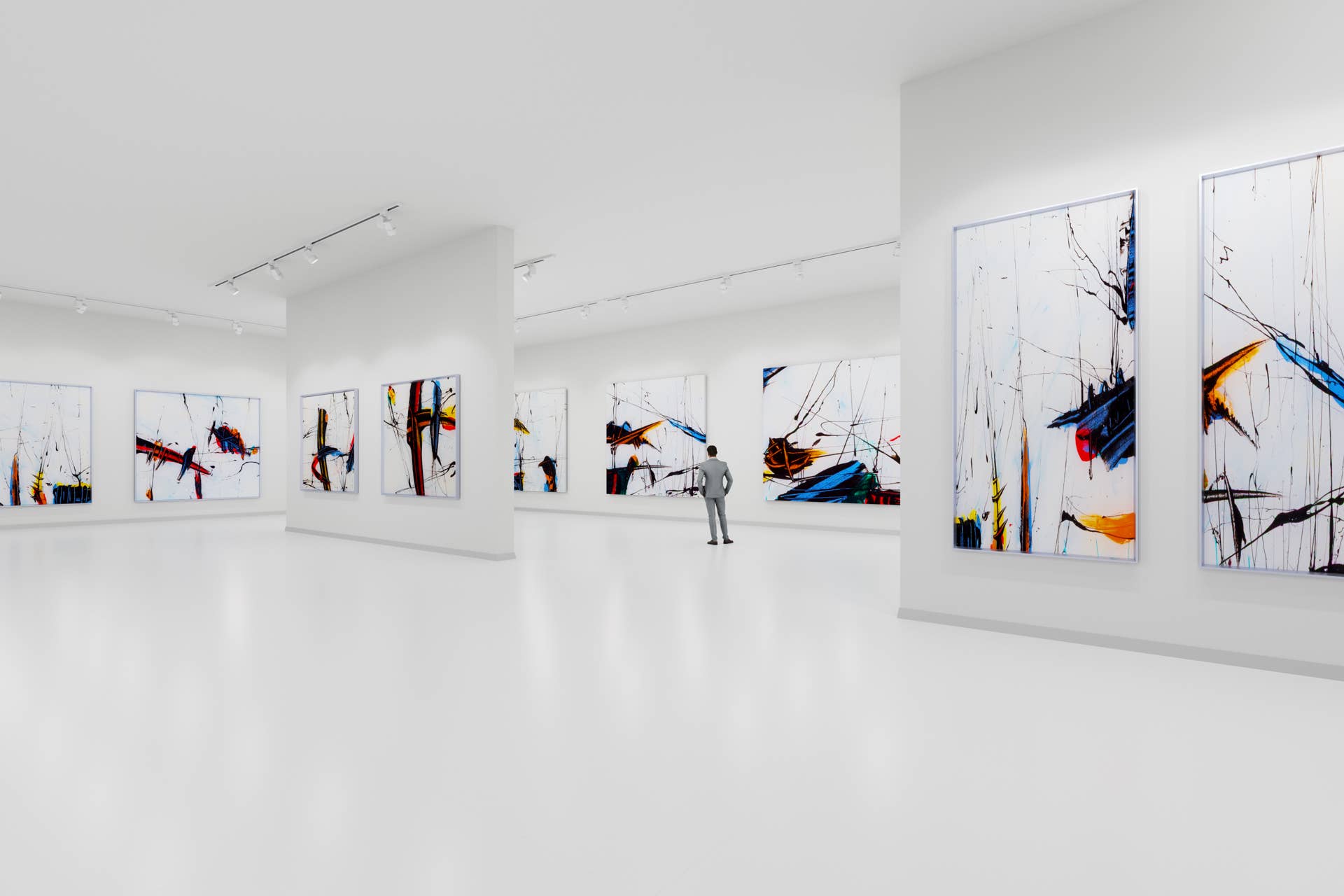
He argues real value in the market comes from the opposite of what most collectors think they’re buying: not creativity, but scarcity that can never be replenished. “The artist is dead. The number of art is very limited,” he said. “But in all of the time of the world, there is more and more people, more and more collectors, and in front of that we have more and more money. When you have these two components, that is a high demand and there is a high volume of money, then the price will grow directly. There is no more supply of art, it’s a limited edition, and then the price will naturally grow.”
He said the market also quietly tolerates fakes once demand outruns what a dead artist actually produced. “There is a very strong demand on the masterpieces and many fake maker of art enjoy this part,” he said. “It’s kind of like other industries around the world. Food. That is fake food. There is many scams around it. It’s a part of the industry.” He said even major museums privately question pieces worth “many millions” in their own
collections, pointing to what he called the highest-selling painting in the world, bought for roughly $150 million by a buyer tied to the Saudi royal family. “The people think it’s fake, one,” he said. “Or maybe it’s authentic one. They don’t know.”
His number was off, but the example holds up. Christie’s sold Leonardo da Vinci’s “Salvator Mundi” for $450.3 million in 2017 to an intermediary later traced to Saudi Arabia’s crown prince. It hasn’t been exhibited publicly since, its whereabouts unconfirmed, and its authenticity still hasn’t settled: the Prado museum in Madrid downgraded its own assessment of the attribution years after the sale. Nobody had to be lying for the world’s most expensive painting to vanish from public view with its own authentication still in dispute.
What actually separates the billionaires
Asked what actually separates the billionaires and bank executives he says he now moves among from everyone else, Chougar didn’t point to talent. “There is many ways to be successful for me,” he said. “That is the family, that is the legacy, that is your ethnical parts.” Without that inheritance, there’s only one route: “Work, work and work. To really try to understand your business, but not only your business. It’s how your business is connected with other business around.” That logic, he said, is how an artist ends up invited to “drink wine” at an Aston Martin event in Monaco with strangers: “They see me as an opportunity. Because I can bring other point of view, other people, new network.”
He was just as candid about what he says the same world costs people. “When you have all what you want, prostitute, drugs, you couldn’t handle what people are made of,” he said, describing friends who didn’t make it out. “They are so beside themself. They kill themselves and they destroy themselves.”
He said he’s pulled back from the version of that life he lived in his twenties in favor of family, and increasingly, prayer. “Take the time to just connect with yourself and to understand who you are, how you are, and where you want to go,” he said. “When you are giving food to your soul, your soul is more stronger, and you really attract the opportunities.”
Whether that’s genuine spiritual practice or just a good sales pitch is, fittingly, the exact
question he raises about the paintings.
Related: Raymond James issues absurd price target for SpaceX stock