Every technology that eventually reshaped ordinary life spent its first years working as a salesman.
Sewing machines toured county fairs. Televisions sat in appliance store windows so crowds could gather on the sidewalk. The personal computer moved from hobbyist kits to shopping mall counters, where a clerk could talk a skeptical parent into one.
The pattern holds because the machine is rarely the hard part. Convincing people to want the machine is the hard part.
For about three years, the humanoid robot pitch has skipped that step. The story sold to investors has been industrial, built on aging workforces, unfilled warehouse shifts and machines that never take a break. Wall Street priced the category on labor replacement, which is why the forecasts keep arriving in trillions of dollars instead of units.
The awkward fact is that almost nobody outside a factory floor has ever stood next to one of these things.
That changes in a few weeks, and not because of Elon Musk. BYD (BYDDY) will unveil its first humanoid robot in early August at its Di Space experience venues, according to CnEVPost.
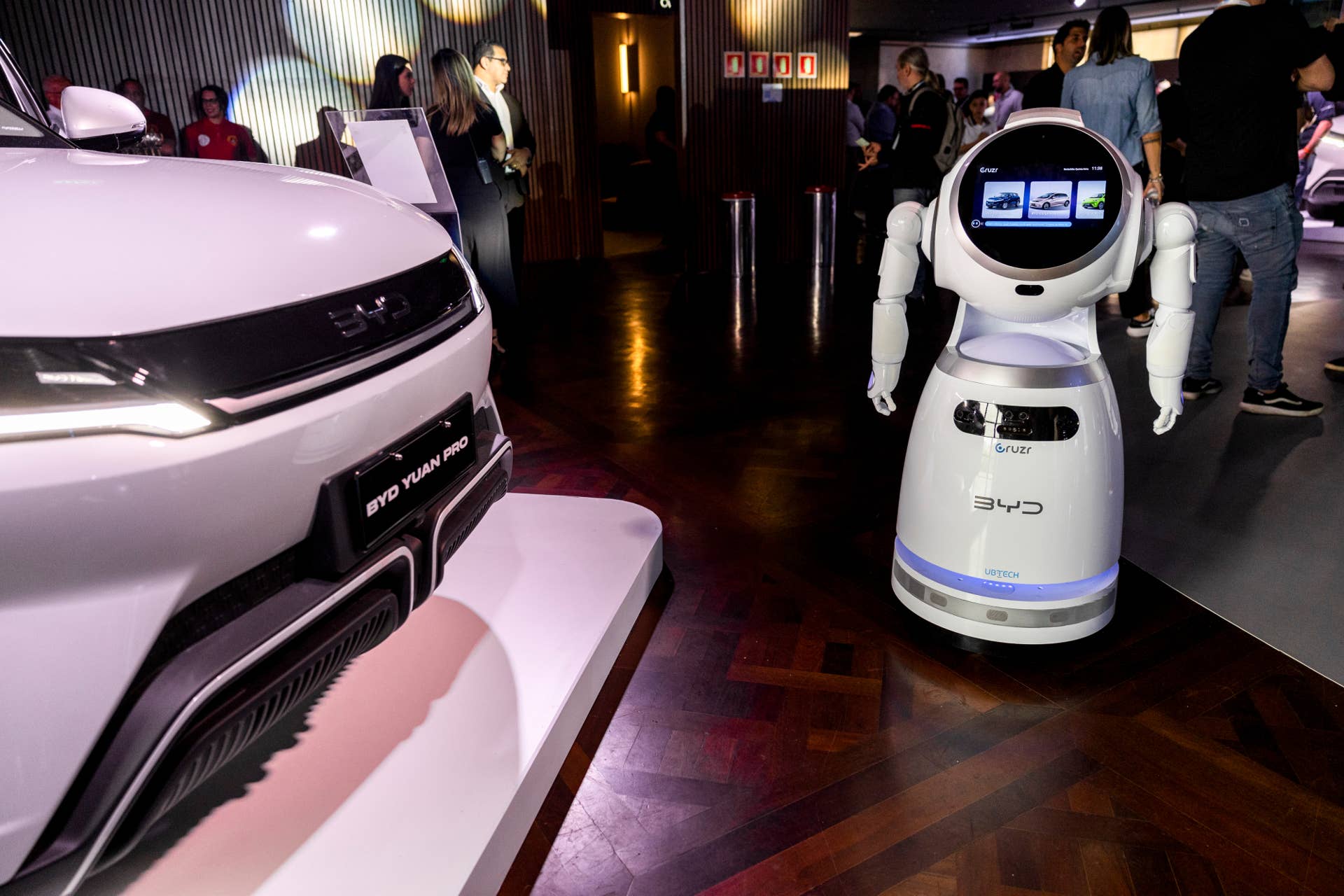
The first assignment is not a production line. It is a car showroom.
Why the humanoid robot race runs through China
The number that pulled capital into this category came from Wall Street, not from any robot that works today. The humanoids market could pass $5 trillion by 2050, with more than 1 billion units in use, according to Morgan Stanley Research.
About 90% of those units, roughly 930 million, would handle repetitive industrial and commercial work rather than anything you would recognize as a household helper.
Related: BYD’s Tesla win comes with a hidden warning
That same research came with a geographic warning. State backing for what the industry calls embodied artificial intelligence may be “far greater in China than in any other nation,” said Sheng Zhong, Morgan Stanley’s head of industrials research.
Chinese automakers treated that as an invitation. XPeng (XPEV) plans to start mass production of its Iron humanoid by the end of this year, and Chery’s Aimoga brand has already begun selling humanoids to consumers, according to CnEVPost.
Here is the scale investors are underwriting, by the numbers:
- The humanoids market could surpass $5 trillion by 2050, including supply chains and networks for repair, maintenance and support, according to Morgan Stanley.
- China is likely to have 302.3 million humanoids in use by 2050, against 77.7 million in the United States, according to Morgan Stanley.
- Only 80 million of those units are forecast to be in homes by 2050, according to Morgan Stanley.
- BYD delivered 557,090 battery electric vehicles in the second quarter, according to Electrek, against 480,126 for Tesla, according to The Motley Fool.
That volume gap explains the strategy. BYD sells more electric cars than anyone, and it sells them through a retail network it already owns.
What BYD plans to show off in August
The tease came from a WeChat account, which is its own comment on how this industry now works. BYD’s Di Space venue in Zhengzhou posted that “in early August, a new friend wants to meet you,” according to CnEVPost.
BYD later confirmed the unveiling to Chinese financial media but has not released a product name, a design or verified specifications, according to Benzinga.
The groundwork is older than the teaser. BYD set up a dedicated team in late 2024 to develop embodied artificial intelligence products, including humanoid robots, under its 15th Business Division, according to CnEVPost.
More Robots:
- Waymo shows it learned critical lesson from previous blackouts
- BMW doubles down on humanoid robots after a U.S. test run
- Tesla’s Optimus robot plan hits major snag
Executive Vice President Stella Li put retail at the front of the plan. “My goal is to place two or three robots in every dealership,” Li said, according to TechNode.
She expects robot sales advisors to be usable in real showrooms within one to two years. She also said robots cannot replace the emotional connection between a human salesperson and a customer, which is a strange thing to concede while ordering thousands of them.
What struck me when I mapped this against the rest of the field is how little the showroom job actually demands. A robot that explains a battery warranty does not need to lift 40 pounds, work a night shift or avoid injuring a coworker.
It needs to talk, point and hold a crowd. That is a far lower engineering bar than a factory, and it runs on a dealer network BYD controls, which turns every store into a demo stage and a data collection site at once.
How Tesla’s Optimus timeline compares
Tesla (TSLA) is attacking the same market from the factory side, and the pace has been slower than the rhetoric.
Construction at the Fremont factory for Optimus began after the company decommissioned its Model S and Model X lines, “with anticipated production later this year,” according to Tesla’s second-quarter shareholder update. Production had not begun as of the July 22 call.
Musk has pointed public sales at the end of 2027. Tesla also has to invent the supply chain as it goes, because almost nothing in an Optimus carries over from a car, and the demand question is separate from the engineering one.
That is the split worth watching. Tesla is trying to build a general-purpose worker and sell it to the world. BYD is trying to build a specialist greeter and place it in buildings it already pays rent on.
My analysis is that the second path produces public proof much sooner, and public proof is what moves a robotics narrative from slide deck to revenue line. It also produces something Tesla cannot buy quickly, which is thousands of hours of unscripted human interaction recorded in a controlled space.
What the robot race means for your portfolio
Strip away the trillion-dollar forecasts and one thing is clear about the next few years. The first humanoid robot most people ever meet will not be building a car or folding laundry in a kitchen.
It will be standing beside a vehicle they are thinking about financing, and its job will be to make them feel something about the brand.
That matters for anyone holding an automaker, a chip supplier or a robotics exchange-traded fund, because retail deployment is where consumer comfort gets manufactured. The company that normalizes these machines gets to set the price expectation for every machine that follows.
Two questions decide whether August is a milestone or a marketing stunt. Does the unit move and speak without a handler standing offstage, and do BYD’s dealers actually want it in the room.
Watch the second one more closely than the first. Engineering problems get solved on a schedule. A showroom manager who decides the robot scares customers away is a problem no amount of capital expenditure fixes, and that verdict arrives long before anyone ships a million units.
Related: China’s BYD sets audacious goal: Overtake Toyota by 2030