Whether it’s regulators or industry experts, the consensus about Lidar seems to be that Level 4 autonomous driving platforms are incomplete without it.
Tesla is not part of that consensus, as CEO Elon Musk has called light detection and ranging driver-assistance an “expensive and unnecessary” fool’s errand, just “expensive hardware that’s worthless on the car.”
But Waymo, which has the most extensive autonomous driving network as well as the most miles driven autonomously, says that any robotaxi system that isn’t using Lidar isn’t operating at its full potential.
“There has been a long-standing debate about what kind of sensors you actually need for autonomous driving. Naturally, more sensors means higher performance, but it also means higher complexity,” Waymo co-CEO Dmitri Dolgov said this week during his Y Combinator keynote.
“So humans, of course, can drive with just eyes,” Dolgov continued. “And if the goal was to just approximately match human performance or to build an assist product, then that is a very reasonable way to go. However, if you are targeting full autonomy and you’re targeting strongly superhuman performance, you find that weak sensing just leads to a safety curve that flattens out way too early.”
Waymo vehicles use three different sensing modalities in their robotaxis: radar, Lidar and cameras.
Meanwhile, Tesla uses just one: cameras. And though Dolgov never mentioned his top rival, it was clear who he was referring to during his speech.
Why are camera-only robotaxis insufficient?
SAE International (formerly the Society of Automotive Engineers) considers advanced driver assistance systems, such as GM Super Cruise and Tesla Full Self-Driving, to be Level 2 automation, which requires the driver to remain engaged.
Anything Level 3 and above is considered truly “autonomous.” This means no human intervention is required when the system activates features such as lane assist and automatic braking. However, the system must be enabled by a present driver who must take over when asked. J.D. Power lists Mercedes’ Drive Pilot as a Level 3 system.
Waymo and Tesla Robotaxi operate on Level 4, but according to Dolgov, Robotaxi’s camera-only approach leaves some big holes in its safety profile.
Related: Waymo vs. human drivers: Experts reveal which is safer
“Cameras give you high resolution in color. But they are passive, and they degrade in darkness and glare,” Dolgov said. “Lidar and radar are active sensors, so that means they see just as well in pitch darkness or, for example, when driving into a blinding sunset.”
Waymo’s three-pronged sensor stack includes radar, Lidar and cameras, and Dolgov says those three systems working in tandem help make Waymo safer than some competitors.
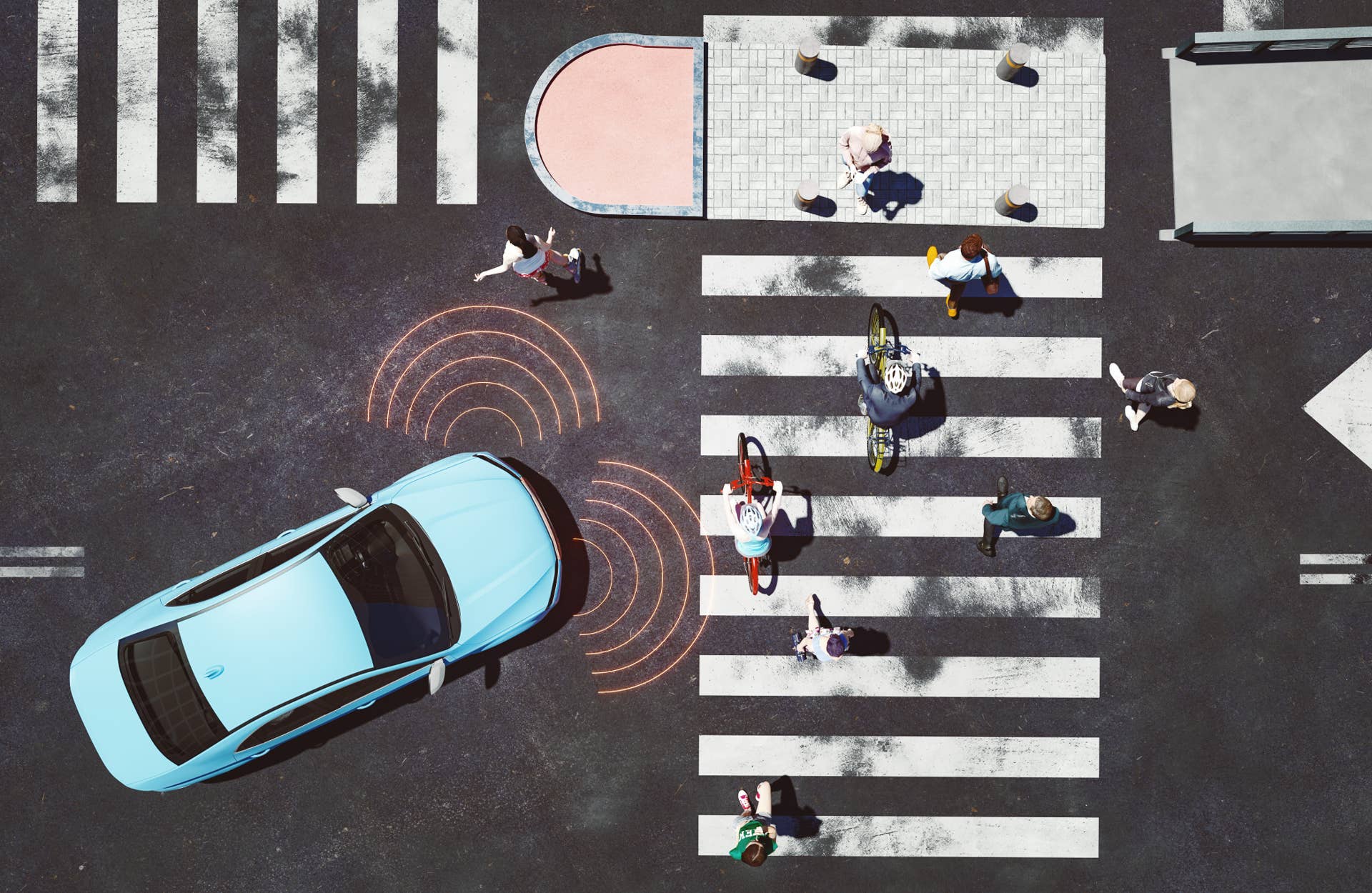
“Lidar gives you a direct measurement of the 3-D structure of the world around you. Radar is good at punching through environmental conditions,” Dolgov said. “In our stack, each modality has an encoder, and the information from each of those sensors gets fused into a single view of the world around you that is much more precise and generally vastly superior to what you get with any one sensor.”
He went on to show a video of a Waymo travelling down a foggy street with side-by-side images of the HD camera and Lidar systems working in tandem. The camera misses a pedestrian standing on the side of the road that the Lidar sees clearly.
NHTSA opens ‘engineering analysis’ into Tesla FSD cameras
Earlier this year, the National Highway Traffic Safety Administration’s Office of Defects and Investigations announced that it was escalating its investigation into Tesla FSD by opening an “engineering analysis” to evaluate Tesla Vision’s “degradation detection system.”
In layman’s terms, the NHTSA is investigating how much camera visibility is degraded by roadway conditions such as glare and airborne obstructions, and whether Tesla FSD (Supervised) can detect and adjust to the resulting degradation and still work safely.
“Available incident data raise concerns that Tesla’s degradation detection system, both as originally deployed and later updated, fails to detect and/or warn the driver appropriately under degraded visibility conditions,” the NHTSA said.
More Tesla:
- Tesla sales rebound hides costly problem for investors
- Tesla record revenue masks cash burn, $1B SpaceX swing
- Elon Musk, Tesla and SpaceX face serious questions from investors
The agency has identified nine crashes in which it says Tesla FSD’s degradation systems may not have been functioning properly. It says FSD “did not detect common roadway conditions that impaired its visibility and/or provide alerts when camera performance had deteriorated until immediately before the crash occurred.
And there could be many more instances that the agency does not know about because their review of Tesla’s responses to its request for more information revealed: “additional crashes that occurred in similar environments and where the system either did not detect a degraded state, and/or it did not present the driver with an alert with adequate time for the driver to react.”
While Tesla FSD isn’t the same as Tesla Robotaxi in terms of its capabilities, both systems rely solely on cameras to function.
Tesla explains why it does not need Lidar
While the NHTSA directly lists the lack of radar as a possible component in these crashes, Tesla says the system is unnecessary.
Most experts consider a light detection and ranging driver-assistance system to be the state-of-the-art technology. Tesla competitors like Toyota offer Lidar, in addition to the camera-based system that Tesla FSD uses.
Tesla Vision refers to the system and software that power the eight cameras on every Tesla vehicle, providing a 360-degree view of its surroundings. Tesla says the system relies on a neural network that allows it to bypass the need for radar assistance.
Lidar uses lasers to measure distances and create highly detailed 3D models of its surroundings. Autonomous driving company Zoox uses this tech, along with cameras, long-wave infrared sensors, and microphones, to map the traffic around it.
Related: Trump FCC gives Tesla a leg up in critical technology race