Everyone is familiar with the ironic saying, “You have to prove you don’t need money to get a loan.” But what happens when you have no money, no credit, and need a refrigerator today?
That’s when rent-to-own (RTO) or lease-to-own (LTO) businesses step in. Traditional banking wasn’t built on charity; it was designed as a profitable enterprise. The RTO model takes profit-seeking to a whole new level, however.
These operators regularly charge subprime consumers effective interest rates well over 100%, avoiding traditional credit caps because their contracts “do not trigger most states’ usury laws,” according to the Federal Trade Commission.
Yet, in a climate of persistent inflation and mounting consumer strain, even the ultimate lenders of last resort aren’t immune. Rent-A-Center, owned by parent company Upbound Group, recently confirmed another wave of store closures targeting underperforming locations.
Rent-A-Center quietly closes 69 underperforming stores
Rent-A-Center’s parent company, Upbound Group, reported on July 30, 2026, its second-quarter earnings results, revealing revenue of $1.2 billion, up 0.5% year over year.
“Adjusted EBITDA declined year-over-year to $127 million due in part to timing of marketing expenses at Brigit and higher fixed costs at Rent-A-Center,” said Upbound CEO Fahmi Karam during the earnings call.
The company also provided results separately for each business segment it owns, including Rent-A-Center, which Upbound Group defines as a “durable, resilient rent-to-own business model proven through 50+ year operating history.”
Rent-A-Center, which runs some 2,100 stores in the U.S., Mexico, and Puerto Rico, recorded $466 million in revenue for the second quarter of 2026, flat compared to the same period of 2025. The business’s adjusted EBITDA declined 8% year over year to $63 million.
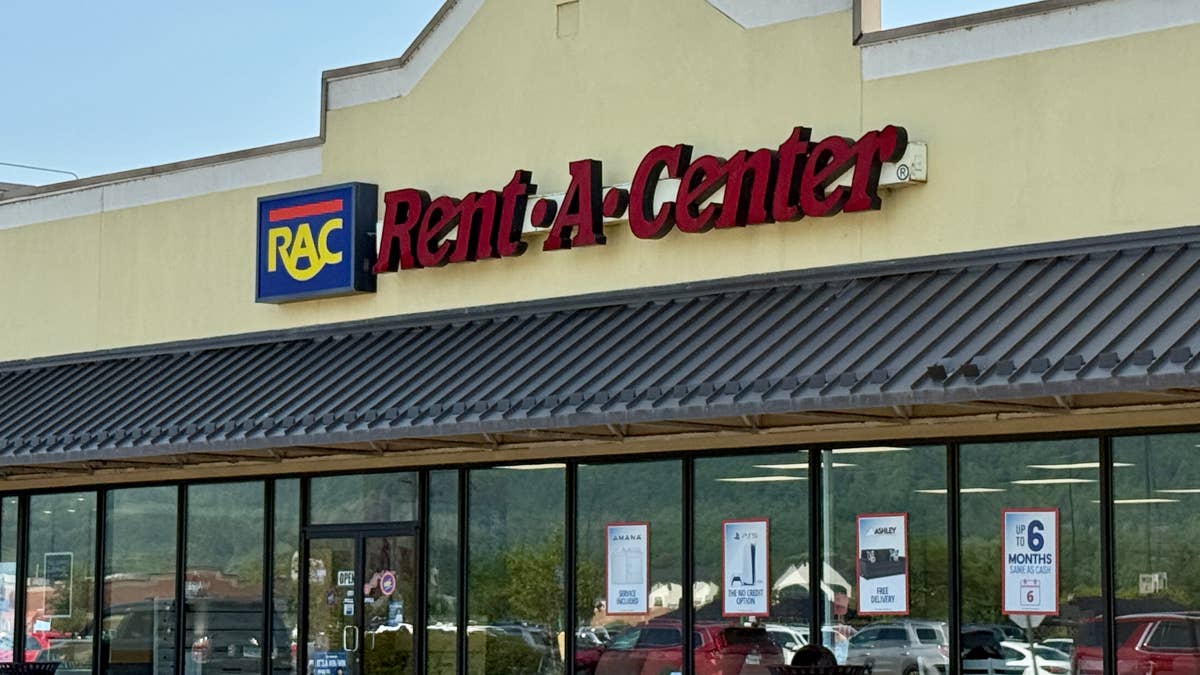
Moreover, during the quarter, the company confirmed it has closed 69 underperforming Rent-A-Center locations.
“These initial optimization efforts led to 69 underperforming store closures in the second quarter, with customer accounts being merged into nearby locations,” stated Karam.
Why Rent-A-Center closed close to 70 locations in Q2
According to the earnings call transcript, the closure of 69 underperforming Rent-A-Center stores was part of a company-wide initiative focused on operational optimization, store-level profitability, and leveraging digital capabilities to right-size its physical footprint.
Karam highlighted that Rent-A-Center achieved year-over-year same-store sales growth for the third consecutive quarter and that it prioritizes portfolio quality, enhancing customer experience, and store-level profitability.
“Against this backdrop, we have begun a Rent-A-Center-wide optimization effort to ensure the brand remains competitive in today’s environment, with the objective to drive efficient operational performance and enhance long-term returns,” he said.
The CEO hinted that more closures may come, describing this as the “first phase of optimization” and saying the company will continue to evaluate its store count and seek to “boost profit contribution.”
Rent-A-Center has closed stores before
At its peak, in 2006, the Plano, Texas-headquartered company operated about 3,535 company-owned stores across the U.S., Canada, and Puerto Rico, including the stores acquired in the Rent-Way acquisition, according to official documents.
Since the company now operates 2,100 stores in the U.S. and Mexico, this means it has closed more than 1,400 stores over the past 20 years.
In 2007, the company unveiled a plan to close about 280 stores nationwide, projecting it would save $2 million to $2.5 million a month in operating expenses, as reported by Chain Store Age.
In 2017, Rent-A-Center closed around 166 stores, and in March 2018, the company eliminated 25% of corporate staff in cost-cutting measures. “Including general and administrative expenses, the [Rent-A-Center] layoffs are expected to produce roughly $28 million in annual run-rate cost savings, with about $20 million saved in 2018,” reported CNBC.
Rent-A-Center legal challenges
In addition to widespread economic challenges over its 53-year history, Rent-A-Center faced legal challenges from time to time.
For example, in 2022, California Attorney General Rob Bonta announced a $15.5 million lawsuit against Rent-A-Center for violations of state consumer protection laws relating to unlawful leasing practices and deceptive marketing.
“An investigation into Rent-A-Center’s ‘kiosk’ business that operates out of traditional retail stores found that the company used an inflated ‘cash price’ for products that was 15% higher than the retail price, potentially costing consumers hundreds of extra dollars, among other violations,” reads the press release.
Rent-A-Center was required to comply with certain injunctive terms to deter further misconduct, and pay $13.5 million in restitution to California consumers and $2 million in civil penalties.
“Rent-A-Center repeatedly relied on deceptive and unlawful tactics to pad its bottom line. Furnishing a home is expensive, and consumers often hope rent-to-own agreements will lessen the cost, not realizing the total price they pay will end up being much higher,” stated Attorney General Bonta.
Other Rent-A-Center legal challenges include:
- Consumer Class Action for Deceptive Overcharging ($13M): The U.S. District Court approved a $13 million settlement (Blair v. Rent-A-Center) covering consumers who were overcharged for household items in violation of California’s Karnette Act, according to Altshuler Berzon Court Approval Brief.
- FTC Anti-Competitive “Store Swap” Action: The Federal Trade Commission took action against Rent-A-Center, Aaron’s, and Buddy’s for making illegal anti-competitive agreements where the companies entered into anticompetitive reciprocal agreements with each other and other competitors, according to Federal Trade Commission’s official press release.
What consumers are saying about Rent-A-Center
There are a number of verified Rent-A-Center Reviews and Complaints published on the ConsumerAffairs website detailing high price multipliers, aggressive door-knocking by store reps when payments are late by 1 to 2 days, and customer service disputes.
The business has an average 2.1 stars rating out of five, based on 1,358 reviews.
“They are bad. They put payments on different accounts. You fall behind or are late they call and come to your house and threaten to call the cops on you. And then come take your stuff,” wrote Margaret.
Related: 64-year-old luxury giant closes at least 217 stores, plans more
Cristina shared their experience with a refrigerator. “I was supposed to have a refrigerator delivered today, then they changed their mind saying I had to submit another payment. They’re full of shit. Why change the payment amount after I had already submitted a payment. I don’t recommend Rent-A-Center to anyone.”
A number of reviews complained of overcharging for used furniture.
The Better Business Bureau has logged 1,490 complaints against Rent-A-Center in the last three years.
Some consumers shared their experiences and frustration on social media. For example, a thread on Reddit argues that the business is a “scam.”
The post received 1,4K upvotes, and the most-liked comment, written by user Skullfacebookseller, summed up the sentiment: “They make their money off desperate people and most likely end up with a repo.”
What consumers should know about rent-to-own models
“A banker is a fellow who lends you his umbrella when the sun is shining, but wants it back the minute it begins to rain,” goes the saying.
We can all relate to this humorous description, since banking is a cold business with clear rules.
However, many consumers may not know that rent-to-own centers don’t follow the same rules, because they don’t offer traditional credit loans.
“Because these installment contracts are structured as ‘rent-to-own’ rather than traditional credit financing, they do not trigger most states’ usury laws, even though their functional interest rates amount to well over 100%. At almost every turn, this $8.5 billion industry escapes regulatory oversight,” according to a 2020 dissenting statement from the Federal Trade Commission then-Commissioner, Rebecca Kelly Slaughter.
A number of industry experts have stressed the “overreaching nature of RTO contracts,” arguing the “unfairness and deception” of RTO transactions.
“First, RTO transactions are exorbitantly priced. Under most RTO contracts, the customer will pay between $1,000 and $2,400 for a television, stereo, or other major appliance worth as little as $200 retail, if used, and seldom more than $600 retail, if new. This means that a low-income RTO customer will pay 1.5 to 12 times what a cash customer would pay in a traditional retail store for the same household item,” according to the National Consumer Law Center (NCLC).
The bottom line is that RTO businesses are best for short-term emergency needs when traditional credit options are unavailable; however, they appear to offer the most expensive path to ownership.
Rent-A-Center’s recent downsizing doesn’t mean low-income shoppers have fewer emergency needs. Rather, it signals that after years of relentless inflation, subprime consumers’ budgets are breaking.
Equifax reported an 18.6% surge in subprime credit card originations and indicated that subprime delinquency rates are more than 10 times higher than those of prime borrowers. It seems that low-income households are simply running out of room to pay prices that are double, triple, or even higher than those at traditional retailers.
Related: Iconic outdoor retailer closes key store due to retail theft