Investors entered the hotly anticipated Q2 earnings season, questioning whether the enormous AI spending spree was becoming tough to justify.
AI hyperscalers have been shelling out billions on chips, data centers, and infrastructure. But investors have grown wary, looking for clearer evidence that those investments could translate into sales quickly enough to support their lofty valuations.
Now JPMorgan just reset its S&P 500 target on the back of a Q2 earnings season that challenged Wall Street’s biggest assumptions heading into the summer.
Strategist Dubravko Lakos-Bujas pointed to developments in corporate earnings and AI investment as critical to the bank’s reassessment, marking a notable shift from the concerns it carried over from the previous reporting season.
What changed in JPMorgan’s S&P 500 outlook?
According to Seeking Alpha reporting, JPMorgan just bumped its 2026 year-end S&P 500 target to 8,000 from 7,800, a 200-point increase.
The bank’s becoming a lot more confident over earnings carrying a market that’s trading near record levels. Compared to the S&P 500’s latest close of 7,757.64, the new target points to nearly 3.1% upside.
Though the headline target might not be that aggressive, tha bank’s earnings forecast moved dramatically higher.
JPMorgan raised its S&P 500 EPS estimate for 2026 to $365 from $350, while lifting its 2027 estimate to $420 from $390.
More AI:
- Nvidia just made a move Wall Street wasn’t ready for
- Microsoft just took sides in AI policy fight
- OpenAI just disclosed something genuinely alarming
That indicates the bank has a lot more confidence in relentless AI CapEx translating into strong long-term earnings growth, as its CEO, Jamie Dimon, discussed last week.
Dimon argued that the AI buildout is a broader investment cycle that’s feeding through the U.S. economy, maintaining that the tremendous investment wave will “play out and pay out.”
Likewise, strategist Dubravko Lakos-Bujas in revamping his S&P 500 target, said the AI spending concerns were significant heading into Q2, but businesses are offering clearer evidence of monetization.
As he put it, “This suggests that monetization may start ramping faster than spending, which should support stronger future revenue growth.”
How strong was the Q2 earnings scorecard?
The broader Q2 scorecard backs up that confidence.
With 88% of S&P 500 companies reporting through Aug. 7, reportedly 86% have beaten EPS estimates, compared to five- and 10-year averages of 78% and 76%, respectively according to Fact Set.
Consequently, FactSet puts blended Q2 earnings growth at a powerful 50.4%, the strongest showing since Q2 2021, while sales growth stands at 15%.
However, there are caveats to those impressive figures.
Alphabet (GOOG) and Amazon (AMZN)’s numbers inflated the headline earnings number through non-operating investment gains.
According to Bloomberg, the Google parent recorded a hefty $98 billion gain linked mainly to equity securities, while Amazon booked $53.4 billion of other income mainly lined to investments in Anthropic as reported by Yahoo Finance. Strip away both companies from the equation, and S&P 500 earnings growth drops from 50.4% to 32%.
Related: S&P 500 on pace to do something it hasn’t done since dot-com bust
Nevertheless, the operating momentum among mega-cap tech giants was also robust.
Alphabet reported a tremendous 24% sales growth, spearheaded by Google Cloud surging 82% to $24.8 billion, more than tripling operating income to $8.8 billion. Additionally, Microsoft (MSFT) Cloud sales surged 27% to $59.3 billion, while Meta Platform (META) sales jumped 28% to $60.8 billion. Additionally, Apple (AAPL) also reported 16% revenue growth for its June quarter.
That said, the test now shifts forward.
FactSet expects S&P 500 earnings to rise another 27.4% in Q3 and 25.2% in Q4, leaving full-year 2026 growth near 30%.
If those estimates hold, JPMorgan’s 8,000 target becomes more about a bet that earnings can grow into a market that has already rerated sharply.
How has the S&P 500 performed in 2026?
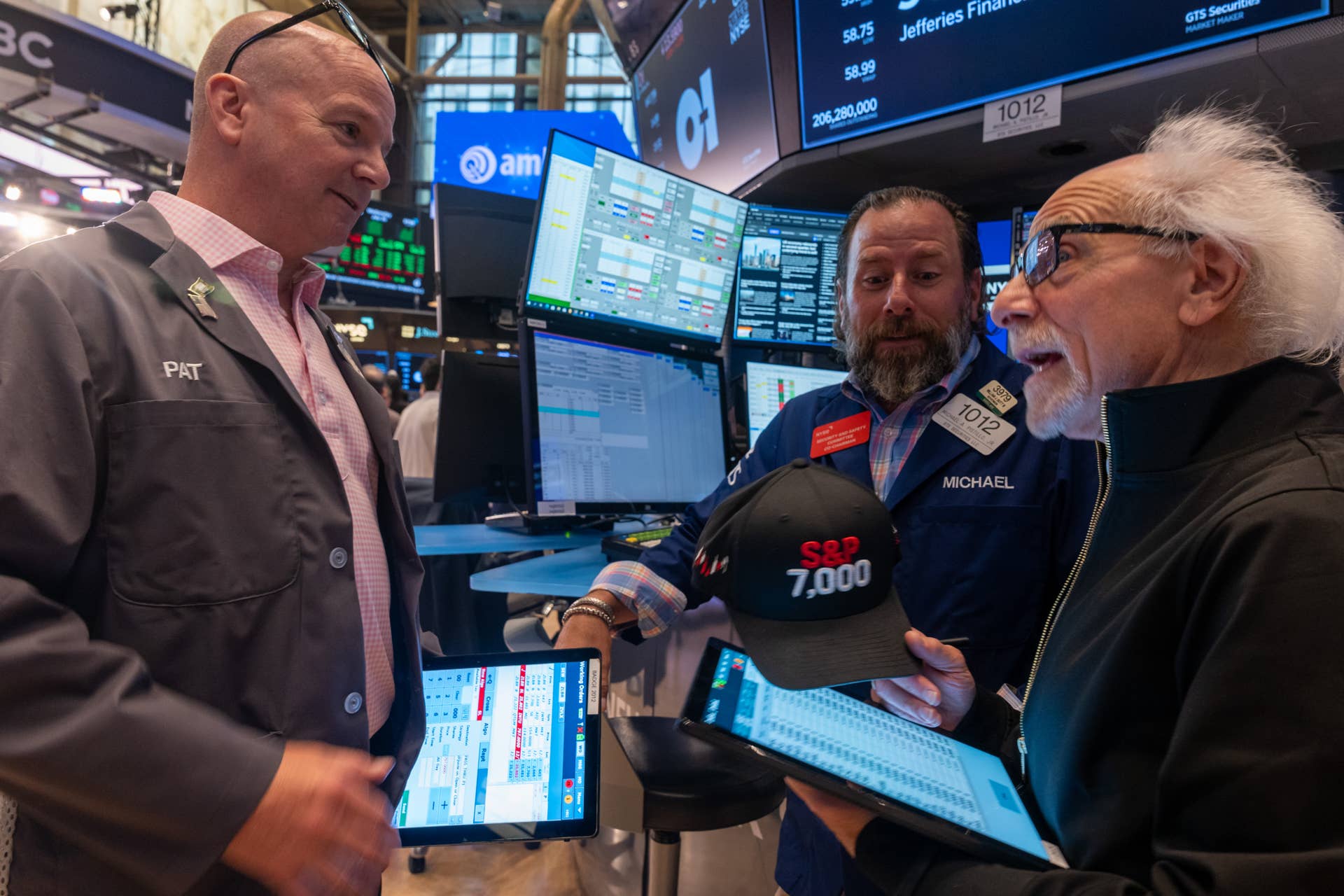
Despite the volatility, the S&P 500 maintained its impressive momentum in 2026, rising 13.3% year-to-date through Aug. 7 to 7,757.64 (an all-time high). On Aug. 10, the index opened at around 7,752, effectively trading near record levels.
For perspective, the benchmark wrapped up 2025 at 6,845.50, according to S&P Dow Jones Indices data, gaining 16.4%.
Consequently, the index has delivered double-digit gains in consecutive years, even as investors navigate testing interest-rate expectations, geopolitical hiccups, and questions about elevated AI spending.
Spencer Platt/Getty Images
Is S&P 500 concentration becoming a bigger risk?
The S&P 500 contains nearly 500 companies, but its returns are highly dependent on what’s becoming a remarkably small group.
As of the latest S&P Dow Jones Indices data, the 10 largest S&P 500 constituents account for 37.6% of the index, while the largest single constituent carries a 7.6% weighting.
That’s an incredibly concentrated setup for what investors typically treat as a broadly diversified benchmark. Moreover, that also means that these handful of companies are having an outsized effect on the entire benchmark.
However, concentration on its own might not be a bearish signal.
According to an S&P Global report, there was only a nuanced relationship between concentration and future market performance.
From June 2015 through June 2025, the top 10’s weight rose by over 20 percentage points, yet the index still generated an annualized price return of 11.7%.
Nevertheless, valuation adds a major wrinkle.
According to FactSet, the S&P 500 is currently trading at around 20 times forward 12-month earnings. Though that’s above its 10-year average of 19.0 times, it’s barely higher than its five-year average of 19.9 times.
Moreover, it has also fallen from 20.4 times at the end of June, even as the index remains near record levels. That means the market’s jump is increasingly being driven by a rapidly growing earnings denominator rather than a pure multiple push.
Related: Bank of America issues stark warning on Fed and economy