Every company eventually learns that the cheapest solution and the acceptable solution are two different things.
That gap is where corporate strategy actually lives. You find the efficient answer, you run it past the people who can veto it, and you discover efficiency was never the only variable.
Apple (AAPL) has spent 15 years being unusually good at this calculation. It built a supply chain that squeezed pennies out of components at a scale nobody could match, and kept gross margins near 47% doing it.
This year that machine ran into something it cannot engineer around. The buildout of artificial intelligence data centers has swallowed so much of the world’s memory production that prices for the chips inside phones, laptops and tablets have gone vertical.
Apple raised prices in June. It told investors costs would keep climbing. Then it went looking for a cheaper source.
It found one in China. Then it found out what Washington thought of that.
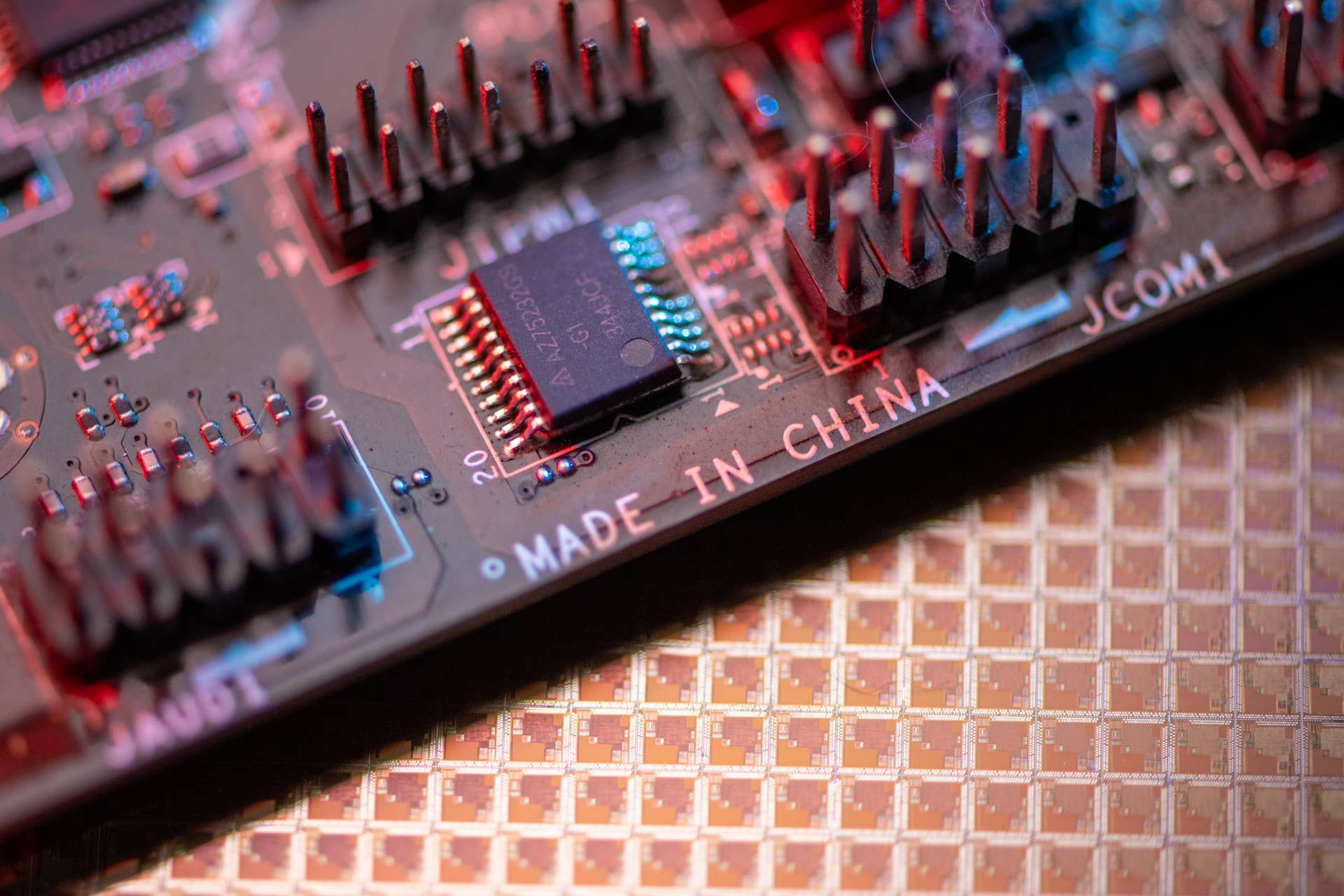
Why Washington is pushing back on Chinese memory
Commerce Secretary Howard Lutnick said the administration opposes big American companies sourcing memory from China, and that he had relayed that to Apple directly, according to The Wall Street Journal.
“The Trump administration is not in favor of that,” Lutnick said in an interview after touring an Apple manufacturing site in Houston.
More Technology Stocks:
- SanDisk CEO reveals what’s next after explosive 3,150% stock rally
- Intel’s stock buybacks: History & investor impact explained
- JPMorgan set a serious Microsoft stock price target for 2027
The suppliers are ChangXin Memory Technologies, known as CXMT, and Yangtze Memory Technologies, or YMTC. Apple had been testing CXMT dynamic random-access memory, or DRAM, for devices sold inside China.
Both sit on a Defense Department list of companies the U.S. government treats as linked to China’s military. YMTC also sits on a Commerce Department trade blacklist.
Related: One quiet Apple update could matter more than it looks
That designation is not decorative. Federal rules bar technology transfer to CXMT, so Apple could buy standard parts off the shelf but could not commission memory built to its own spec.
Apple customizes nearly everything it puts in a device. Memory is one of the few components where it does not have to, which is exactly why the workaround looked viable in the first place.
How the memory shortage became a consumer pricing problem
The squeeze did not start with Apple and will not end with it. Hyperscalers building AI infrastructure have been outbidding every consumer electronics maker on earth for the same wafers.
Conventional DRAM contract prices climbed roughly 90% to 95% quarter over quarter in the first three months of this year, the steepest jump on record, according to TrendForce.
Apple stopped absorbing it in June. The company raised prices across Macs, iPads, the Apple TV, the HomePod and the Vision Pro, with increases running $100 to $300 depending on configuration.
“The consumer electronics industry is facing an unprecedented challenge,” Apple said in a statement at the time, reported by CNBC.
Shares fell more than 6% that day, the worst session since April 2025. Investors were not reading a press release about storage costs. They were reading a company admitting it had lost pricing control over a core input.
This is the same pass-through dynamic that showed up when major retailers raised shelf prices to cover tariff costs. Somebody pays. It is rarely the company.
What the memory squeeze does to your next iPhone
When I ran the component math against Apple’s own margin guidance, the scale of the problem got a lot more concrete than any headline number.
Here is what the squeeze looks like in sequence:
- Conventional DRAM contract prices rose about 90% to 95% quarter over quarter in the first quarter of 2026, according to TrendForce.
- Apple raised Mac, iPad and Vision Pro prices by $100 to $300 in June, according to CNBC.
- Memory’s share of the iPhone Pro bill of materials climbed from roughly 10% a year ago to about 34% in the third quarter, according to TrendForce.
- Seven senators gave Apple until Aug. 21 to commit that no CXMT or YMTC memory goes into any Apple product, according to Sen. Chuck Schumer’s office.
That third bullet is the one that should get your attention. A component that accounted for a tenth of an iPhone Pro’s build cost now accounts for a third of it.
What struck me in my analysis is how few levers Apple has left. It cannot manufacture its way out on a useful timeline. Micron, Samsung and SK Hynix are allocating output to data centers, where the margins are better.
Jefferies cut Apple to Underperform on Aug. 10 with a $263.66 target, citing memory costs against a thinning set of premium-pricing options. Apple closed Aug. 14 at $305.93.
The consumer version of that analyst note is simple. Higher entry prices, or the same prices with less storage.
Why the senators made this a national security fight
The July 29 letter was led by Sen. Jim Banks, an Indiana Republican, and Senate Democratic Leader Chuck Schumer, which is not a pairing that happens by accident.
“This short-sighted move would be a mistake,” the senators wrote, warning that Apple would grow dependent on a firm the government has formally designated a Chinese military company, Bloomberg reported.
Their sharpest point was procedural rather than ideological. Once a part clears qualification for Apple production, extending it worldwide is one procurement decision away, according to the letter.
Apple has been here before. It evaluated YMTC flash memory for the iPhone in 2022 and walked away after congressional scrutiny. Washington remembers that, which is part of why the pressure arrived this fast.
There is a competitive argument underneath the security one. Every dollar Apple sends to CXMT funds capacity that eventually competes with the American memory makers whose expansion plans Wall Street has been pricing in.
What Apple’s next chief executive inherits
Tim Cook hands the company to John Ternus on Sept. 1, Apple announced in April.
Ternus spent 25 years in hardware engineering. He is inheriting a hardware cost crisis with a geopolitical lock on the cheapest exit, roughly two weeks before an iPhone launch.
The senators’ deadline lands 11 days before he takes the job. Whatever Apple says in that response becomes the position Ternus has to defend.
Watch for a quieter version of the same strategy. China-only devices, standard parts, minimal announcement. That path is still technically open. It just costs Apple something Cook spent 15 years accumulating, which is the benefit of the doubt in Washington.
The reason this matters beyond one company is that Apple is the stress test. If the most sophisticated supply chain in consumer electronics cannot buy its way around an AI-driven shortage without a national security fight, nobody smaller is going to.
Your next phone is where that argument gets settled.
Related: Apple’s next iPhone battle just got more complicated