Wealth has always had two answers to a tax bill. Pay it, or move somewhere the bill cannot follow.
For most of American history the second answer was the expensive one. It required lawyers, accountants, a persuasive paper trail, and usually a second house in a state with better weather and a friendlier revenue department.
Then a third answer appeared, and it turned out to be the cheapest of the three. You do not pay and you do not move. You buy the election that decides whether the tax exists.
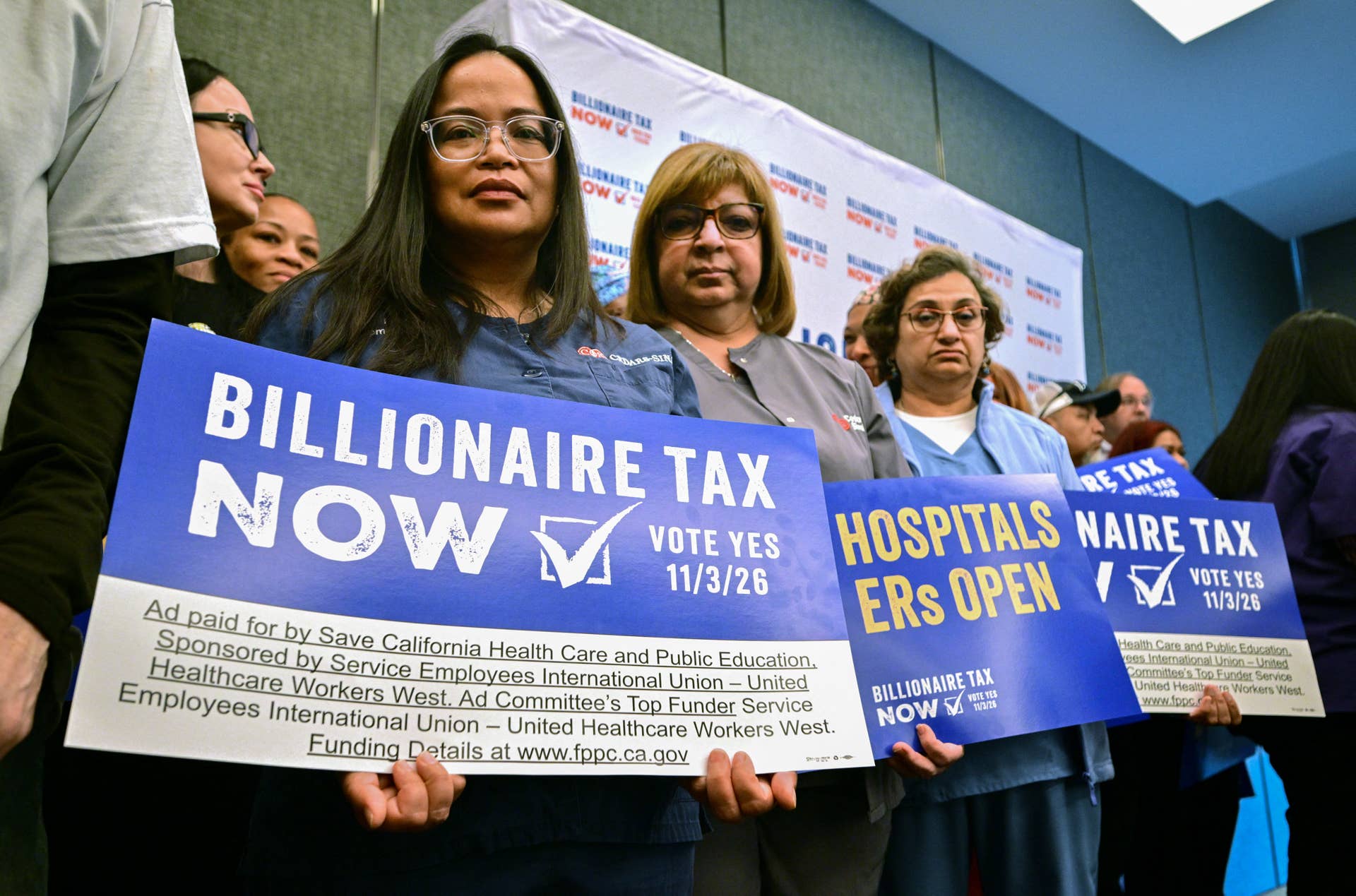
California is stress testing that idea this year. The state holds more billionaires than any other, roughly 200 of them, and a measure on the Nov. 3 ballot would take a one-time 5% slice of their net worth. Ninety percent of the money would fund the state health care program, according to NPR.
The exodus got the headlines. At least six billionaires established residency elsewhere before the deadline that mattered, including Google co-founders Larry Page and Sergey Brin, according to Fortune.
What the roughly 200 who stayed did next is the part that should hold your attention. And one of the six who left is bankrolling it.
Brin has given $102 million this year to Building a Better California, the group leading the campaign against the measure, according to data from the California secretary of state.
What $102 million buys in a ballot fight
I ran Brin’s spending against his own exposure, and the ratio is what makes this worth following.
His net worth stood at roughly $276 billion on Aug. 16, according to the Bloomberg Billionaires Index. A 5% levy on a figure that size lands somewhere near $13.8 billion.
Measured against that, $102 million is about three quarters of one percent. Priced as insurance, it is cheap.
Here is how the money and the polling stack up:
- Brin has contributed $102 million this year to Building a Better California, including a $20 million donation in a recent filing, according to state campaign data reported by CPA Practice Advisor.
- The union-backed campaign supporting the tax has raised just over $30 million, according to Fortune.
- Proposition 40 led 48% to 41% among likely voters in a survey released Aug. 14, according to the UC Berkeley Institute of Governmental Studies.
- Brin’s fortune has grown by roughly $26 billion so far in 2026, according to the Bloomberg Billionaires Index.
Building a Better California describes itself as a nonpartisan group focused on “supporting forward-looking ideas to improve affordability and quality of life,” according to the organization’s website. It says Proposition 40 would damage the state economy and cost the budget billions without lowering health care costs, according to its published FAQ.
Related: J.P. Morgan flags gathering storm in U.S. wealth taxes
The other side frames the same spending very differently. Brin “would rather spend $100 million to fund a shady opposition campaign” than pay the levy, said Service Employees International Union United Healthcare Workers West Vice President Debru Carthan, in a statement reported by Common Dreams.
Brin has explained his position in personal terms. He said he “fled socialism with my family in 1979” and does not want California heading the same direction, he told the New York Times in April, in comments cited by Fortune.
Why leaving California may not settle the bill
The mechanic that makes this fight strange is buried in the measure’s residency language, and it is the part most worth understanding if you have ever thought about moving for tax reasons.
Proposition 40 applies to anyone who was a California resident on Jan. 1, 2026. There is no proration for leaving in February, or June, or the week before the election. Net worth is then valued as of Dec. 31, 2026. “This retroactive residency date is likely to be challenged in court,” according to the California Budget and Policy Center.
More Taxes:
- A guide to the capital gains tax rate: Short-term vs. long-term capital gains taxes
- Secretary Bessent cracks down on non-profit tax loopholes
- IRS rules may fail to protect Americans from one AI tax risk
That date passed nearly eight months ago. Anyone who packed a moving van in December beat it. Anyone who moved in January did not.
So the spending makes sense even for someone who already left. A residency change is a defense you have to win in an audit. Killing the measure outright needs no lawyer at all.
Which is what Propositions 41 and 42 are for. Proposition 41 would bar new taxes enacted after Jan. 1 of this year. Proposition 42 would prohibit both wealth taxes and retroactive taxes outright, according to KQED. If a countermeasure and Proposition 40 both pass, the one with more votes takes effect.
Brin is not alone in funding that strategy. Ripple co-founder Chris Larsen, PayPal co-founder Peter Thiel, and venture capitalist Ron Conway have all spent against the measure, a pattern TheStreet tracked when Ripple quietly moved millions into the opposition earlier this year.
What the polling says about all that money
What struck me when I pulled the latest Berkeley numbers is how little the spending has moved.
Proposition 40 holds 48% support against 41% opposition among likely voters. The measure “is shaping up to be a closely fought contest,” said Institute of Governmental Studies co-director Eric Schickler, according to Berkeley News.
Seven points is not a comfortable lead. Measures sitting under 50% in August often lose, because undecided voters break toward no. But it is a lead, and it has survived a spending gap of better than 3 to 1, a fight TheStreet valued at $100 billion when the measure first qualified.
The more useful finding sits underneath. Voter awareness of Propositions 41 and 42 is low. That is the cheapest ground left to buy, and where the remaining money will go.
The politics are not clean on either side. Gov. Gavin Newsom opposes the tax, arguing it erodes the state’s revenue base over time, while the California Democratic Party officially supports it. The California Teachers Association is opposed. Sen. Bernie Sanders and Rep. Ro Khanna are in favor.
Why this state tax fight matters to your wallet
If you are reading this from Ohio or Georgia, the temptation is to file this under California problems. I would not.
Statehouses have been circling wealth and high-earner taxes for two years. Maine enacted a surcharge on income above $1 million in April, and Washington and Illinois have floated versions of the same idea. J.P. Morgan Private Bank flagged California’s measure as the most advanced example of a trend running well past one state, an analysis TheStreet covered when the measure qualified for the ballot.
The transferable lesson has nothing to do with billionaires. It is the residency snapshot.
Most people assume leaving a state ends its claim on them. It does not, and never really has. California audits departing residents on domicile, not mailing address, and the questions get granular. Where do your kids go to school. Where do you garage the car.
Proposition 40 just wrote that logic into a single fixed date, which is what makes it a template. If it survives the courts, expect other states to copy the date and skip the audit.
That is the outcome worth watching on Nov. 3, and it will not be settled that night. Whichever way the vote breaks, the lawyers are already booked.