Every household that has ever carried a balance knows there are only two ways out. You spend less, or you earn more.
Washington has spent four decades arguing almost entirely about the first one. There have been commissions and supercommittees, sequesters and shutdowns, debt ceilings raised in the last hour before default and grand bargains that never quite closed. The working vocabulary of American fiscal policy is a vocabulary of subtraction.
The ritual barely changes. A milestone gets crossed. Fiscal hawks in both parties issue statements about mortgaging the future. Someone proposes a commission. The commission produces a report, the report produces a news cycle, and the borrowing continues at whatever pace the Treasury needs that quarter.
That framing survived because the arithmetic still felt survivable. Money was cheap for most of two decades, and the government could roll over what it owed at rates that made the stock of debt look almost decorative.
The number was enormous but abstract, a figure on a scrolling billboard that moved too fast to read and stood too far from anything a reader could touch.
This week the abstraction ran out.
The gross national debt crossed $40 trillion on Aug. 18, a threshold reached just five months after the government passed $39 trillion. The day before, the 30-year Treasury bond yield touched its highest level in nearly two decades.
And then the official responsible for financing all of it went on television and made the case for the other option.
What Bessent said about growing out of the debt
Speaking with CNBC on Aug. 20, Bessent laid out the argument he plans to take to the world’s largest economies. Global growth “is the way to take care of this mountain of debt,” he said, according to CNBC.
That is not a small rhetorical move. It reframes a $40 trillion liability as a growth problem rather than a spending problem, and it puts the Treasury on the opposite side of nearly every deficit hawk in Washington.
Bessent has been building toward this. The United States rejects “the premise of weakened global growth,” he told an audience in Dallas earlier this year, according to the U.S. Department of the Treasury.
The venue for the argument is already booked. Bessent hosts G20 finance ministers and central bank governors in Asheville from Aug. 31 to Sept. 1, with deputies meeting the weekend before, according to the Treasury Department.
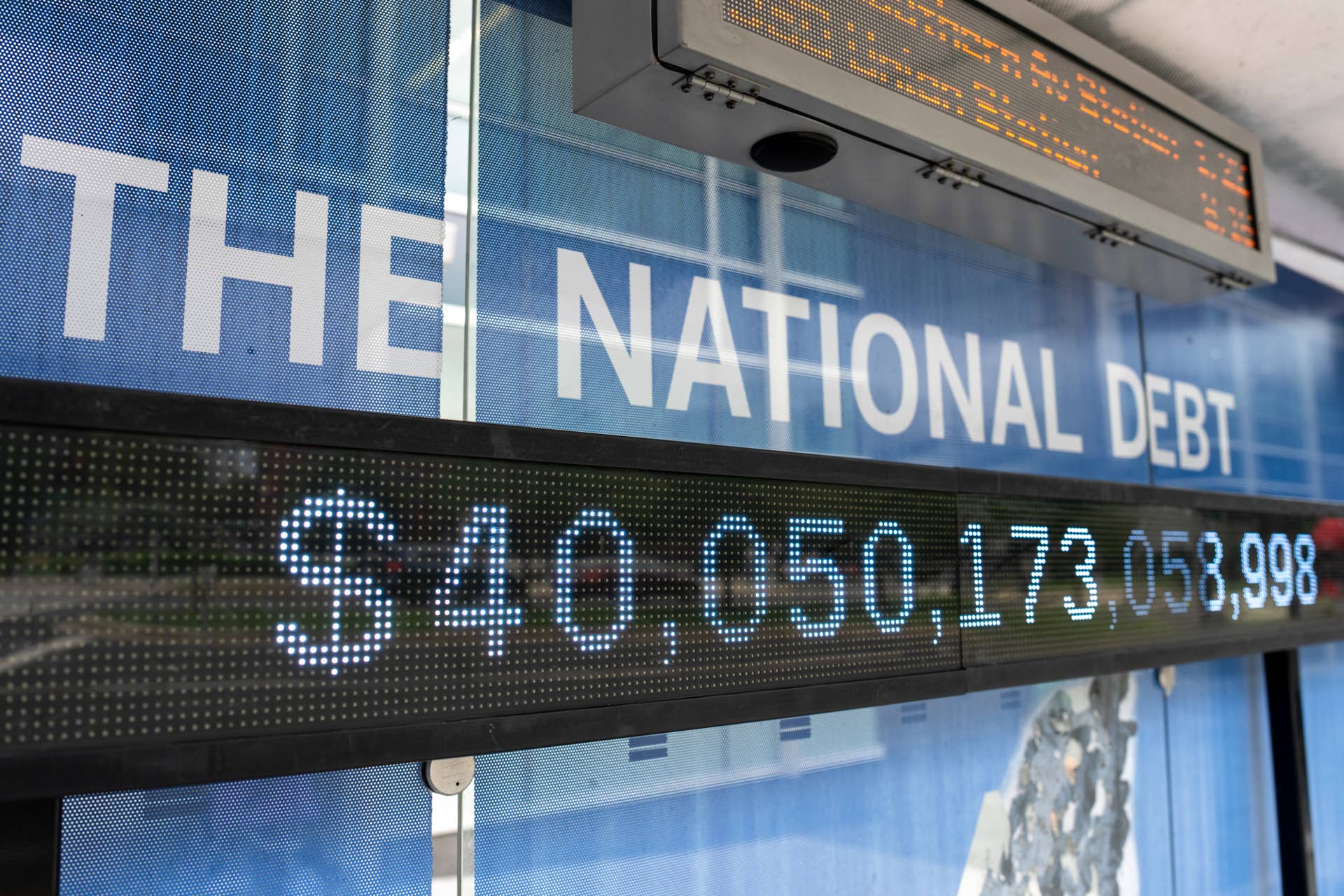
How the national debt reached $40 trillion
The pace is the part that changed. Total public debt outstanding hit $40.047 trillion on Aug. 18, split between $32.266 trillion held by the public and $7.782 trillion in intragovernmental holdings, according to Reuters.
I pulled the milestone dates from Treasury’s own reporting and lined them up, and the spacing is the story. The last two trillion each took roughly five months. The first trillion took nearly two centuries.
- Debt first reached $1 trillion in 1981, after nearly 200 years, according to the Committee for a Responsible Federal Budget.
- It passed $20 trillion in late 2017, The Hill reported.
- It crossed $30 trillion in 2022, according to The Washington Times.
- It hit $38 trillion in October 2025 and $39 trillion in March 2026, the Associated Press confirmed.
- It reached $40.047 trillion on Aug. 18, according to Treasury data reported by Reuters.
Interest is now the expensive part. The government pays roughly $1.1 trillion a year to service the debt, slightly more than it spends on defense, according to Al Jazeera.
Why the bond market is not sold on the growth math
Here is where my analysis gets uncomfortable for both camps.
Run the stabilization math, and Bessent’s case is arithmetically coherent. With debt near 122% of gross domestic product and deficits running about 6% of it, nominal growth of roughly 5% a year would hold the ratio flat. Strip out inflation near 2.5%, and you need sustained real growth around 2.5%.
More Economic Analysis:
- Jim Cramer drops stunning take on the economy
- Wells Fargo resets its inflation target for 2026 and 2027
- Billionaire investor warns a 2027 recession could punish stocks
That is not fantasy. It is also not something the American economy has delivered reliably for a decade, and it leaves zero margin for a recession.
The catch is who absorbs the risk while everyone waits to find out.
A spending cut is a decision somebody makes and votes on. A growth bet is a decision nobody votes on, and if it misses, the cost arrives as higher mortgage rates, weaker bond funds and a smaller share of the federal budget available for anything other than interest.
The bond market has noticed. The 30-year yield climbed above 5.3% this week, its highest since April 2007, and the debt now sits near 122% of GDP, according to The Hill.
Related: Bessent’s upbeat economy pitch is meeting hard pushback
Budget watchdogs are blunter. It is staggering “how predictable the fiscal decline of a global power can become,” said Maya MacGuineas of the Committee for a Responsible Federal Budget. The current path is “plainly unsustainable,” said Margaret Spellings of the Bipartisan Policy Center, according to NPR.
The White House frames it as Bessent does, pointing to “accelerating economic growth to get America’s debt-to-GDP ratio trending in the right direction,” spokesman Kush Desai said, the Associated Press reported.
Treasury is hedging in practice. Bessent doubled the size of long-dated debt buybacks to at least $4 billion.
What the Asheville meeting means for your borrowing costs
Strip away the diplomacy, and this is a question about your mortgage.
The 30-year yield is what prices home loans, and it is not responding to spending promises. It is responding to supply. Every month the government borrows more than it collects, it adds paper to a market that already wants a higher return to hold it.
That shows up in what you pay to borrow, and in what your bond fund is worth. The iShares 20+ Year Treasury Bond ETF (TLT) has spent the summer absorbing exactly that pressure.
Which is why Asheville matters more than a normal ministerial. If Bessent persuades allies to run growth-first policy, global demand rises, and the math has a chance. If he doesn’t, the United States is left growing alone against a debt load compounding faster than it has in 40 years, and the adjustment happens through yields instead of through legislation.
That is the trade he is making. Not austerity, not denial, but a bet that output can outrun compounding.
The market gets to vote on it every single trading day, and this week its answer was 5.3%.
Related: Scott Bessent just made a bold move on the bond market