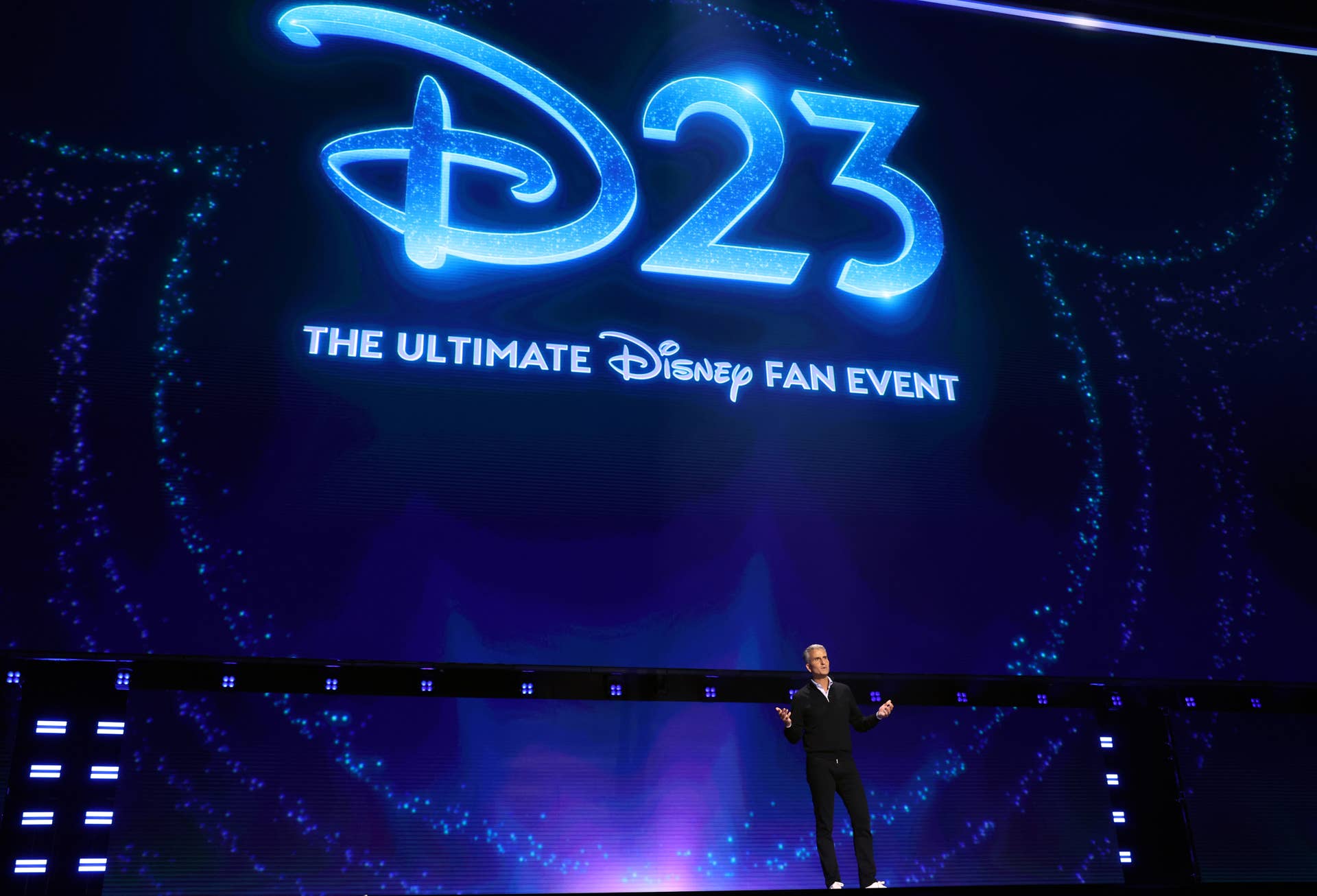
Disney spent three days this past week at its D23 fan convention, unveiling new movies, theme park attractions, and games centered on some of its most recognizable characters.
Behind the lineup, which included announcements for Frozen, Coco, Star Wars, and the Marvel Cinematic Universe, was something bigger: an early look at where new CEO Josh D’Amaro plans to put Disney’s money.
D’Amaro, who has been CEO for about five months, is pushing Disney to operate more efficiently while concentrating investment behind intellectual property that can generate revenue across multiple businesses.
This includes movie theaters, Disney+, merchandise, theme parks, and, increasingly, video games.
This strategy was on display throughout D23, D’Amaro’s first major fan event as CEO.
Disney unveiled Frozen 3, Coco 2, and Incredibles 3, while detailing major theme park expansions and a growing role for gaming.
The announcements come as Disney is spending heavily and is on track to spend about $24 billion on content this fiscal year, and expects content spending to grow over time.
At the same time, Disney is still looking for places to cut.
CFO Hugh Johnston told analysts at Disney’s Q3 earnings call that the company is pursuing “meaningful reductions” to costs, including labor and selling, general, and administrative expenses, as it works to improve productivity and create room to invest in growth.
So, Disney isn’t simply spending more; it is being selective about where it spends.
Disney Parks get new attractions and sequels
Disney’s reliance on familiar franchises is hardly new, but D’Amaro has laid out a clear financial rationale for continuing to invest in them.
Frozen 3 arrives in 2027, followed by Incredibles 3 in 2028 and Coco 2 in 2029.
But these properties aren’t limited to movie screens. Disneyland is building its first Coco attraction, while the franchise will also appear in the upcoming Kingdom Hearts IV video game.
Disney’s parks pipeline also includes attractions tied to Marvel and other established properties.
D’Amaro explained the economics behind that strategy during Disney’s latest earnings call, using the Pixar franchise Toy Story as an example.
The five Toy Story films have generated more than $4 billion at the global box office and more than 2 billion hours streamed on Disney+, according to Disney.
Related: Disney shutting down key theme park app by fall
The franchise also generates more than $1 billion in annual global retail sales and is featured throughout Disney’s parks and cruise ships.
D’Amaro called it the “Disney flywheel”, one story making money across theaters, streaming, retail, and physical experiences.
Disney’s financial results help explain why that model is getting more investment. Disney Experiences reported record fiscal third-quarter revenue of about $10 billion, up 10% from a year earlier.
Global guests increased 4%, domestic park attendance rose 3%, and per-capita spending at domestic parks increased 4%. The company is also several years into a $60 billion, 10-year investment cycle for its Experiences business.
Disney says it evaluates those investments against defined return targets, with D’Amaro saying projects are expected to generate double-digit returns over their lifetimes.
D23 provided a preview of where some of that money is headed.
Disney cuts jobs while investing more
The expansion is happening while Disney trims costs elsewhere.
Pixar was affected by Disney’s latest round of layoffs this summer, which eliminated several hundred studio positions, with cuts concentrated in production and operations.
Those reductions are part of a broader effort to make Disney more efficient, even as management plans to increase investment in content, parks, and technology.
The timing is particularly notable at Pixar.
Disney is cutting positions at the animation studio while returning to some of its best-known properties, including Toy Story, Coco, and The Incredibles.
Disney has not drawn a direct connection between those layoffs and its franchise strategy. But Johnston’s comments suggest that cutting operating expenses and freeing money for growth are parts of the same broader financial strategy.
Artificial intelligence is also becoming part of that efficiency push.
Disney is using AI to make films faster
D’Amaro told investors at the earnings call that Disney is using AI across its studios.
He specifically named Pixar, Industrial Light & Magic, Disney Research Studios, and Walt Disney Imagineering as businesses building on years of machine-learning work.
Disney is using the technology to move films through parts of the production pipeline more quickly.
It also helps expand the number of titles available in 3D and other premium formats and bring visual effects to shots where they may previously have been too expensive.
More Tech:
- Anthropic-powered AI model sends shocking message to employee
- Rocket Lab clears 1st hurdle in its biggest satellite deal
- Apple’s $54 billion iPhone machine may be about to break its biggest ritual
AI is also accelerating technical processes, including rendering and denoising. D’Amaro stressed that Disney intends AI to support rather than replace artists, describing its creative process as human-centered and creator-led.
But he also made the financial case for the technology, saying greater efficiency can free capital for new content, guest experiences, and technology infrastructure.
Gaming could be Disney’s next big thing
D23 also showed where Disney believes its franchise machine can expand next.
Games made with Disney’s licensing partners generated an estimated $3.5 billion in annual consumer spending during each of the previous four years before surpassing $4 billion in the latest fiscal year, according to the company.
Disney also says nine gaming franchises have each generated more than $1 billion in retail sales.
Now it wants to connect games more closely with the rest of its business.
At D23, Disney and Epic Games unveiled Millennium Falcon: Smugglers Run|Fortnite, extending the Star Wars attraction at Disneyland and Walt Disney World.
“For the first time, through the recently launched mission aboard Millennium Falcon: Smugglers Run, the attraction extends into a connected digital adventure in Fortnite, deepening the way guests can interact and engage with both,” said Asa Kalama, Executive-Creative & Interactive Experiences, Walt Disney Imagineering.
The project follows Disney’s $1.5 billion investment in Epic Games announced in 2024 as the companies work on a broader Disney universe connected to Fortnite.
Disney+ is also set to play a role.
D’Amaro said Disney intends to evolve the streaming service beyond films and television by incorporating games, merchandise, and other experiences. Elements of that expanded ecosystem are expected to begin rolling out in spring 2027.
The goal, according to Disney, is to deepen engagement, lower churn, and increase the lifetime value of its customers.
Disney is not alone in chasing gaming audiences. Netflix, for example, has been moving toward streaming games directly to televisions.
Disney’s opportunity is different because a game need not succeed as an isolated business. It can promote a movie, extend a franchise, increase engagement with Disney+, or connect consumers with a physical attraction.
Disney even argues its franchise model can generate value when a film itself disappoints.
D’Amaro acknowledged that The Mandalorian, Grogu, and the live-action Moana did not meet the company’s box-office expectations.
But he said The Mandalorian and Grogu still boosted Star Wars retail sales, drew guests to an updated Millennium Falcon attraction, and generated gaming engagement.
That’s what made D23 more than a preview of Disney’s coming movies and attractions.
It showed the strategy taking shape under D’Amaro: spend heavily on franchises that can travel across Disney’s businesses, use technology to make those businesses more efficient, and build new ways to keep consumers interacting with its characters after a movie ends.
Related: Disney may give streaming away for a surprisingly profitable reason