BackRub … guys, seriously?
In the mid-1990s, Stanford University students Larry Page and Sergey Brin began developing a search engine as a research project.
The internet was becoming popular at this time, but it lacked effective search engines that prioritized quality over quantity in search results.
Brin and Page developed a new approach to organizing the web through their PageRank algorithm, which determined the importance of a website and its relationship to other sites.
The two students originally dubbed their creation BackRub because the program analyzed the web’s “back links” to understand how important a website was and what other sites it related to.
As you might have guessed, the name did not last, and that’s why we don’t say that we “BackRub” for information on the internet today.
They eventually renamed their search engine “Google,” a play on the mathematical term “googol,” which represents the number 1 followed by 100 zeros.
Page and Brin chose the name to signify their mission to organize a massive, seemingly infinite amount of information on the internet. Here’s how this university project grew into one of the largest and most powerful tech companies on the planet.
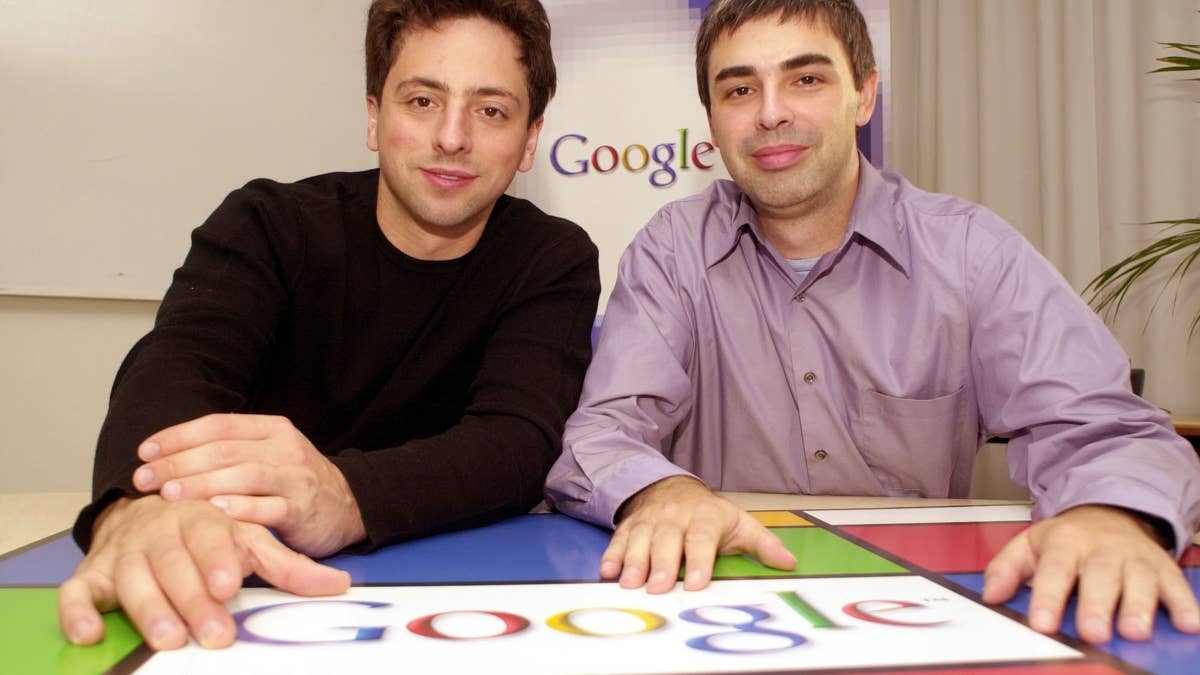
Google’s founding and early years
Page and Brin’s goal was simple.
“We want Google to be the third half of your brain,” Brin said.
Like Apple (AAPL), Amazon (AMZN), Microsoft (MSFT) and many other tech companies, Google got its start in a garage.
The Google garage was rented in California’s Menlo Park for $1,700 a month, and years later, once Google was a household name, busloads of people would begin showing up to take pictures of the place. Google purchased the property in 2006, and a company spokesman said, “We plan to preserve the property as a part of our living legacy.”
The company has grown from those early days and now owns major tech platforms like YouTube and Android, hardware brands like Fitbit and Nest, and experimental “other bets” like self-driving car company Waymo and AI lab DeepMind, plus investment funds like GV.
Related: History of Micron: The story behind the computer memory giant
Google eventually became a subsidiary of Alphabet (GOOGL), now one of the world’s most valuable companies, with a market cap of roughly $4 trillion as of summer 2026.
But back in August 1998, Andy Bechtolsheim, co-founder of Sun Microsystems, wrote a $100,000 angel investment check made out to “Google Inc.”, which was a little awkward since the company wasn’t legally incorporated at the time and didn’t have a corporate bank account.
Page and Brin had to hustle, and the pair rapidly filed paperwork to establish their company. Google was incorporated on Sept. 7, 1998.
In 2000, Google reached a milestone of one billion pages indexed, making it the world’s largest search engine at the time. The company also added several new language versions, including Chinese, Japanese, Korean, French, German, Italian, Spanish, and more.
In the same year, Google introduced AdWords, its online advertising platform, which was later rebranded as Google Ads in 2018.
Advertising has historically accounted for roughly 75% to 80% of Alphabet’s total revenue and an even higher share of its operating profits.
“By the time I joined the company in November of 2001, it was apparent that we were changing the world,” Miriam Rivera, who worked at the company from 2001 to 2006, wrote in Entrepreneur in 2016.
“As an early employee at Google — the second attorney hired there — there were times when shivers ran up my spine thinking about what we were building. Democratizing access to information and bringing the real world online — it was an inspiring place to be.”
Google’s growth, IPO, and acquisitions
On April Fool’s Day 2004, Google launched Gmail in beta, offering a then-unheard-of 1GB of storage.
Just a few months later, on August 19, Google held its initial public offering. The final IPO price was $85 per share, after the company lowered its indicated range from $108–$135 to $85–$95.
The stock debuted on the Nasdaq stock market and closed its first day of trading at $100.34 per share.
“Google is not a conventional company,” Page and Brin said in their first founders’ letter. “We do not intend to become one. Throughout Google’s evolution as a privately held company, we have managed Google differently.”
Related: 3M: The history behind the massive global conglomerate
“Now the time has come for the company to move to public ownership,” they added. “This change will bring important benefits for our employees, for our present and future shareholders, for our customers, and most of all for Google users.”
The prospectus contained the famous phrase “Don’t be evil,” which was Google’s motto for about 19 years, and a phrase used in the company’s corporate code of conduct.
Google Maps launched on Feb. 8, 2005, while Google Earth launched on June 28 after Google acquired Keyhole, a Silicon Valley software company that created EarthViewer 3D.
This was a busy year for Google, as the company also acquired the Android mobile operating system on July 11, 2005, for about $50 million.

The company reached another milestone on Oct. 2, 2015, when it became a subsidiary of its newly formed parent company, Alphabet.
The founders announced the change a few months earlier to separate core internet services from experimental “other bets” projects.
Page said the new structure “will allow us to keep tremendous focus on the extraordinary opportunities we have inside of Google.”
“We’ve long believed that over time companies tend to get comfortable doing the same thing, just making incremental changes,” Page said in a Aug. 10 blog post. “But in the technology industry, where revolutionary ideas drive the next big growth areas, you need to be a bit uncomfortable to stay relevant.”
Page and Brin announced their resignation from their executive posts in December 2019, with the CEO role to be filled by Sundar Pichai, who is also the CEO of Google. The two men remain employees, board members, and controlling shareholders of Alphabet.
Alphabet’s stock and financials
Alphabet, which has roughly 190,000 employees, joined the Dow Jones Industrial Average on June 29, 2026, replacing Verizon Communications (VZ) in the 30-stock index.
The company pays a quarterly dividend and has a consensus rating ranging from Buy to Strong Buy among Wall Street analysts.
Related: Alphabet’s stock splits: History & prospects explained
Alphabet’s total revenue for the full year 2025 was $402.84 billion, marking a 15.1% increase from 2024 and crossing the $400 billion threshold for the first time. Net income was $132.2 billion, up from $100.1 billion the year before.
“We have exciting momentum. Alphabet revenue grew 24% year-over-year,” Pichai said during the company’s second-quarter earnings call on July 22. “Our AI investments are redefining what’s possible across every part of our business.”
A timeline of key events and milestones in Alphabet’s history
January 1996: Larry Page and Sergey Brin start the BackRub research project at Stanford University.
September 15, 1997: Google registers the google.com domain.
September 4, 1998: Google Inc. is officially incorporated, operating out of a garage in Menlo Park, California.
October 23, 2000: The company launches its self-service advertising program, Google AdWords. Google Maps and Google Earth debut in the same year.
Feb. 8, 2005: Google Maps is launched.
June 28, 2005: Google Earth is launched after the company acquires Keyhole.
July 11, 2005: Google acquires Android for about $50 million.
October 9, 2006: Google announces an agreement to buy YouTube in an all-stock transaction.
August 10, 2015: Co-founder Larry Page announces plans to create Alphabet in a public blog post and make Google a subsidiary.
October 20, 2016: The first-generation Google Pixel smartphone is released in the United States.
December 13, 2016: Alphabet formally introduces Waymo, an autonomous driving technology company and commercial robotaxi service, as an independent, standalone business.
March 21, 2023: Google releases its conversational AI tool, Bard (later rebranded to Gemini).
February 4, 2026: Alphabet reports full-year 2025 revenue of $402.84 billion
Related: Alphabet’s stock buybacks: History & investor impact explained