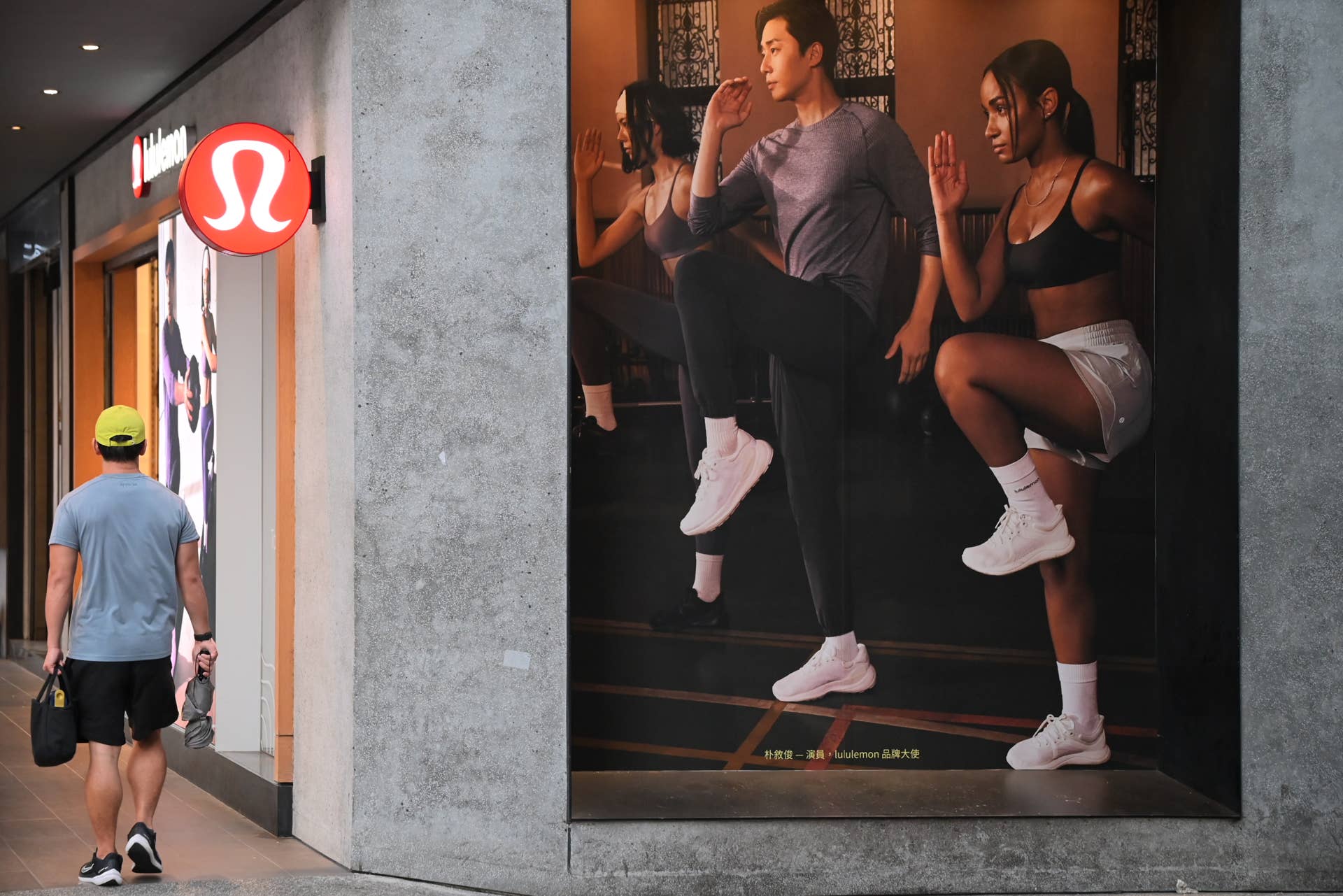
There was a time when you couldn’t walk through an airport, a grocery aisle, or a high-end gym without seeing the brand’s iconic logo.
Lululemon Athletica Inc. (LULU) didn’t just sell activewear; it sold an aspirational uniform that seemed entirely immune to the laws of retail gravity.
Lululemon once traded like a company that could do no wrong, closing at a record $511.29 in December 2023 on a run that turned a split-adjusted $9 initial public offering into a gain of more than 5,500%, according to a Motley Fool report.
For years, Wall Street treated the yoga-pants maker as one of retail’s rare permanent winners, a brand that could raise prices, open stores, and beat estimates quarter after quarter without consequence. That version of the company no longer exists.
Shares of Lululemon dropped 15% on Thursday, Sept. 3, following its earnings release, before the sell-off accelerated to 18% overnight as investors digested a 9% comparable sales decline and a second full-year outlook cut, according to CNBC.
Heading into the print, the stock had already languished roughly 42% lower for the year. The Thursday session and overnight slide added billions more in lost market value in a matter of hours.
Lululemon’s year of compounding bad news
The drop was not an isolated event. It was the third double-digit sell-off Lululemon has suffered in 2026, each tied to a different piece of the same unraveling story.
In April, shares fell 12% after the company named former Nike executive Heidi O’Neill as its next chief executive, with the stock already down more than 21% for the year at that point, according to Bloomberg.
Related: Lululemon Athletica Inc. Q2 2026 Earnings: Recap of $LULU Earnings Call, Forecast
Analysts at Needham and Evercore ISI said the market had expected the board to instead pick Jane Nielsen, a former Ralph Lauren executive favored by activist investor Elliott Investment Management, which had built a stake worth more than $1 billion in the company, Reuters reported.
Two months later, Lululemon cut its annual profit forecast for the first time this year after a soft spring, sending shares down another 8.6% and pushing its market value further from the roughly $67 billion it commanded at its 2023 peak.
After the Sept. 3 slide, that figure has fallen by more than three-fourths.
The tariff refund is masking a deeper problem
The Sept. 3 report followed a familiar script. Lululemon technically beat earnings estimates, posting $2.92 per share against a forecast of $1.80, but only because a $134.5 million tariff refund inflated gross margin.
Revenue still missed expectations, and comparable sales in the Americas, the company’s largest market, kept sliding.
Interim co-chief executive Meghan Frank told analysts that “negative commentary” on social media hurt store traffic during the quarter and that core categories, including leggings, slowed by more than expected, according to CNBC.
That explanation has grown familiar. Lululemon has now cited social media backlash, product missteps, or macroeconomic pressure in nearly every earnings call this year, a pattern that suggests the problem runs deeper than any single quarter’s excuse.
A governance fight complicates the turnaround
O’Neill takes over as CEO on Sept. 8, just five days after this report landed, according to Lululemon’s own announcement.
She inherits not only a sales slump but also an active proxy fight with founder Chip Wilson, who nominated three board candidates in December and has said he will not settle unless directors tied to private equity firm Advent International step down.
More Retail:
- Home Depot is making a big bet on cautious consumers
- Another state just banned a controversial retail pricing practice
- JPMorgan just flagged a slow-build food crisis
Lululemon’s board has called Wilson’s slate “outdated,” but his roughly 4% stake and public campaign keep the fight alive heading into this year’s annual meeting.
Layering a contested boardroom battle on top of a leadership transition and a sales slide leaves O’Neill with far less room to maneuver than most incoming chief executives get.
Michael Burry calls Lululemon a ‘trickster’ and eyes the $100 floor
Not everyone is running for the exits. Legendary “Big Short” investor Michael Burry, who holds Lululemon as his portfolio’s largest position at 17.4%, anticipated the weak quarter and is actively eyeing an opportunity in the carnage.
Reacting to the stock’s 18% overnight collapse, Burry labeled the athleisure giant a “trickster” that seems “determined to take me where mermaids fear to tread,” according to a Seeking Alpha report.
However, Burry noted that heavy volume signals show the shareholder base has completely turned over, leaving newer holders who are less likely to panic-sell at these lower levels.
Burry signaled plans to double down rather than fold, revealing he intends to buy more shares if the stock trades under $100. For the contrarian investor, Lululemon’s slide isn’t a terminal decline, but a high-stakes waiting game.
Private capital is betting against Lululemon’s moat
The clearest sign of how far Lululemon’s advantage has eroded sits outside the public markets.
Vuori, a privately held rival, raised $825 million from General Atlantic and Stripes in a deal that valued the company at $5.5 billion, with investors explicitly framing the bet as taking market share from Lululemon, according to NBC News.
Alo Yoga has followed a similar path, courting the affluent, younger shoppers Lululemon has struggled to keep.
That gap, a shrinking public company on one side and richly funded private challengers on the other, is the real story behind the Sept. 3 plunge.
Lululemon still generates billions in profit and remains larger than either rival by revenue. But the market has stopped pricing it as the category’s inevitable winner, and O’Neill’s first task will be proving that verdict wrong before her private-market rivals get the chance to go public and compete for the same shoppers directly.
The ultimate question for Wall Street, and for O’Neill, is whether this week’s collapse marks the beginning of a slow, irreversible downfall for a former retail king, or if the original athleisure giant still has enough fight left to defend its empire.
Related: Kohl’s has a customer problem that’s proving hard to fix