Every few years, someone promises Americans a fix for the number on the corner gas station sign.
Right now, that number reads $4.12 for a gallon of regular, according to AAA. In January, it read $2.81. That gap is one of the more expensive things to happen to American households this year, and almost none of it traces back to anything a household did.
It traces to a war. U.S. strikes on Iranian targets near the Strait of Hormuz have pushed Brent crude to roughly $95 a barrel and West Texas Intermediate to about $91, according to Trading Economics.
Crude is close to half of what you pay at the pump, so every dollar of that shows up in your tank within a couple of weeks. It’s why a fix involving the largest proven oil reserves on the planet gets everyone’s attention.
One arrived this week. I read the actual terms rather than the announcement, and my analysis says the relief most people are picturing is somewhere between one and 10 years away.
Venezuela’s National Assembly voted Sept. 1 to hand Washington preferential access to 17 oil fields holding about 65 billion barrels, roughly a fifth of the country’s reserves. Energy Secretary Chris Wright landed in Caracas that night. The deal was signed Wednesday, Sept. 2.
Then Chevron (CVX) put more than $7 billion behind it.
Why Venezuela’s oil reserves went dark for two decades
Venezuela sits on more than 303 billion barrels of proven crude, the largest stockpile on earth, according to OPEC. It is also, by any honest reading of the last 20 years, the worst-run oil patch on earth.
Production peaked above 3 million barrels a day in the late 1990s. Hugo Chávez completed nationalization of the industry in 2007, pushing ExxonMobil and ConocoPhillips out of the country. Both are still pursuing compensation nearly two decades later.
What followed was underinvestment, collapsing pipeline and power infrastructure, and sanctions. Output fell to roughly 1.1 million barrels a day by mid-2026, according to Reuters. Chevron stayed the whole time. It has operated in Venezuela since 1923.
That history matters because it sets the realistic clock on any recovery. Barrels in the ground are not barrels in a tanker.
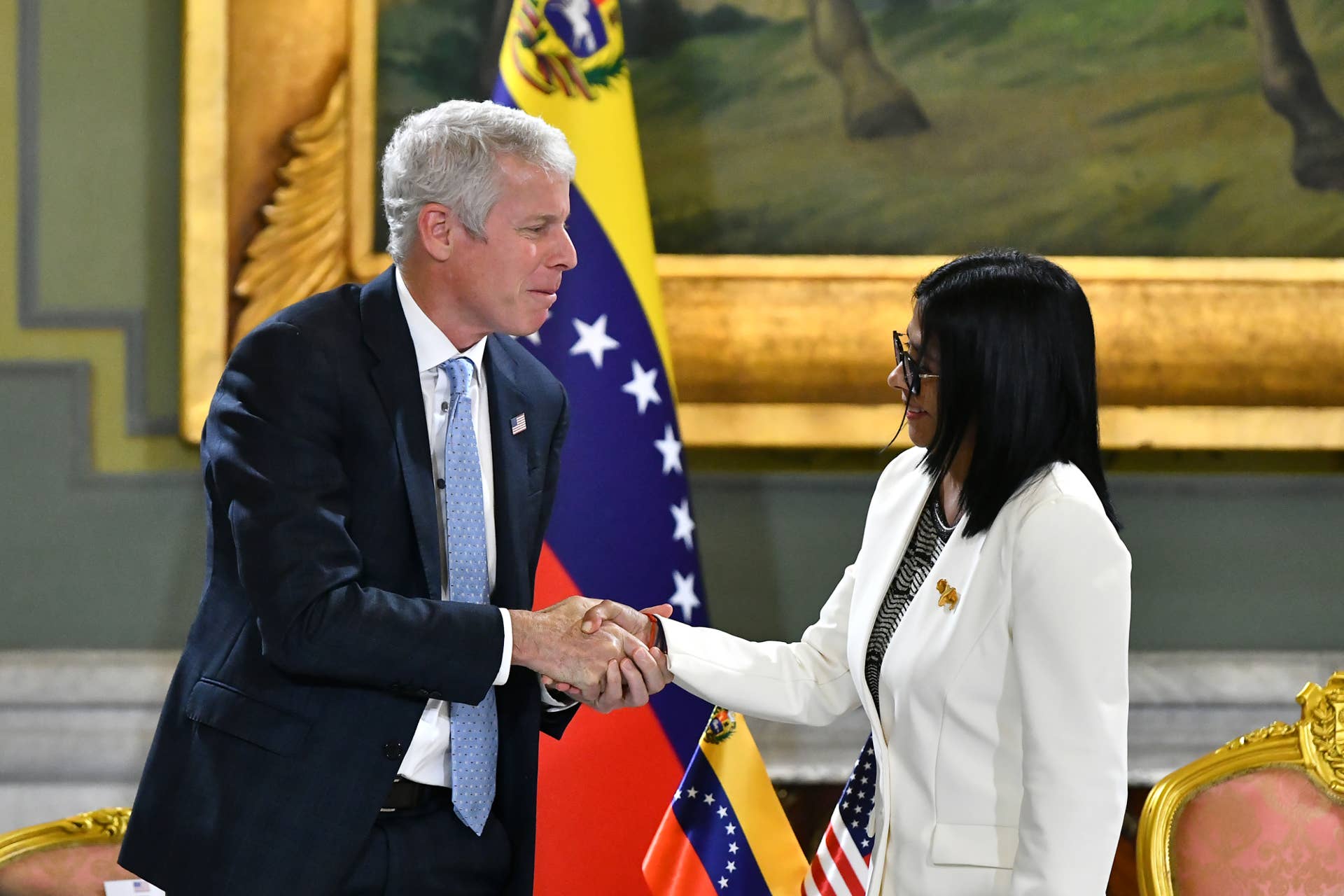
What Washington actually got in the Venezuela oil deal
The structure is the part almost nobody is talking about, and it is genuinely without precedent in modern American energy policy.
The 17 fields carry 100-year rights held by North American Blue Energy Partners, Venezuela’s second-largest private oil company. A new entity is being created around them.
The U.S. Department of Defense’s Office of Strategic Capital takes a 35% equity stake in it, and the State Department is entitled to buy 20% of output at production cost, according to Euronews.
Related: Is Trump’s big, splashy Venezuela oil deal real?
U.S. citizens must form a majority of the board. Washington holds a veto over who sits on it.
Secretary of State Marco Rubio described the arrangement as an agreement with the U.S. government itself, specifically the Defense Department, “which holds a special account allowing it to take possession” of a share of the assets, according to Euronews.
Read that again. The Pentagon is now an equity holder in an oil company.
Here is the deal by the numbers:
- 65 billion barrels across 17 fields, on 100-year rights, Euronews noted
- 35% U.S. government equity stake in the new venture, according to Euronews
- $7 billion Chevron investment through 2031, Reuters noted
- 600,000 barrels a day Chevron target, up from about 280,000, Reuters reported
- 303 billion barrels in total Venezuelan proven reserves, OPEC confirmed
The administration’s case is that U.S. control ends the corruption that hollowed out PDVSA, counters Russian and Chinese positions in the hemisphere, and lowers prices for American drivers. “Today is a transformative day,” Wright said in Caracas, according to NBC News.
The objections are on the record, too. Opposition lawmakers in Caracas abstained from the vote, saying they had not been shown the written terms.
NABEP is owned by Alejandro Betancourt, who has faced money-laundering investigations in Spain and Switzerland without charges being filed and has been accused of involvement in a PDVSA corruption scheme. A U.S. official called him a “proven operator,” the New York Post reported, although the official conceded that geopolitics sometimes means dealing with imperfect figures.
Why cheaper gas is not the near-term payoff here
Chevron’s commitment is the most concrete thing in this story. The company will invest more than $7 billion through 2031 to lift its Venezuelan output to roughly 600,000 barrels a day from about 280,000 now, with new acreage in the Orinoco Belt.
The number that actually matters is buried in the company’s own guidance. Total production costs are expected to run under $20 a barrel.
Chevron CEO Mike Wirth said the existing roads, water, and power make the economics unlike a greenfield project, noting that “our ability to grow at low cost is quite different,” according to Reuters.
More Energy:
- Tesla stock investors stand to gain from U.S. power grid
- Is Trump’s big, splashy Venezuela oil deal real?
- Chevron stock turns heads as company strikes fresh oil
Sub-$20 barrels in a $90 world is a margin story, not a pump story.
Because on the pump side, the timing does not work. Analysts put the wait for meaningful new barrels at anywhere from one to 10 years. Washington is putting no money into the venture, arguing its backing alone will draw private capital. Wright projects Venezuelan output of 2 million barrels a day by the end of the decade.
The end of the decade is four years out. Your next fill-up might be tomorrow.
Exxon is not buying it, either. A spokesman recently said that nothing has changed at the company, according to the Associated Press, and Exxon’s CEO called Venezuela “uninvestable” earlier this year, as Politico reported.
President Donald Trump has said Exxon is going into Venezuela, Reuters noted. Exxon says otherwise.
What the Venezuela oil deal means for your money
If you own energy exposure, this is a cost-curve event, and you should treat it as one. A supermajor adding 320,000 barrels a day at less than $20 of cost while crude trades near $90 shows up in free cash flow long before it shows up at a gas station. That is the trade, and it is a slow one.
If you do not own energy exposure, the honest read is that nothing about your November heating bill or your commute changed on Sept. 2. What moves your pump price between now and the midterms is Hormuz, not Caracas.
The part worth filing away is the precedent. The U.S. government did not buy oil. It bought equity, board control, and a call on output at cost. If that structure works, it will not stay in Venezuela.
Watch the barrel count, not the announcements. Venezuela has produced ambitious oil plans for 20 years. What it has not produced is oil.