Every technology that gives you time back eventually has to answer a second question. What are you supposed to do with it?
The car has been unusually bad at answering that one. For a century the driver’s seat has been the least productive square yard in American life, roughly an hour or more a day of legally mandatory attention pointed at a windshield.
Automakers noticed a long time ago. They put screens in headrests, streaming apps in center consoles and arcade games in parked cars, all of it aimed at everyone except the person actually driving.
That constraint quietly set the ceiling on what a cabin is worth. You cannot sell a driver’s attention, because the law and the physics agree it belongs to the road.
Take the steering wheel out and the arithmetic inverts. Every occupant becomes a viewer. The cabin stops being a corridor people pass through and becomes a room where something can be sold to them.
Tesla (TSLA) is now the first company charging for rides in a car built with no wheel at all. On Sept. 4, its chief executive made the entertainment ambition explicit.
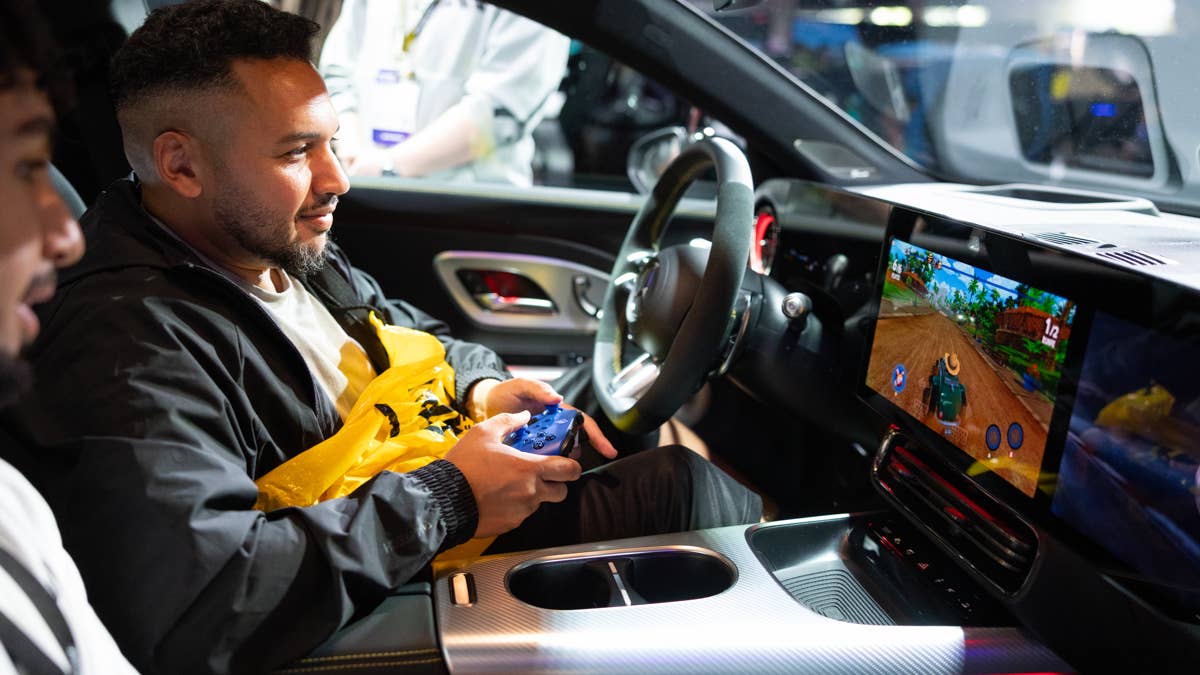
Riders in the Cybercab will eventually be able to plug in their own game console, Elon Musk said.
What Musk actually told Cybercab riders
“You will be able to plug in your PlayStation or XBox,” Musk wrote on X at 11:05 p.m. EST on Sept. 4.
He was replying to Tesla’s own corporate account, which had spent the previous evening selling the cabin rather than the car. The company sold the cabin as a space for “theater, music and gaming apps,” according to Tesla, on a 22-inch touchscreen, and said Starlink V5 hardware is coming to the vehicle.
More Tesla News:
- Tesla uses data transparency to get what it wants
- Elon Musk sends a strong message to Tesla and SpaceX investors
- Tesla stock investors stand to gain from U.S. power grid
Sony (SONY) and Microsoft (MSFT) had no part in the announcement. Musk was describing his own hardware, not a partnership.
Why the console claim is vaguer than it looks
Here is what stopped me when I went back through the post. Musk used the future tense to describe something that partly exists already.
Early Cybercab riders have already shown that wired and wireless controllers work through the cabin’s USB-C ports for built-in Tesla Arcade titles, reported Not a Tesla App. If a controller already connects, then “will be able to” has to mean something else.
That something else would be a video input, and Tesla has never shipped one. Getting a PlayStation’s picture onto that 22-inch panel requires an HDMI port or DisplayPort over USB-C, plus the software to accept an outside signal.
Related: Tesla just set a date for its riskiest launch yet
Neither has been announced. Neither appeared on the spec sheet at the launch event.
So there are three possible readings of one short sentence. Musk meant a controller, which works today. He meant a video input, which is real engineering nobody has confirmed. Or he meant a handheld, which is the version most likely to actually get used.
Very few people are going to carry a home console into a two-seat robotaxi. A Steam Deck or a Switch is a different story, and so is a work laptop.
The numbers behind the gaming pitch
My analysis keeps landing on the same problem. Tesla is describing a mature entertainment platform while operating a fleet you could park in a single lot.
Where the Cybercab actually stood the day Musk made the promise:
- Tesla had 420 autonomous vehicles registered in Texas, 45 of them Cybercabs, against Waymo’s 988, according to GuruFocus.
- The National Highway Traffic Safety Administration opened an audit query covering roughly 1,000 Cybercabs over the company’s self-certification, reported Quartz.
- Waymo was delivering about 500,000 paid rides a week across 10 U.S. cities as of March, according to TechCrunch.
- Tesla shares closed at $354.08 on Sept. 4, down 5.92% on volume 53% above the three-month average, according to Yahoo Finance.
Forty-five cars is not a platform. It is a pilot with a good screen.
How the screen changes Tesla’s robotaxi math
A robotaxi ride is a thin business. Tesla raised its Austin base fare from $1 to $3.25 in March, and the per-mile rate stayed at a dollar, which tells you how little room there is in the fare itself.
Screens are not thin. A 22-inch display in front of a captive passenger for 20 minutes is the kind of inventory streaming companies and advertisers have spent a decade trying to buy.
Tesla has announced nothing resembling advertising in the Cybercab, and I want to be careful not to invent a business model the company has not claimed. But the sequencing is worth noticing. Musk did not spend his post-launch evening talking about fleet size, pricing or the federal audit. He talked about the screen.
That is a choice about which story the company wants told.
What the launch week actually revealed
The console line landed at the end of a bad day. Tesla stock fell about 6% on Sept. 4 after an invite-only event that was not streamed and that Musk did not attend, and Wells Fargo told clients in a note titled “TSLA Cybercab Launch Event Underwhelms,” according to CNBC.
The event skipped the things investors ask about. No fleet count. No timeline for charging full fares. No answer on the federal exemption question I flagged when Tesla first set the launch date.
Then, hours later, a promise about video games.
This is a pattern anyone who has covered Tesla for a few years will recognize. When the near-term numbers get uncomfortable, the conversation moves to the next capability, and the next capability is always described in the future tense.
That is not automatically dishonest. Tesla has shipped plenty of things it promised late. It is simply worth knowing which kind of statement you are reading, because the market prices them very differently.
What to watch as Cybercab rides expand
Three things will tell you whether the console line was product or atmosphere.
Watch for a physical port. If a teardown or an updated spec sheet shows HDMI or DisplayPort input on the Cybercab, Musk was describing engineering. If it never appears, he was describing a controller.
Watch the NHTSA audit. A finding against Tesla’s self-certification could cap production at 2,500 units a year under a formal exemption, which would make the entertainment roadmap academic.
And watch the fleet number. Tesla still has not said how many Cybercabs it plans to run in Austin, and the wait times that have dogged its Model Y robotaxis are a supply problem, not a software one.
The most interesting thing about a car with no steering wheel was never going to be the driving. It was always going to be what fills the space where the driver used to sit.
Related: Elon Musk’s $30,000 Cybercab is about to face its biggest test