Investors often fixate on the Federal Reserve’s next move, especially after inflation reports spur widespread chatter about an impending rate increase.
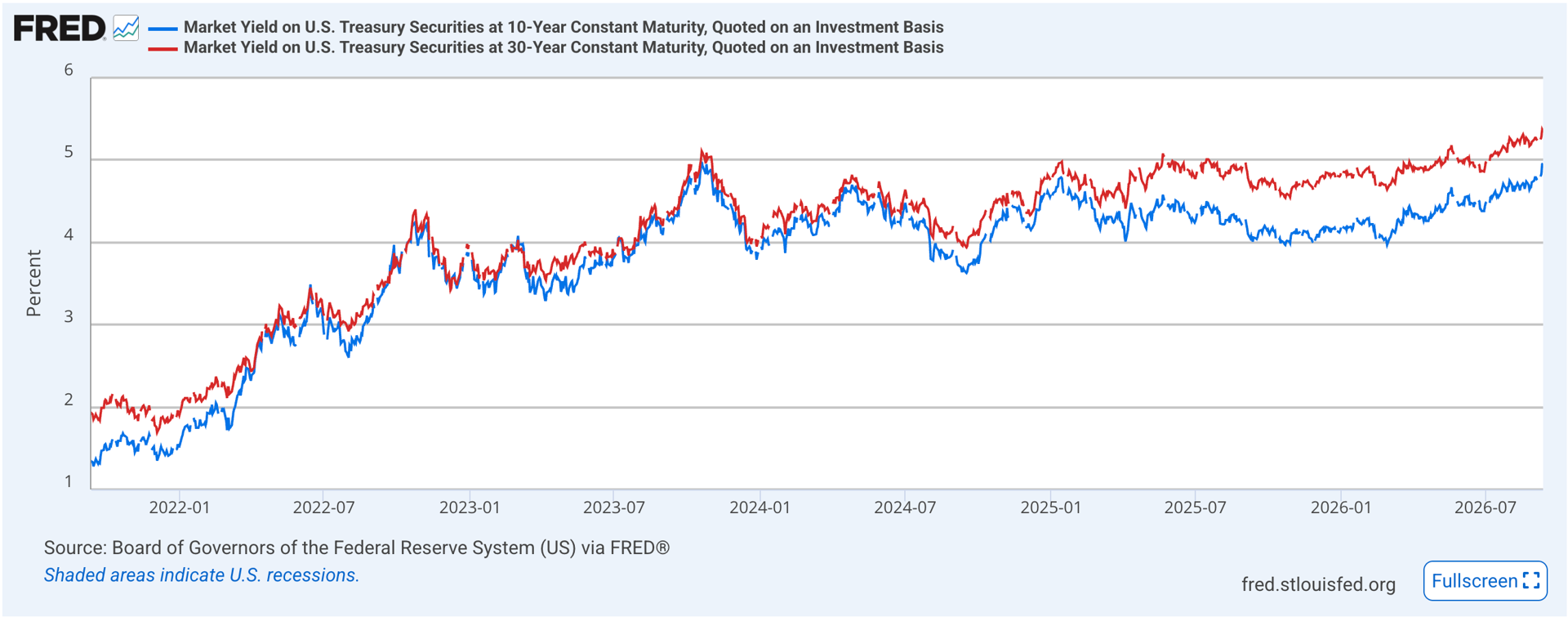
Justin Burgener, a portfolio manager at Cabeli Funds, sees a different risk with broader reach: rising yields on longer-dated bonds. In his view, higher long-term rates can pressure government financing, household spending, and the large capital investments supporting artificial intelligence. That means the next Fed hike may matter less than whether long-term borrowing costs keep climbing.
Burgener remains modestly defensive because he sees an expensive market with more potential for expectations to disappoint. Still, his approach is not to make daily calls on the S&P 500 or to abandon stocks altogether. He looks for individual companies that can grow through difficult end markets, then becomes more interested when their shares lag the broader market by roughly 10%.
Here is how that framework connects interest-rate risk with stock selection.
Who is Justin Burgener?
Burgener currently serves as a portfolio manager at Gabelli, a global investment firm where he manages the company’s Dividend Growth Fund and co-manages two others.
Burgener has worked in the investment world for over two decades, and he specializes in sectors like industrials, healthcare, and transportation — industries that investors often consider defensive safe havens during periods of market volatility and economic uncertainty.
Speaking with TheStreet’s Caroline Woods about the current state of the yield curve and the possibility of a pullback, this is what he had to say about how smart investors can consider approaching today’s market conditions.
Why long-term Treasury yields can pressure stocks and the economy
The long end of the yield curve refers to yields on longer-dated government bonds. Those yields influence the cost of financing across the economy, including mortgages, corporate borrowing, and government debt.
Burgener’s concern is that the same rise in long-term rates can hit several parts of the market at once. Consumers face tighter financial conditions, while companies undertaking major projects must pay more to finance them.
“The biggest risk is the long end of the curve, I think, because that just creates government funding concerns. It challenges the consumer. It even makes AI-related CapEx more expensive to fund.”
—Justin Burgener, when asked what he sees as the market’s biggest risk
Burgener’s point is counterintuitive because AI investment has helped drive earnings growth. Capital expenditure, often shortened to CapEx, is money a company spends on long-lived assets such as data centers and equipment.
Burgener argues that current AI-related spending can lift revenue and earnings for suppliers today, while the equipment eventually creates depreciation expense, an accounting charge that reduces future profits, for the large cloud companies buying it.
He said earnings growth has been strong, but he questions how investors should value earnings that may be elevated by that timing mismatch. Higher long-term yields also lower the present value investors place on future cash flows.
For a market already trading at a high valuation, that creates a difficult trade-off: Earnings can remain healthy while the price investors are willing to pay for those earnings falls.
Why traditional defensive sectors may not protect investors from higher rates
A defensive posture does not automatically mean loading up on consumer staples, health care, and utilities. Those sectors have often appealed to investors for their dividends and relatively steady demand. Burgener cautioned that higher long-term yields can work against yield-oriented stocks, because bonds become more competitive as an income investment.
Some traditional defensive companies also remain exposed to a pressured consumer. Burgener instead highlighted businesses with distinct operating strengths. His first example was Merck & Co., whose partnership with Moderna on a cancer vaccine reinforced his view of Merck’s research-and-development capabilities. He said Merck had risen almost 40% year to date, so he had trimmed the position to manage its size, while continuing to hold most of it.
For investors considering Merck after its advance, Burgener described a more selective entry point. He said he would look to add if the shares pulled back 5% to 10% relative to the market. Relative performance compares a stock’s return with a benchmark’s return, rather than judging a stock solely by whether its price has dropped in general.
How Ferguson Enterprises fits a stock-specific strategy
Ferguson Enterprises illustrates the type of company Burgener prefers in a more uncertain market. He said the building-products distributor is exposed to both residential and nonresidential construction, with the latter benefiting from large projects such as data centers. Burgener estimated that data centers account for close to 15% of Ferguson’s nonresidential sales.
His core argument is about growth relative to the company’s end markets. Burgener said Ferguson has outgrown those markets by 300 to 400 basis points, or 3 to 4 percentage points, through its participation in large projects, its focus on contractors that handle both heating, ventilation, and air conditioning and plumbing work, and its execution in its Ferguson Home business. A company that gains market share can grow even when the markets it serves are flat or shrinking.
Burgener also pointed to Ferguson’s $1.6 billion acquisition of FlowWorks as a way to expand into pumps, valves, and industrial markets. He projected $12 in earnings over the next 12 months and said the stock could be worth $280 in 18 months if its outgrowth persists.
Those are Burgener’s estimates, not guarantees, and they depend on the company continuing to execute as construction conditions and yields evolve.
When a relative pullback can create a buying opportunity
Burgener’s practical rule is designed for investors who already have a list of businesses they would be comfortable owning for three to five years. Rather than trying to predict the next few weeks for the market, he looks for a pullback of about 10%, or close to 10%, relative to the S&P 500 or an appropriate sector index before becoming more aggressive.
The rule is a screening tool, not a promise that a stock has reached its low.
The same discipline applies to The J. M. Smucker Company. Burgener said Smucker’s reported 5% sales growth in its latest quarter, including 1% volume growth, and raised its full-year sales guidance by 200 basis points. He also cited the company’s brands, including Folgers, Café Bustelo, Jif, and Uncrustables, as reasons it has a better growth profile than many consumer-staples companies.
Burgener expects Smucker to deleverage toward three times EBITDA, a measure of earnings before interest, taxes, depreciation, and amortization. He said that could eventually make share repurchases more feasible. He estimated that Smucker could approach $150 per share in 18 months, but that outlook rests on the company’s operating performance, debt reduction, and capital-allocation decisions.
The takeaway for investors in an expensive market
For long-term, buy-and-hold investors, Burgener’s framework begins with the business rather than a prediction about the index. Identify companies with credible revenue and earnings growth, a reasonable valuation, and a reason to gain market share. Then decide in advance whether a decline reflects a broken business case or temporary pressure that could lead to a more attractive entry price.
That approach also requires accepting a trade-off. Waiting for a relative pullback can mean missing a stock that keeps rising, while buying after a decline can expose an investor to further losses if the original investment case was wrong.
With long-term yields rising and policy uncertainty still elevated, Burgener’s message is to size positions carefully, keep an eye on borrowing costs, and reserve new purchases for businesses an investor would be willing to hold through multi-year volatility.
Burgener’s market view does not depend on calling the precise timing of the next Fed decision. Instead, it depends on recognizing that a sustained increase in long-term yields can reshape valuations and financing conditions, then using that volatility to evaluate a short list of durable companies more carefully.