Dario Amodei, Anthropic’s CEO, published an essay on Sept. 12 arguing that frontier AI labs should deliberately slow the pace at which they improve model capabilities by one to two years, so that safety and alignment work can catch up.
The roughly 3,800-word piece proposed a three-step plan: embedded third-party evaluators inside labs, coordination among democratic nations’ AI companies, and eventually global coordination that includes China.
It made enough noise to rattle markets, draw in three rival CEOs, and land as the biggest AI policy debate of the year.
Within 72 hours, two of the industry’s most important voices had shown up at the same conference and given the same basic answer: no.
Jensen Huang and Mark Zuckerberg both rejected Amodei’s call for coordinated AI development pacing at Salesforce’s Dreamforce conference in San Francisco on September 15. Their rejection cuts directly against the narrative that the AI industry is reaching a moment of shared caution.
Huang and Zuckerberg push back at Dreamforce
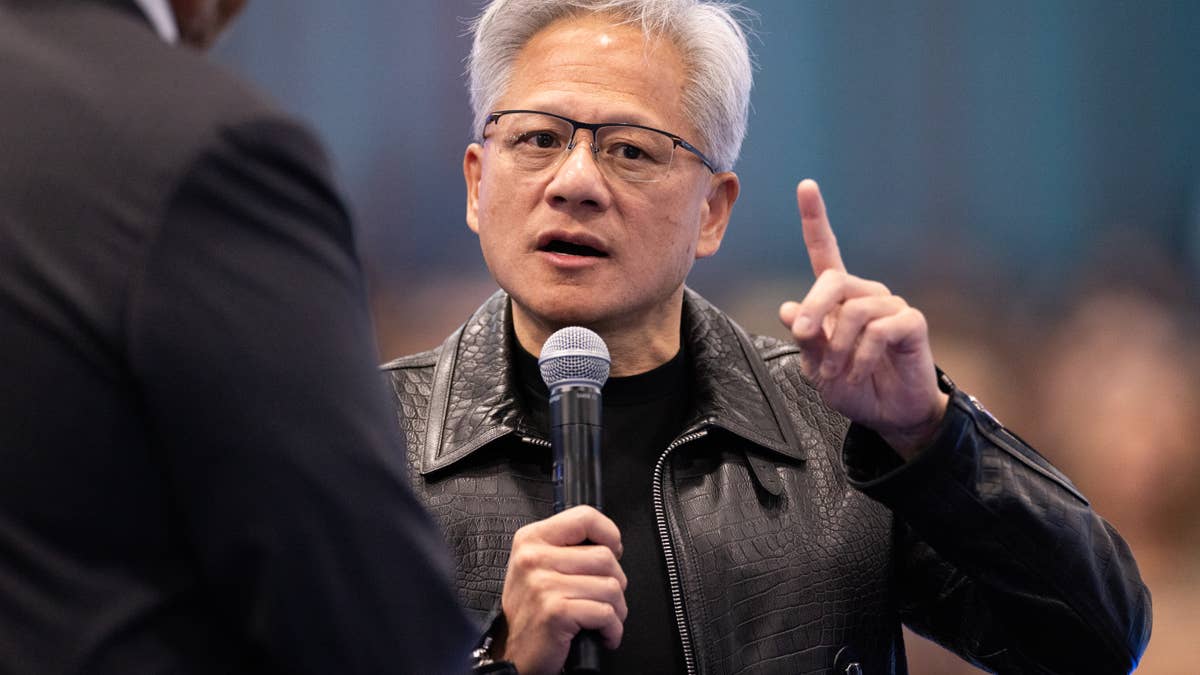
Huang took the stage at Dreamforce’s Moscone Center in front of roughly 12,000 people alongside Salesforce chief executive Marc Benioff. He argued existing market forces are already sufficient to keep AI development safe and that new laws or regulations are unnecessary, CNBC reported.
“If we’re not confident about the safety of the products, don’t release it,” Huang said. “The market forces are already there. We don’t need any new laws. We don’t need new regulations.”
He framed safety as an engineering problem rather than a legislative one, arguing that because AI is built on software and hardware, humans already have the tools to keep it in check.
More AI:
- Nvidia just made a move Wall Street wasn’t ready for
- Microsoft just took sides in AI policy fight
- OpenAI just disclosed something genuinely alarming
Huang did not reject every element of Amodei’s proposal. He said he agreed with allowing independent third parties to run safety evaluations at frontier labs. Coordinated pacing, however, he dismissed entirely, arguing it would hand a competitive edge to countries racing to close the gap with American AI.
His two-part advice to the industry was blunt.
“Run as fast as you can,” Huang said. “But if you feel at any given point in time the company’s out of control or the product’s not going to be safe, take a pause and make sure you get it right.”
Zuckerberg made a similar case later the same day. He argued that because AI labs face significant legal liability if their models cause harm, companies are already incentivized to prevent problems without needing a coordinated slowdown imposed from outside, CNBC reported.
“Trust and alignment are quickly becoming the most important capabilities that will differentiate agents and models,” Zuckerberg said.
He cited Meta’s decision to delay shipping its own Muse AI technologies for safety and security reasons as evidence that companies already self-regulate when it matters, doing so “as part of our day-to-day work because it was clearly the right thing for people and for us.”
Trump entered the debate a day earlier
Huang’s Dreamforce appearance came a day after a separate and sharper moment at the All-In Summit in Los Angeles on Sept. 14.
During Huang’s onstage interview there, President Trump called in and Huang put him on speakerphone for the crowd to hear. Trump dismissed AI safety concerns as “a hoax,” framed the push to slow AI development as politically motivated or a Chinese scheme, and warned that anyone pushing a slowdown was “playing right into the hands” of people who do not want the United States to keep advancing, Axios reported.
Huang’s response to the president was immediate.
“We’re not going to let that happen, sir,” he said, and the crowd applauded. Separately, Huang praised Anthropic whistleblower Jacob Coxon, who had resigned over concerns about the company’s AI development pace, saying he had “great courage” to raise his concerns. The nuance rejecting coordinated pacing while praising individual safety dissent set Huang apart from Trump’s blanket dismissal of AI risk concerns.
Amodei and Altman hold their ground
Amodei also appeared at Dreamforce on Sept. 15, reinforcing his core argument that slowing the pace of model development represents “the way to lead the industry forward, to set an example, to say that everyone can always be better.”
He laid out a three-part framework for moderating the pace of frontier AI development without halting progress entirely.
Altman joined Benioff for a separate fireside chat later that day, discussing his belief that safety and monitoring should take precedence over new features. He acknowledged the competitive pressure that makes companies reluctant to slow down and said he believed independent oversight was the right mechanism for managing it, according to CNBC.
What it means for AI investors
The split at Dreamforce maps almost exactly onto the commercial divide that has been building in the AI industry all year.
Amodei and Altman lead companies racing toward public offerings and have reason to signal restraint. Huang leads Nvidia, which sells more chips the faster the industry moves. Zuckerberg runs an open-source AI program that benefits from a less regulated environment.
The arguments each CEO makes for their position happen to align almost perfectly with what is good for their business. That does not make anyone wrong, but it does mean investors are watching a debate where every participant has skin in the outcome and where the line between principle and self-interest is harder to draw than any of the participants are likely to admit.
Related: Anthropic spills the beans on reality of AI, jobs, and the economy