Investors looking at $100 oil, elevated Treasury yields, and political scrutiny of data centers could conclude that the stock market’s next problem is likely to be a broad economic slowdown. This isn’t an uncommon take. Danish economist Henrik Zeberg recently told Business Insider his models forecast a dot-com-like crash in the stock market before the end of the year, followed by a full-blown recession.
David Wagner, head of equity and portfolio manager at Aptus Capital Advisors, reaches a different conclusion: He sees a sentiment-driven pullback rather than a growth-driven crash, and he favors a barbell-shaped investment strategy that combines AI infrastructure beneficiaries with quality companies whose valuations have fallen.
His practical screen for both of these types of stocks is momentum, both in prices and earnings expectations. He also advocates avoiding lower-quality small companies that do not generate profits.
Wagner sat down with TheStreet’s Caroline Woods to build his case:
Why David Wagner sees a sentiment pullback — not a growth scare
Wagner’s starting point is deliberately simple. Rather than trying to trade every geopolitical headline or policy debate, he focuses on economic growth and corporate profitability. In his view, those two measures offer a more useful guide to the market’s underlying conditions than daily swings in oil prices or Treasury yields.
He called the latest Q2 earnings season the strongest of his career. Wagner said the average stock posted year-over-year earnings growth of 15.8%. He also said profitability was improving in the market capitalization-weighted S&P 500, the S&P 500 Equal Weight Index, and small-cap benchmarks.
Those are broad assertions from Wagner’s market read, rather than independently reported figures, but they explain why he remains constructive despite expectations for a pullback in equities.
“I’d vehemently answer sentiment risk. I mean, anywhere you look right now, there is growth everywhere.”
—David Wagner, when asked whether the market faces a sentiment-driven or growth-driven pullback
Wagner’s distinction matters because it changes how an investor interprets a decline. A sentiment-driven pullback is a drop caused by fear, uncertainty, or a sudden change in market mood, even when the broader growth picture remains intact. A growth-driven pullback reflects weakening business conditions and can be harder for stocks to shake off.
He said the two types have looked different in recent examples. Wagner characterized the 2025 tariff tantrum as a growth scare that produced a 17% market decline from peak to trough. He described the pullback tied to the Iran conflict earlier in the year as a sentiment scare, with the market down about 7% to 8%.
Those are simply examples that illustrate his framework, though, not a forecast that every future decline will follow the same pattern.
Oil and rates can still unsettle investors. Wagner said oil at $100 a barrel was more noise than a fundamental threat, citing greater drilling efficiency in the United States than during past oil shocks.
Rates are a near-term concern in his view. Wagner is watching a 10-year Treasury yield at 5%, which he said could weigh on sentiment and pressure more expensive parts of the market.
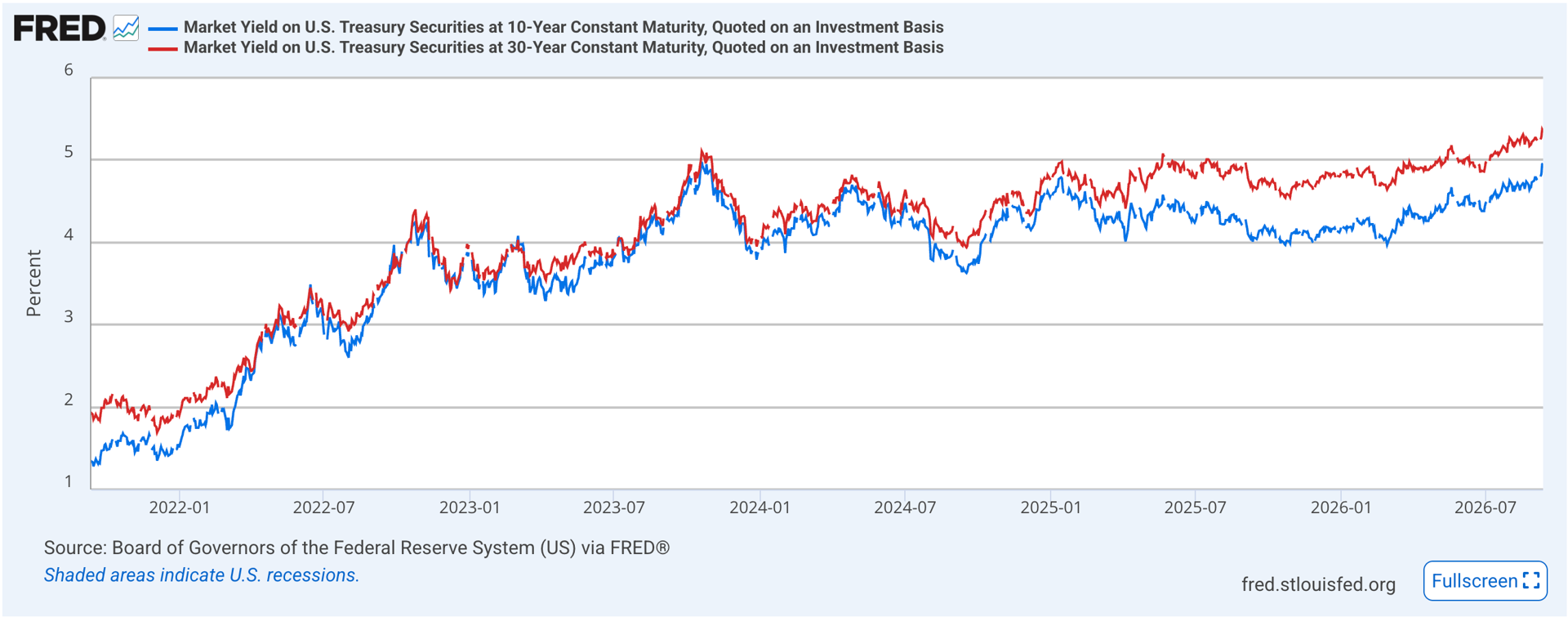
Higher yields (the annual return implied by a government bond’s market price) can reduce the present value investors assign to future corporate profits, which can put downward pressure on stock prices, particularly for companies whose expected earnings lie further in the future.
Yet Wagner emphasizes the speed of a yield increase over the level alone. A rapid move can force investors to reassess equity valuations quickly, while a higher yield that develops more gradually may be easier for markets to absorb. That is why his thesis allows for ongoing volatility without treating every sudden burst of volatility as evidence that the expansion has ended.
Why AI spending remains the market’s main structural risk
Wagner separates temporary macro concerns from the issue he believes could change the market’s foundation: a meaningful slowdown in artificial intelligence spending.
Artificial intelligence has driven much of the growth narrative in recent years, and a slowdown in spending on the equipment and facilities that support it could affect expectations across technology, power, and industrial companies.
“AI has been the center story. It’s been the main character for the market for the last three years, and I think it’s going to continue to be the main character over the next few years.”
—David Wagner, when asked about the biggest risk to the market
Wagner does not describe the AI trade as a bubble that must inevitably end badly, although this perspective has grown increasingly common. Economic advisor John Higgins, for instance, said he sees “signs that we are now in the late stages of a bubble in AI.”
Wagner’s counterintuitive comparison is that some investment booms can leave behind useful infrastructure, while debt-fueled speculation in a commodity can prove more destructive. He placed the 1999 dot-com bubble in the first category and Dutch tulip bulb mania in the second.
The distinction helps explain his preference for businesses selling the physical inputs required for an AI buildout.
He admits, though, that politics could still create a short-lived scare. Wagner said data centers have become part of affordability debates in Texas and Ohio, raising the possibility that investors might worry about slower capital expenditure (CapEx). CapEx is money a business spends on long-lived assets such as data centers, power equipment, and networks. Wagner’s view is that the bottleneck is the availability of parts and infrastructure, rather than political opposition, though he acknowledges that politics could affect market sentiment.
Related: What was the dot-com bubble & why did it burst?
What is Wagner’s ‘barbell’ investment strategy?
A barbell strategy pairs two different types of holdings, rather than concentrating a portfolio in one narrow theme.
The first side of Wagner’s barbell is growth-oriented companies that benefit from the physical work of building AI capacity. The second side is one value-oriented company that he thinks has temporarily fallen out of favor
The growth side of the barbell: Amphenol and Quanta Services
In Wagner’s version of a barbell investment strategy, the growth end includes Amphenol Corporation and Quanta Services, Inc.,
What does Amphenol do?
Amphenol is Wagner’s preferred way to look beyond the familiar chipmakers and hyperscalers (the giant cloud-computing companies that operate vast data centers, like Amazon, Google, and Microsoft).
He described Amphenol as the connectivity system that moves power and data around an AI server rack. The company sells components used across copper, fiber-optic, and hybrid designs, a breadth that Wagner believes reduces the need to guess which specific AI architecture will dominate in the future.
Wagner said Amphenol’s data-communications business has become its largest segment and is expanding at an unusually fast rate for the company, citing a valuation of roughly 36 to 37 times forward earnings and a growth rate of about 18%. (Forward earnings are analysts’ expected profits for a future period. Neither valuation nor growth is a price target, and neither guarantees that the stock will rise.)
What does Quanta Services do?
Quanta Services represents the power side of the same buildout. Wagner’s argument is straightforward: A data center cannot operate without electricity, and new electricity demand requires equipment, grid connections, substations, generation, and skilled labor. He said Quanta Services performs much of the work required before a graphics processing unit can run.
Wagner said Quanta Services had a backlog of about $53 billion, up roughly 50% year over year, driven by AI-related power projects, and that management had raised four-year guidance. (A backlog is work a company has been contracted to perform but has not yet completed.)
He also said Quanta’s management estimated that its data-center work accounted for roughly 80% to 90% any given buildout, excluding chips. (Those figures are Wagner’s characterization of the company’s results and management commentary, not independent estimates.)
The risk is clear. These companies depend on data-center construction and AI capital spending continuing at a strong pace. If hyperscalers pull back on projects, the shares of infrastructure suppliers could suffer even if their long-term businesses remain sound.
Wagner’s thesis here is more of a view about where spending and demand will persist, rather than a claim that the stocks are insulated from a market selloff.
The value side of the barbell: Copart, Inc.
Copart, Inc. fills the other side of Wagner’s barbell. The company operates an online marketplace for used, damaged, and totaled vehicles. Its shares have fallen by double digits year-to-date, prompting Wagner to argue that a strong franchise can become more attractive when investors lose interest in its near-term story.
His case centers on competitive position. Wagner said Copart and its competitor, IAA, Inc., owned by Ritchie Bros. Auctioneers Incorporated, have historically divided the market roughly evenly. He said Copart gained market share from 2020 through 2024 due to technological advantages, then faced pressure after Ritchie Bros. Auctioneers acquired IAA and outlined initiatives to regain share.
Wagner sees signs that Copart is responding. He cited the return of a former chief executive officer, the executive’s substantial stock ownership, and a new growth plan. He also said Copart bought back about 5% of its shares outstanding during the prior two quarters and held cash equal to about 12% of its market capitalization.
Share buybacks reduce a company’s total number of shares outstanding. Although they do not automatically create value, they increase earnings on a per-share basis, which can make a stock more attractive to buyers, in turn increasing its price.
For Wagner, the point is not that a falling stock is automatically a bargain. The point is to look for a business with a plausible operating catalyst, financial flexibility, and a reason for investors to reassess its valuation. He selected Copart when asked which of his four picks he would buy if restricted to one name at current prices.
Related: What is a stock buyback? Definition & effects
How to use earnings momentum without chasing every winner
Wagner’s screening method offers the most transferable part of his approach. He calls himself a factor investor, meaning he uses measurable characteristics to identify potential investments. The factor he favors now is momentum, but he looks for it in two places: the stock’s price behavior and changes in earnings expectations.
Technical momentum refers to a stock’s price trend. Fundamental momentum refers to improvement in the business outlook, such as analysts raising their earnings-per-share estimates.
Wagner specifically watches the 30-day change in earnings-per-share expectations. An investor using that measure should recognize its limitation: Analyst forecasts can change again, and rising estimates do not make a company immune to an expensive valuation or a broader market decline.
That two-part test explains why Wagner can own winners in AI infrastructure while also looking at laggards such as Copart. He wants AI-linked companies with improving earnings expectations, alongside quality businesses that have been rerated lower by the market but are beginning to show both fundamental and technical momentum.
A rerating is a change in the valuation multiple investors are willing to pay for a company’s earnings.
Progressive Corporation is another example of the latter category in Wagner’s discussion. He argues that the auto insurer’s current effort to gain market share is holding down underwriting margins, leaving the market too pessimistic about its valuation. He said a later shift toward higher margins could lead investors to assign a higher earnings multiple.
Why Wagner avoids low-quality small-cap companies
Wagner’s enthusiasm has a boundary. He said he is avoiding non-earners (companies that don’t turn a profit), especially among smaller firms with high leverage (debt) and slowing growth.
His concern is that these lower-quality stocks have had an unusually long period of outperformance and could be vulnerable if volatility returns. This is a quality screen, not a broad rejection of small-company stocks.
In other words, when market conditions become less forgiving, Wagner’s preference is for companies with earnings power and more durable balance sheets.
Related: Kevin Mahn sees S&P 500 pullbacks as chances to stay invested
The takeaway for investors weighing AI stocks and Copart
Wagner’s approach is designed for investors who already accept stock-market risk and can tolerate a pullback without being forced to sell.
It begins by deciding whether weakness appears tied to deteriorating growth or to changing sentiment. Investors who conclude that business conditions are weakening may want a more defensive posture; investors who share Wagner’s view that growth remains intact may focus on companies whose earnings outlook and price trends are improving.
The next decision is whether a holding has a specific reason to work. For Amphenol and Quanta Services, Wagner’s reason is sustained demand for the connectivity and power infrastructure behind AI data centers. For Copart, it is a potential recovery in market-share momentum backed by buybacks, cash, and management changes. Those are distinct theses, so an investor should assess each one on its own merits rather than treating them as interchangeable bets.
Finally, Wagner’s bullish stance should not erase valuation and concentration risk. A portfolio built around a single technology spending cycle can be exposed if that cycle slows, while a turnaround candidate can stay cheap if its operating improvement does not arrive.
The decision procedure is simple: Distinguish fear from weakening fundamentals, demand evidence of improving earnings expectations, and make sure each position has a business-specific catalyst that still makes sense if the market becomes less enthusiastic.
Wagner’s central message is that investors should treat a sentiment-driven decline differently from a deterioration in economic growth. His preference for AI infrastructure alongside Copart rests on a view that earnings strength remains broad, while the biggest market risk would be a genuine slowdown in AI spending.
David Wagner on Street Talk · Watch the full segment