In technology, the loudest applause usually comes at the demo, not the delivery. A flashy prototype draws headlines. The unglamorous rollout that actually generates revenue often gets a shrug.
CoreWeave, Inc. (CRWV) just lived that gap. The AI cloud provider rents out Nvidia Corporation (NVDA) chips to companies building artificial intelligence systems.
On Wednesday, September 16, it said it had linked hundreds of Nvidia’s newest Rubin GPUs into a single working cluster, not just a test rack, according to the announcement.
For investors, that business model makes CRWV one of the most direct public ways to bet on AI infrastructure demand, without owning a chipmaker outright.
Nvidia, by contrast, is best known as the company that designs the GPUs everyone in the AI race is trying to get their hands on.
That distinction matters more than it sounds. CoreWeave first brought a single Vera Rubin rack online in June, a milestone that sent its stock up nearly 14% in one day, according to a Motley Fool market recap.
Related: Jim Cramer drops 5-word verdict on Nvidia stock
Wednesday’s update is the less flashy, more consequential step: proof that the system works at the scale customers actually pay for.
Why the multi-rack milestone matters more than the first
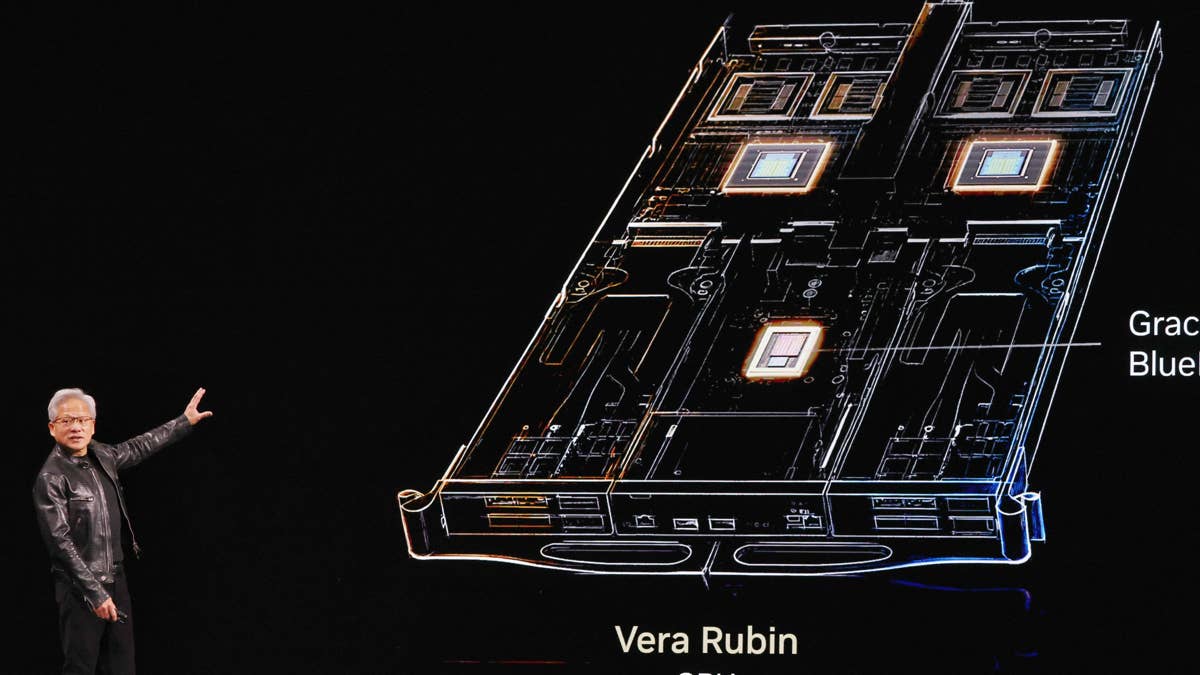
A single Vera Rubin rack pairs 72 Nvidia Rubin GPUs with 36 Vera CPUs on one liquid-cooled shelf, according to Nvidia’s own materials. That proves the chip works. It says nothing about whether a customer can rent enough of them, wired together, to train or run a real AI model.
The latest cluster is different. CoreWeave linked the racks with Nvidia’s Spectrum-X Ethernet networking, fast enough to support roughly 128,000 GPUs on one non-blocking network, according to the announcement. That is the plumbing agentic AI systems need to keep learning without stalling.
Investors noticed the difference. Shares rose about 3% after the announcement, a modest move compared to June’s 14% pop, according to Seeking Alpha.
Markets tend to reward the announcement of a breakthrough more than the harder work of scaling it.
What Wall Street thinks of CoreWeave stock right now
Wall Street remains bullish, but not uniformly. Analysts covering CoreWeave carry a consensus “Buy” rating with an average price target of $144.46, implying more than 70% upside from current levels, according to S&P Global Market Intelligence data compiled by StockAnalysis.com.
That consensus hides real disagreement. Bernstein reiterated a sell rating on September 14 with a $74 price target, while Truist Securities kept a buy rating and a $165 target the same month, according to StockAnalysis.com. The gap reflects a genuine debate over CoreWeave’s heavy debt load.
That debt load is real. CoreWeave carries roughly $51.6 billion in total debt against $5.5 billion in cash, according to StockAnalysis.com’s balance sheet data.
The company is betting that today’s cluster and the customers lining up to rent it will justify the borrowing.
CoreWeave isn’t just an Nvidia reseller
CoreWeave’s story is not only about chips. Alongside the cluster news, the company rolled out three upgrades to CoreWeave AI Object Storage, the system that feeds data to those GPUs. They matter because idle GPUs waiting on data are as costly as GPUs that do not exist.
Two of those upgrades speed up how data moves. Cross-region write acceleration replicates data faster across CoreWeave’s network, easing bottlenecks for training runs that span multiple regions, while a new Archive tier gives customers a cheaper home for data models rarely touch.
A third caches frequently used files closer to the GPUs that need them, cutting data-retrieval latency by as much as eight times, according to CoreWeave.
Those storage upgrades are critical for retaining the mega-cap clients that actually drive CoreWeave’s revenue.
Microsoft, Meta Platforms and OpenAI are among its largest customers, each renting compute to run their own AI products, not reselling Nvidia hardware on Nvidia’s behalf. That customer mix is what actually pays down the debt Wall Street is watching.
None of this makes CoreWeave immune to Nvidia’s shadow. Even CoreWeave’s own chief executive, Michael Intrator, has pushed Nvidia to expand chip supply faster or risk losing customers to AMD.
That tension, not blind loyalty, is closer to how the relationship actually works.
More AI:
- Nvidia just made a move Wall Street wasn’t ready for
- Burry says AI leaders have ‘nothing to slow down’
- The next AI boom could be hiding in cybersecurity
The real bottleneck in AI is shifting
While fighting for chip supply is one headache, the news was really two announcements wearing one headline.
A faster chip cluster and a faster storage system, released together, point to the next strain in the AI buildout.
For years, the AI infrastructure story was about who could buy the most chips first. Skeptics increasingly frame it as a data-movement and financing problem instead, a theme Fortune has tracked across the sector’s debt-fueled buildout.
The storage upgrade, paired with the compute milestone, is CoreWeave’s attempt to answer both critiques at once.
CoreWeave crossed one threshold this week. The next one is harder: keeping hundreds of thousands of GPUs fed with data as fast as they can compute.
That test, not this week’s headline, will determine whether this generation of AI clouds earns its valuation or simply outpaces its balance sheet.
Related: Bernstein’s AI slowdown warning has one clear loser