I get a coffee, an iced tea, or some other drink from Starbucks nearly every day.
That, at least to me, feels like a nonnegotiable reward for working hard. Yes, I’m spending $4-6 on something I can make at home, but it’s an ingrained ritual that’s a pleasant part of my day, and something that’s a fixed cost, not an indulgence.
But buying an $8-$12 smoothie from Jamba Juice, Smoothie King, or the new place opening down the road from me, Bora Bora Smoothie Cafe? That choice seems increasingly difficult to justify as consumers become more selective about where they spend, while GLP-1 drugs add another challenge for food and beverage companies.
“As households navigate ongoing financial pressures, consumers are becoming more intentional about where they spend, balancing health, wellness, and enjoyment while prioritizing the outcomes they value — a shift further shaped by growing GLP-1 adoption,” Circana reported in its 2026/2027 Global Food and Beverage Outlook.
The market makes a chain like Jamba Juice, which has terminated 116 franchise agreements and had another 14 operators not renew, a challenge to operate.
Jamba Juice loses 130 franchise operators
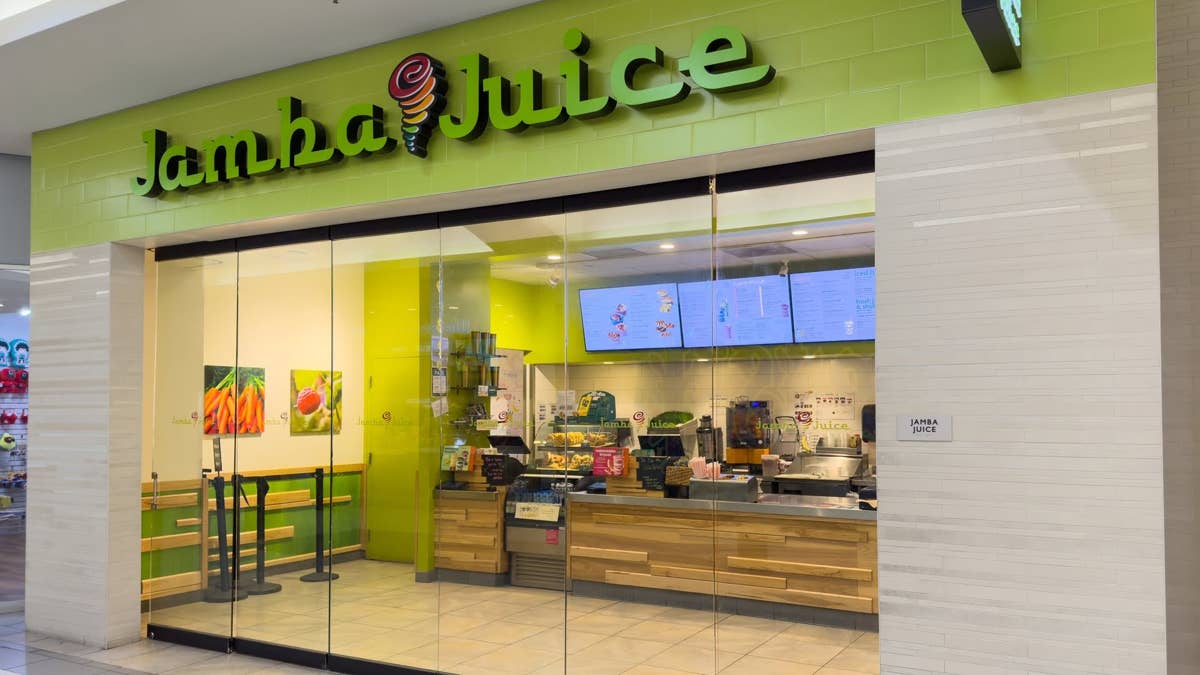
Jamba Juice sells smoothies, blended coffee, fruit and acai bowls, various drinks, oatmeal, and juices.
The company, which is franchised, reported that it has lost a lot of locations.
In a “special risks” section of its 2026 franchise disclosure document (FDD), which can be downloaded here, the smoothie chain revealed that 130 Jamba Juice franchise agreements have not survived the last three years.
“During the last three years, 130 outlets were terminated, not renewed, reacquired, or ceased operations for other reasons. This franchise could be a higher-risk investment than a franchise in a system with a lower turnover rate,” the company shared.
The 2025 FDD shows that the chain closed nearly 50 stores (although it also added locations). Most of those were the company terminating the franchise deal. Only three of the stores that closed in 2025 were franchise operators deciding not to renew.
There was a net loss of 17 when offset by the openings.
“In an unusual twist, that turnover rate has been overwhelmingly driven by franchise terminations, the document reveals, with some 116 Jamba Juice franchises being terminated since the beginning of 2023. Over that same period, only 13 franchises were listed as non-renewals, and just one store ceased operations for another reason,” Fast Company reported.
Jamba is performing well below industry norms.
“The high level of terminations is not typical of Jamba’s competitive set. By comparison, rival Tropical Smoothie Cafe had only 28 terminations over the same three-year period, despite that chain having a much larger footprint. Planet Smoothie, a smaller competitor, had just 4 terminations,” added Fast Company.
Shutterstock
What does it cost to open a Jamba Juice?
Jamba Juice explains its franchise model on its website: “Every market is different. That’s why Jamba offers multiple development formats designed to match different investment goals, locations, and growth strategies,” the company shared.
The company shared the costs of its various models:
- Traditional store: Starting at $480,850
- Drive-thru: Starting at $517,000
- Nontraditional investment (like a mall food court or rest stop): Starting at $249,025
The company also shared its financial requirements:
- Initial franchise fee: $35,500
- Minimum liquid capital: $120,000
- Minimum net worth: $300,000
- Estimated initial investment for a traditional store without a drive-thru: $481,000 to $941,000
A traditional Jamba store requires an estimated initial investment of $480,850 to $941,300, according to the company’s 2026 FDD.
Jamba faces an economic problem
Starbucks has seen its U.S. same-store sales climb, which suggests that even in a challenging economy, the company’s customers see its coffee, snacks, and meals as an affordable indulgence.
“North America comparable store sales increased 8.1%, primarily driven by a 4.5% increase in comparable transactions and a 3.5% increase in average ticket; U.S. comparable store sales increased 7.9%, primarily driven by a 4.2% increase in comparable transactions and a 3.6% increase in average ticket,” the company shared in its third-quarter earnings release.
Jamba’s closures suggest the people don’t see the chain’s products the same way, according to RTM Nexus CEO Dominick Miserandino.
“The challenge for Jamba is that a smoothie is easier to cut out of the budget than coffee. Coffee has become part habit, part ritual, and part reward. A smoothie may be healthier or more substantial, but at $9, consumers are much more likely to look at it and say, ‘I don’t really need that today,’” he told TheStreet.
Consumers have become more careful with their money, according to EY-Parthenon Americas Retail Sector Leader Will Auchincloss.
“More than half of consumers report saving nothing, and one in five households are spending beyond their income. For retailers, demand remains intact but increasingly selective, making value, affordability and clear differentiation more important than ever,” he said in an EY-Parthenon release based on an August survey.