Industries eventually have to decide where learning ends and stealing begins.
Musicians sample old records. Drugmakers wait for a patent to expire, then sell the generic. Automakers buy a rival’s newest model on launch day and take it apart in a garage, one bolt at a time.
Nobody loses sleep over most of that, because the rules are old and everyone knows them.
Artificial intelligence doesn’t have old rules yet. The top American labs spend fortunes training their models, and a rival with enough accounts can ask those models millions of questions, then use the answers to teach a cheaper model of its own.
That sounds like a fight for engineers until you notice who ends up paying. The AI tools at your job, the chatbot on your phone and the chip stocks sitting inside your 401(k) all ride on how it gets settled.
Washington has already chosen its word for the practice: theft. On Monday morning, the most powerful executive in the chip business went on live television and chose a different one.
Nvidia (NVDA) CEO Jensen Huang was asked on Squawk Box whether AI model distillation amounts to robbery. “That’s called competition,” Huang said, according to CNBC.
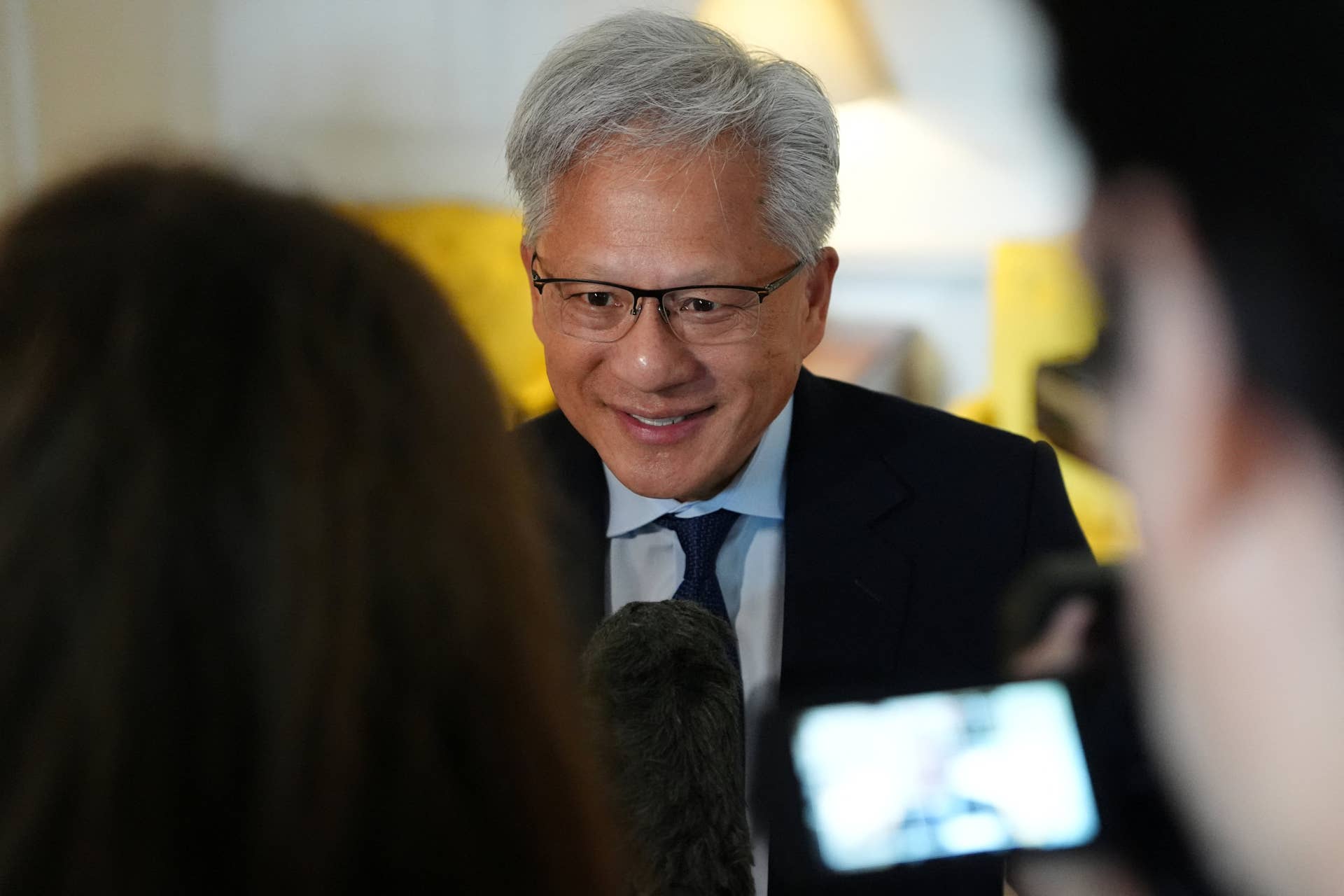
Jensen Huang rejects Treasury’s AI theft label
Huang’s case is simple. Companies are allowed to test a rival’s products as much as they want, he said, and Nvidia’s own hardware gets stripped down by competitors trying to learn how it works, CNBC reported.
He admitted he would rather rivals didn’t do it. But he argued competition makes everything better, and that a company unhappy with how its product is used can vet its customers and cut off the service, CNBC reported.
Related: Zuckerberg, Musk, and Huang take key stand on huge AI issue
That puts him squarely at odds with Treasury Secretary Scott Bessent. Bessent said in July that officials had found traces of U.S. models inside Chinese ones and warned that “we have the ability to sanction them because of this theft,” he told Fox Business, as reported by CNBC.
Huang didn’t blink then, either. A day later, he said U.S. companies should “absolutely” be allowed to run Chinese AI models, according to Axios.
The White House did not immediately respond to CNBC’s request for comment on Monday, Sept. 28.
Why the distillation fight escalated in September
The dispute stopped being a war of words on Sept. 8. Three agencies accused six China-based developers, including Alibaba (BABA) and DeepSeek, of running “industrial-scale knowledge distillation campaigns” against American models, according to CISA.
More Artificial Intelligence:
- Bill Gates doubles down on AI warning after decades of optimism
- OpenAI paused training again, and Washington’s in the middle of it
- Huang says 1 number in the AI debate isn’t science-based at all
The advisory came from the National Security Agency (NSA), the Federal Bureau of Investigation (FBI) and the Cybersecurity and Infrastructure Security Agency (CISA). It said the firms pulled billions of tokens from U.S. frontier models since at least late 2024, in violation of those companies’ terms of service.
The agencies also described distillation as a valid training method that becomes a problem when it’s used to shortcut a competitor’s work. As TheStreet reported, U.S. intelligence agencies now say someone is quietly copying America’s AI.
Here’s how the fight has built since summer:
- July 21: Bessent says the U.S. could sanction overseas models built on stolen capability, per CNBC.
- July 22: Huang says U.S. firms should be free to use Chinese models, per Axios.
- Sept. 8: The NSA, FBI and CISA name six Chinese AI developers in a joint advisory, per CISA.
- Sept. 9: China’s Commerce Ministry says the allegations lack evidentiary and legal basis, per China IP Law Update.
- Sept. 20: Bessent proposes a U.S.-China channel for flagging AI incidents after talks in New York, per CNN.
- Sept. 28: Huang calls distillation competition on live television, per CNBC.
Nvidia’s China sales tell a different story
Here’s the part that surprised me. Huang isn’t defending a China revenue stream, because Nvidia barely has one left in data centers.
Nvidia has been guiding with zero China data center compute revenue baked in, as TheStreet reported after Nvidia’s first-quarter beat. Huang has also said export curbs wiped out Nvidia’s share of China’s AI chip market, TheStreet reported in its look at Nvidia’s uncomfortable new reality.
So when I lined up his July comments against Monday’s, the “talking his book” read fell apart. In my analysis, he’s defending the loop his whole business runs on: models get built, studied, shrunk and rebuilt, and every pass runs on someone’s chips.
There’s a defensive angle, too. China’s antitrust regulators found in September 2025 that Nvidia’s compliance with U.S. export rules violated the terms of its Mellanox deal approval, according to Nvidia’s latest quarterly filing.
Beijing has also warned it would answer new restrictions tied to distillation with “resolute countermeasures,” Tech Insider reported. My read is that Nvidia, with its China antitrust exposure already on record, is the most obvious American company within reach.
What a record $150 billion buyback says about the risk
Huang spoke the same morning Nvidia added a record $150 billion to its buyback, lifting its remaining capacity to $235 billion, Reuters reported.
The stock traded at about 16.5 times forward earnings, its lowest multiple since January 2015 and well under its 15-year average of 30, according to LSEG data cited by Reuters. That’s a market pricing in slower growth for the world’s most important AI supplier.
If you own an S&P 500 index fund, you own a slice of Nvidia whether you chose it or not. A sanctions fight that spills into chip retaliation is exactly the kind of risk that can keep that multiple compressed.
Huang is betting the other way. A buyback this size says management thinks the shares are cheap, and his comments on Monday, Sept. 28, say he thinks Washington’s theft framing is the bigger threat to the AI boom than Chinese copying.
Shenzhen talks set up the next sanctions test
Washington and Beijing are also still talking. Bessent said the two sides agreed to meet again in about two months in Shenzhen, China, to work on protocols for serious AI incidents, Benzinga reported.
That meeting is the one to watch. If Treasury names a specific Chinese lab before then, Huang’s stance turns from a policy opinion into a bet against his own government.
If it doesn’t, Huang may have just shaped the rules of AI’s copying era before Washington finished writing them. And the cheaper AI tools that follow would run on Nvidia chips either way.