Every investor eventually learns that safety has a price. You just don’t always see the bill until it shows up.
For most of the past two years, the bill for owning gold and silver looked tiny. The metals paid you nothing, but savings accounts and bonds paid so little that almost nobody cared.
That math fueled one of the great precious-metals runs of our lifetimes. Gold broke past $5,000 an ounce and silver topped $100 in January, and millions of ordinary savers bought in as a shield against inflation, war headlines and a wobbly dollar. Some bought coins, and others bought funds that track the metal.
Then the ground started moving under them. The Federal Reserve stopped talking about cuts and started talking about hikes, oil refused to come down, and bond buyers began demanding more money to lend Washington cash for a decade.
On Monday, Sept. 28, that slow grind turned into a shove. Gold and silver prices crashed as the 10-year Treasury yield climbed back above 5.2%, and the gap between what metals pay you and what bonds pay you got too wide to ignore.
Gold and silver prices slide to a seven-week low
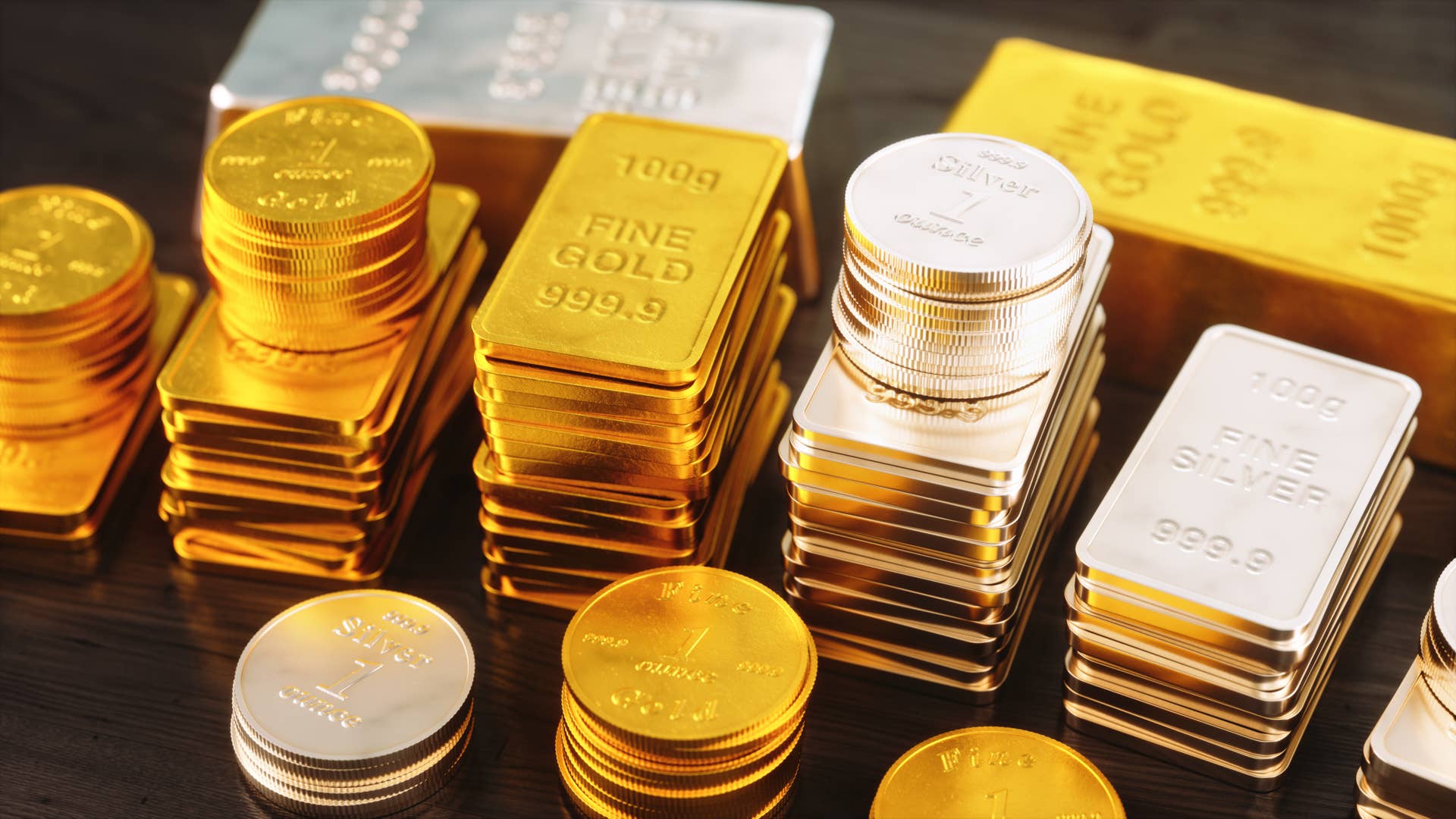
December gold futures settled 3.52% lower at $4,135.40 an ounce on Sept. 28, according to Comex settlement data reported by GoldSeek. Spot gold touched its weakest level in seven weeks, reported Trading Economics.
Silver took the harder hit. Spot silver slid 4.31% to $61.53 an ounce, while the gold-to-silver ratio widened to roughly 67, according to USAGOLD.
More Gold & Silver:
- Top Wall Street firm resets gold price target for 2030
- JPMorgan revisits silver price target ahead of 2027
- A seven-year standoff over Venezuelan gold nears its end
The pain spread to the miners, too. Newmont (NEM) fell more than four percent as the metal dropped, reported CNBC.
Max Baecker, president of American Hartford Gold, framed the fork in the road bluntly. “If hikes bring inflation under control, gold faces sustained pressure,” he said in a note, according to CNBC.
Why a 5.2% Treasury yield hits precious metals hard
Gold and silver have one structural weakness. They never mail you an interest check, so every point a Treasury bond pays is a point you give up by holding metal instead.
That trade-off just got expensive. The Fed raised its benchmark rate by a quarter point to a range of 3.75% to 4% on Sept. 16, according to the Federal Reserve. It was the central bank’s first increase since 2023.
Bond yields kept climbing after the decision. The 10-year Treasury yield hit its highest level since 2007 last week, reported Trading Economics.
Related: Gold, silver rally off ugly crash, but investors remain on edge
Oil poured fuel on the fire. Brent crude pushed back above $100 a barrel after President Donald Trump rejected Iran’s latest proposal to reopen the Strait of Hormuz, reported Yahoo Finance.
Higher energy costs mean stickier inflation, and stickier inflation means a Fed that keeps hiking. Bond yields and oil prices together “act as a thorn in gold’s side,” said Tim Waterer, chief market analyst at KCM Trade, in a Reuters report published by CNBC.
Here’s how the damage stacked up on Monday, Sept. 28:
- Gold futures: Settled at $4,135.40, down 3.52% (Source: Comex data via GoldSeek)
- Spot silver: $61.53, down 4.31% (Source: USAGOLD)
- 30-year Treasury yield: Topped 5.3% alongside the 10-year’s move above 5.2% (Source: Reuters via USAGOLD)
- October hike odds: 70.3%, up from 64.2% a day earlier (Source: CME FedWatch via Yahoo Finance)
- Newmont (NEM): Down more than four percent (Source: CNBC)
I ran the numbers on what this means for a regular saver. A $10,000 gold position bought at the end of August, when gold futures closed at $4,481.50 according to CME Group, would be worth about $9,227 at Sept. 28’s settle.
That’s a paper loss of roughly $773 in four weeks. The same $10,000 parked in a 10-year Treasury at 5.2% earns about $520 a year, or $43 a month, without touching an ounce of metal.
Central banks keep buying bullion while hedge funds bail
The selloff hides one detail worth your attention. The biggest buyers of gold on the planet haven’t gone anywhere.
Central banks and other official institutions bought a net 289 metric tons of gold in the second quarter, a record for any second quarter, according to the World Gold Council.
Baecker sees that buying as a long-term reserve strategy that runs on its own clock, separate from Fed decisions, reported CNBC.
Hedge funds are playing a much shorter game. Money managers’ net long bets on gold fell to their lowest since late July in the week ended Sept. 22, according to Investing.com, citing Commodity Futures Trading Commission (CFTC) data.
When I covered Robert Kiyosaki’s refusal to buy until the chart turned in June, the big question was “Is this a dip or a trend?”. My analysis of Sept. 28’s numbers points to rates as the driver, with gold along for the ride.
The real yield tells you why. With August’s Consumer Price Index (CPI) running 3.4% higher than a year earlier, according to the Bureau of Labor Statistics, a 5.2% Treasury leaves you with about 1.8 percentage points of real return. Gold has to beat that just to break even with a bond.
Analysts at SFA (Oxford), writing for refiner Heraeus, said the rise in borrowing costs shows the Fed’s September hike “has not quelled concerns over persistent inflation and elevated government borrowing,” according to BullionVault.
What this selloff means for your savings and safe havens
If you own gold as insurance, Sept. 28 raised the premium. Every month you hold it, you give up interest a Treasury would have paid you.
The next test lands at the Fed’s Oct. 27-28 meeting. A second straight hike would keep pressure on metals, while a pause or a real Hormuz deal could flip the trade fast, since talks between Washington and Tehran are expected to resume this week.
For savers, the quieter opportunity sits in plain sight. As I noted when your cash started paying 4.10%, boring money finally pays you to wait, and 5.2% on a Treasury raises that bar again.
Gold spent two years as the easy answer. Now it has to earn its spot next to a bond that finally pays rent.
Related: Gold bulls just found a smarter way to bet on the rally