A running joke among Palantir (PLTR) investors is that the company’s harshest critics eventually become its biggest believers. 59-year-old Alex Karp, the famously eccentric CEO, seems to enjoy watching it happen.
Alex says his best ideas are the ones his team says can’t work. He recently recalled a member of his own executive team once telling him to stop hyping Foundry, Palantir’s core data platform, because nobody believed in it. That was a few years ago.
If you didn’t know, Palantir helps organizations make sense of huge amounts of data so they can make better decisions.
Think of it this way. A company might have sales data in one system, customer information in another, and inventory records in another. Palantir connects that information, analyses it, and helps people see what’s happening and what they should do next.
In the recent second-quarter fiscal 2026 results, Palantir reported revenue of $1.94 billion, up 93% from a year earlier, with U.S. commercial revenue jumping 149% to $764 million.
After those Q2 results, CEO Alex Karp had a comment for investors, according to a Yahoo Finance earnings call transcript.
“For the first time, people believe us,” Karp said.
However, Palantir’s stock has not kept pace with its growth. Yahoo Finance data shows a 16% year-to-date return and a 9.31% return in the last 1 year.
Also Read: Palantir Technologies Inc. Latest News
Palantir stock lags despite near-triple-digit growth
Goldman Sachs sees that gap as an opening. The firm upgraded Palantir from Neutral to Buy on Oct. 8 and set a 12-month price target of $230, about 18% above the $194.12 share price in its report shared with me at TheStreet.
The note is titled “Upgrade to Buy: Moat likely compounds into another step function change in TAM.”
More Wall Street:
- Wall Street’s AI trade faces its biggest valuation test
- The next Wall Street shift is already underway
- Wall Street sends strong 4-word verdict on the stock market
Goldman said investors keep raising two questions. Has the best of Palantir’s AI opportunity already been realized? And can its forward-deployed engineer (FDE) model last?
Goldman says shares are up 16% this year versus 24% for the Nasdaq-100. It also says shares trade at a discount to growth peers on an enterprise value-to-free cash flow basis, and it expects another stretch of outperformance into 2027.
Why Goldman thinks Palantir’s market is getting deeper
Goldman argues the first wave of corporate AI, mostly coding and customer service, delivered similar results everywhere.
The next wave has companies applying AI to what makes them different, an idea Karp calls Sovereign AI. Goldman expects industries with thin tech talent to lean on Palantir.
Three new verticals show the shift:
- Finance: Former AIG CEO Peter Zaffino joins in January 2027 to lead financial services growth, Palantir reports.
- Chips: Nvidia is deploying Foundry and AIP across its supply chain after an expanded partnership announced Sept. 10.
- Neoclouds: Nebius named Palantir its preferred sovereign AI infrastructure provider on Sept. 8.
Palantir has also done this with a lean sales operation. It went from roughly 12 U.S. commercial salespeople at the start of 2021 to about 80 by year-end.
It added 200 reps in 2022, when revenue was $2 billion, according to the note. At a similar scale, Goldman notes, ServiceNow had about 2,400 sales and marketing employees.
In Washington, Goldman points to the TITAN program entering production, a $10 billion, 10-year Army enterprise agreement, and Maven becoming a Program of Record. Foundry also serves as the cloud data layer for Next Generation Command and Control.
The Palantir engineers who show up at the front door
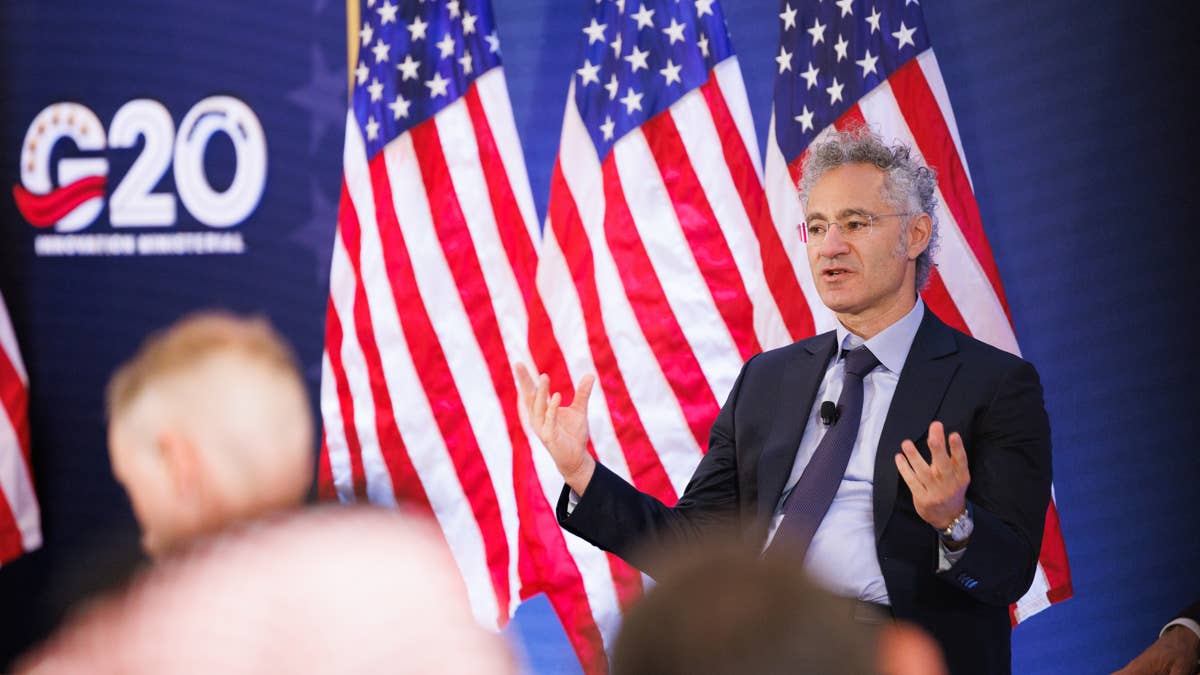
Palantir’s own people have not always loved the hype. Speaking on Oct.9 at Zeta Live ’26, Karp recalled that Ted Mabrey, who now runs the commercial business, told him his constant boasting was wearing on employees. Karp said he has stopped talking to people for about six months.
Investors once mocked the other thing Palantir does: embedding engineers inside client companies. That approach is now one of the fastest-growing jobs in Silicon Valley.
Related: Palantir’s CEO just sent a message Silicon Valley won’t ignore
Zeta CEO David Steinberg said he copied it because it’s “so freaking efficient.” According to Palantir, Zeta is rebuilding its Data Cloud on Foundry under a seven-year partnership targeting more than $100 million in annual sales.
My read is that a customer copying your playbook says more than any analyst note. Goldman agrees the model is more than hiring engineers.
It relies on tight feedback loops between field operations and product development, with Palantir now using AI Forward-Deployed Engineers (FDEs) to automate parts of that process. Goldman says that lead has held even as rivals invested in the first half.
Goldman’s $230 target comes with risks
The target rests on 60x 2029 GAAP earnings of $4.50, discounted at about 13.5%. Goldman raised revenue estimates to $8.37 billion for 2026, $13.2 billion for 2027, and $25.75 billion for 2029. Palantir’s own guidance is expected to be between $8.150–$8.158 billion.
It flags three risks:
- Competitors replicating the FDE approach
- Slower enterprise AI adoption if returns prove hard to scale
- Congressional changes that could shift government contract win rates
For investors, Goldman’s message is that the question is no longer whether Palantir’s AI boom is something on the table, but whether the market is deep enough for another round of higher estimates. With growth near 100% and a $230 target, the bank is betting it is.
The big idea is that businesses need both AI models and a way to connect models to their actual operations and data.