Jensen Huang no longer talks about AI like a software story. Speaking in Berlin on October 21, the Nvidia chief told the crowd that AI has become a manufacturing industry, and he pitched the company’s hardware as the machinery behind it.
The timing is interesting. Nvidia held up better than most chip names during last week’s AI sell-off, helped by second-quarter revenue that more than doubled from a year earlier, mostly on data center sales, as reported by TheStreet.
Now it wants to speed up the slowest part of the whole business: getting the buildings ready.
Nvidia’s plan to build data centers in weeks, not months
The DSX POD is a blueprint rather than a finished product Nvidia sells off the shelf.
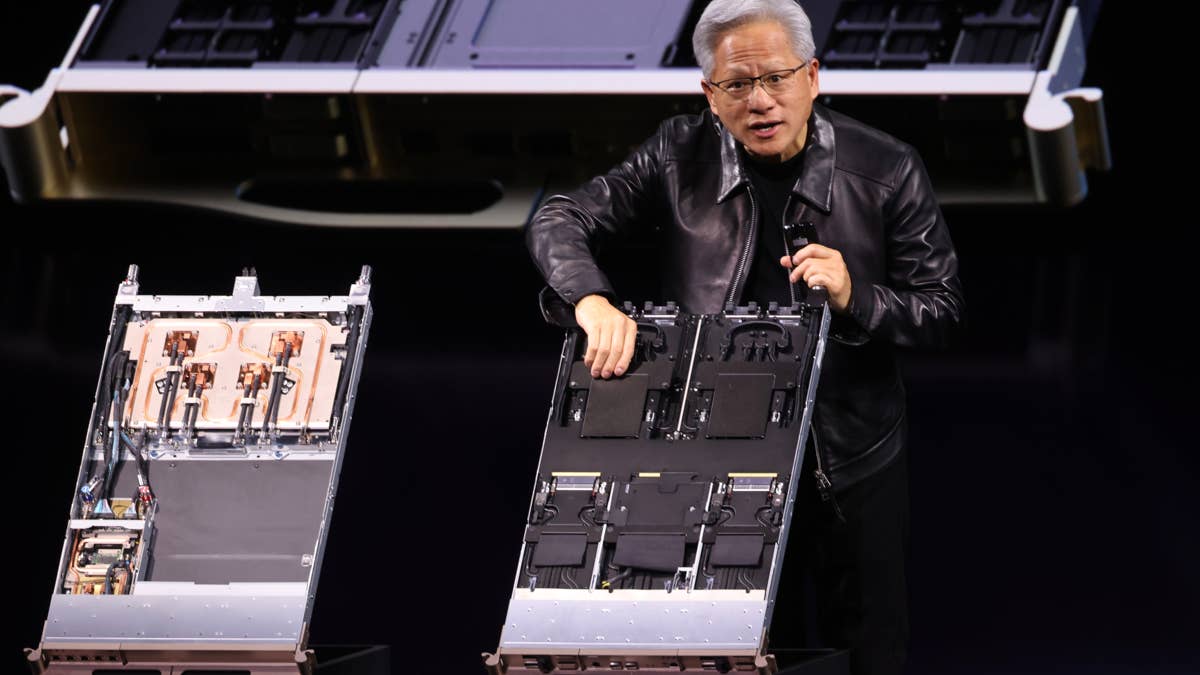
It is a reference design for complete Vera Rubin AI factories that partners build inside modular containers, with all the cabling, piping, and testing handled at the factory before anything ships, according to Nvidia.
Also read: Nvidia and Micron are about to lord their successes all over Wall Street
The boxes are packed tight. Each container holds seven Vera Rubin NVL72 racks with 504 GPUs, plus roughly 20 kilometers of copper cabling and 17 kilometers of networking that arrive already installed and tested, The New Stack noted. That’s the kind of fiddly work that usually eats up weeks on a construction site.
The headline promise is speed. Nvidia says a DSX POD can be up and running in as little as 14 days, and Huang used the same stage to tell his audience that every country and company is building their own AI.
Vera Rubin is the engine inside. Back in July, Huang brushed off reports of manufacturing problems and said Rubin hardware was already in production, while Nvidia said Rubin-based products would reach partners in the second half of 2026 and its Vera CPU was in full production.
Why every week of delay costs money
“An AI factory creates value when it starts producing tokens,” Huang said, adding that the value does not come when construction wraps up. Nvidia says cutting deployment at a prepared site from six months to about two weeks gets customers to revenue sooner.
The sums involved are huge. Huang told the Berlin audience that each gigawatt data center costs about $50 billion to build, and he estimated that kind of capacity could bring in about $40 billion a year in revenue, as reported by Investing.com. Every month a site sits idle is money left on the table.
Demand is not the problem. Morgan Stanley analyst Joseph Moore believes Nvidia’s underlying demand is closer to 100% growth than the 70% it has guided for, while CFO Colette Kress warned that supply will “remain a bottleneck” through at least fiscal 2028, TheStreet reported.
There is a catch, though. The two-week timeline only works if the site already has power, cooling, and network connections in place. The container solves the inside of the building, not the grid outside it.
Power is still the bigger bottleneck
The grid is where most AI projects get stuck. Energy firm Currence estimates that 30% to 50% of the large data center capacity expected to come online in 2026 will be delayed, with electricity among the main obstacles, TheStreet reported. A faster container does not change that math.
Microsoft just ran into that wall. The company pulled out of a planned deal for capacity at Nscale’s AI data center in Loughton, England, after grid officials said power for the site may not arrive until the 2030s. Microsoft declined to comment on the withdrawal, and Nscale says it is exploring other power sources, including fuel cells, for the project.
More Nvidia:
- Nvidia stock flashes massive signal as Wall Street leans in
- Nvidia’s AI boom revives a Warren Buffett warning for investors
- Nvidia puts $500 billion on the table, challenges banking as we know it
The site had been planned around roughly 23,000 Nvidia GPUs. Power used to be an assumption in data center planning. Now it is a constraint that shapes the entire project from the start.
Water is the other pressure point, and here the DSX POD helps. Because Vera Rubin can run on coolant as warm as 45 degrees Celsius, dry coolers can replace evaporative cooling towers in most climates.
Nvidia also estimates that this saves about 54 million liters of water a day for a 2-gigawatt deployment, though very hot climates may still need chillers on the worst days.
Partners line up for an early 2027 rollout
Nvidia has a long list of builders ready to go. Seventeen companies, including Anduril, Crusoe, Dell Technologies, HPE, Schneider Electric, Foxconn’s Ingrasys, and Vertiv, are signed on as partners, with worldwide deliveries targeted for early 2027, according to Nvidia.
Europe is clearly part of the pitch. A day before the keynote, the German government agreed to an AI partnership with Nvidia at a Berlin investment summit, with about a dozen German companies, including Siemens and Audi, expected to join.
Huang argued that countries should treat their data as a national resource to build a “national intelligence.”
Sovereign projects are already leaning on the same toolkit. A Japanese consortium called Noetra, backed by SoftBank, Sony, NEC, and Honda, plans an AI factory with about 27,500 Rubin GPUs built on Nvidia’s DSX framework.
If containers get factories like that running faster, Nvidia gets paid faster, too.
Related: Nvidia dodged the AI selloff, and Jensen Huang has a theory why