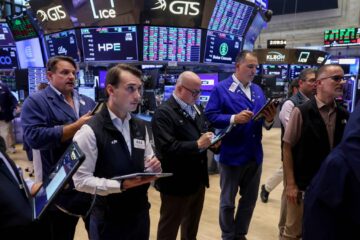
When tech stocks stumble, investors often wonder: Is this a buying opportunity or the beginning of something worse?
Eddie Ghabour, co-founder and CEO of Key Advisors Wealth Management, sat down with TheStreet’s Caroline Woods to explain how he actually uses a high-yield bond fund to gauge risk in the tech sector—and position his portfolio for the months ahead.
The bond market isn’t usually the first place investors think to look, especially as they try to judge whether the Fed’s latest interest rate decision could put additional pressure on highly valued technology companies.
Given a potential November rebound, Ghabour said his firm would add to its beaten-down semiconductor and memory stock holdings. But if another rate hike arrives while high-yield credit conditions worsen, he would sell more tech stocks and shift to a more defensive playbook.
So how can everyday investors follow his strategy? Ghabour believes one exchange-traded fund, the iShares iBoxx $ High Yield Corporate Bond ETF HYG, could help them spot early warning signs of trouble in the tech sector.
Here’s why Ghabour is watching HYG now.
Why the bond market matters to tech investors
“The bond market is smarter than the stock market,” Ghabour said. It’s a provocative statement, but his reasoning is pretty straightforward.
While stock investors tend to focus on earnings growth and momentum, bond investors focus on a company’s financing costs—and whether the businesses they’ve lent money to can actually pay them back. This is known as repayment risk.
The central measure in Ghabour’s strategy is the high-yield spread, which is the difference between the yields on riskier corporate bonds and safer government bonds.
When that spread widens, it’s often a sign that lenders are becoming more nervous about the economy.
Since rising borrowing costs can constrain smaller companies, Ghabour believes that widening credit spreads can serve as an early warning of trouble ahead, potentially signaling slower economic growth within the next six months.
Ghabour points to weakness in the secondary bond market, where previously issued bonds trade, as an example. In his view, a rate increase from the Federal Reserve would add pressure to already-tightening conditions.
And that matters a lot to tech companies investing billions of dollars into data centers and other AI infrastructure.
The bond market is smarter than the stock market.
Eddie Gabor, when asked why credit-market weakness can precede a stock-market decline
Related: Michael Burry followed Anthropic’s cash and saw familiar names
How Ghabour uses HYG as a credit-market watchlist
For everyday investors, Ghabour suggests watching HYG, an exchange-traded fund that serves as an indicator of conditions in the high-yield bond market.
His reasoning is straightforward: If HYG continues to decline, it could indicate that investors are demanding higher yields to hold riskier corporate bonds. If those yields rise relative to government-bond yields, the widening gap could signal mounting stress in the credit market.
A falling HYG price alone would not cause Ghabour to abandon technology stocks. He said one company-specific issue, referring to CoreWeave, did not worry him by itself. The signal becomes more concerning, in his view, if stress spreads to bonds issued by Oracle and major cloud companies. That could raise their cost of capital and make it harder for them to meet planned 2027 capital-spending targets.
Monitoring HYG may help investors spot trouble in the credit market, but they still need to consider their own risk tolerance when investing in tech stocks. Ghabour describes semiconductor and memory stocks as volatile, even as he saw their steep prior declines as a potential buying opportunity ahead of a possible rebound.
Related: Cathie Wood buys $9.1 million of tumbling tech stock
Why a Fed hike changes Ghabour’s technology playbook
Ghabour points to the fourth quarter of 2018, when the Federal Reserve raised interest rates in September and December, as an example of what could happen again if credit conditions worsen. He said the Nasdaq fell 20% in that quarter and the S&P 500 Index fell approximately 10%.
While history doesn’t necessarily repeat itself, Ghabour believes that raising interest rates when the credit market is already flashing warning signs could cause damage.
Raising rates is not going to bring oil prices down.
Eddie Gabor, when asked why he thinks inflation could remain sticky
Ghabour argues that geopolitical tensions involving Iran, rather than interest rates, were the key driver of elevated oil prices. If oil prices fall as tensions ease, he expects inflation pressure and yields to decline.
That would be good news for borrowers, the housing market, and stocks.
It also explains why Ghabour believes it’s still too early to worry about a possible December rate hike, especially since oil prices and inflation data could still change.
How a defensive shift differs from abandoning AI
If the Federal Reserve raises interest rates and credit spreads widen further, Ghabour says he would sell semiconductor and software stocks, and move toward more defensive holdings, like cash, gold, utilities, and health care.
He believes technology and other higher-beta holdings, or stocks that tend to swing more sharply than the broader market, would be among the first to feel the pressure.
But that doesn’t mean Ghabour is giving up on his longer-term, bull-market thesis. He expects AI to create powerful investment opportunities over the decade, although he also anticipates booms and busts along the way. His favors established AI beneficiaries, such as Microsoft, along with cybersecurity exposure through BUG, and Eli Lilly and Company, over neocloud companies whose bond-market signals he considers a red flag.
For shorter-term investors, Ghabour recommends patience rather than constant trading.
He said a tech-heavy investor who has already had a strong year could hold some cash until mid-November, when he expects the outlook for a December hike to become clearer. However, investors with cash available and sufficient risk tolerance could also consider semiconductors, memory stocks, and Microsoft, given their recent sharp corrections.
Related: Risk of more Mideast war boosts oil, threatens your wallet
The takeaway for investors watching HYG and technology stocks
When it comes to your portfolio, consider whether you’re looking for long-term exposure to AI beneficiaries, a tactical position for a potential technology rebound, or both.
Ghabour believes monitoring HYG can help investors spot warning signs in the credit market, particularly if they own technology companies that depend on continued access to cheap capital.
If HYG continues to weaken and similar stress appears in bonds issued by Oracle and major cloud companies, it may be time to reassess how much volatility your portfolio can absorb.
But if credit conditions remain stable, Ghabour believes there are still opportunities to invest in selective technology exposure, particularly those that have experienced sharp corrections.
Ultimately, his message is straightforward: Keep an eye on the bond market, even when you’re investing in stocks.
Sources
Eddie Gabor on Street Talk · watch the full segment
Cited segments:
- Gabor said widening high-yield spreads can raise companies’ cost of capital and increase the risk of slower economic growth. (0:18–1:20)
- Gabor identified widening secondary-market bond spreads for Oracle and hyperscalers as a sell signal. (3:15–4:08)
- Gabor suggested HYG as a high-yield bond-market proxy for everyday investors. (3:36–4:34)
- Gabor said Micron and other memory names had declined 30% to 50% in a month. (8:16–9:12)
- Gabor said a December rate hike would lead him to sell semiconductors and software and move toward cash, gold, utilities, and health care. (15:41–16:20)
- Gabor named Micron as the stock he would buy and hold through 2027, and cited a high-yield spread of 4% over the risk-free rate as a bull-market warning threshold. (21:32–21:58)
Some or all of this content may have been generated by AI. While we strive for accuracy, AI can occasionally produce incorrect information. If you buy something via one of our links, we may earn a commission.