Price hikes have pushed many Americans to the brink of cancellation when it comes to their streaming services.
That’s not actually how I feel, but it’s easy to see why people would question their streaming bills.
In my case, in addition to paying for cable television, I also subscribe to Amazon Prime, Netflix, Apple TV, the Disney bundle with ESPN Unlimited and Hulu, Peacock, and HBO. In fact, the only major streaming service I don’t get is Paramount+, mostly because aside from UFC, I have no idea what airs there.
I don’t fully pay for Netflix, as T-Mobile covers some of that, and I get Amazon Prime and Apple TV as part of broader bundles I’d likely pay for even without the streaming service, but for all the others, I’m paying full price.
And while I can justify paying for these services based on the fact that covering them is part of my job, that’s not really why I keep them. Every service I pay for has at least one program, series, or sporting event that brings me joy.
I may not watch anything else on Peacock, for example, but they have the English Premier League and I follow Chelsea. Disney has Star Wars and Marvel shows, ESPN has WWE premium live events, while Apple has “Foundation,” “Shrinking,” “Severance,” and more.
But although I see the value, many Americans do not, and new data from Hub Entertainment Research Churn Tracker found that one in five survey respondents said they had canceled a SVOD service in the previous six months, with saving money as the top reason.
ALSO READ: Disney+ subscribers face a costly mistake hiding in plain sight
Americans push back on streaming bills
“In the survey, 85% agreed that frequent price hikes make them feel taken advantage of, and 80% said higher prices push them to look for free alternatives. Only 16% said a price increase would cause them to cancel immediately, but a quarter said it would prompt them to actively shop for cheaper or free replacements,” the data showed.
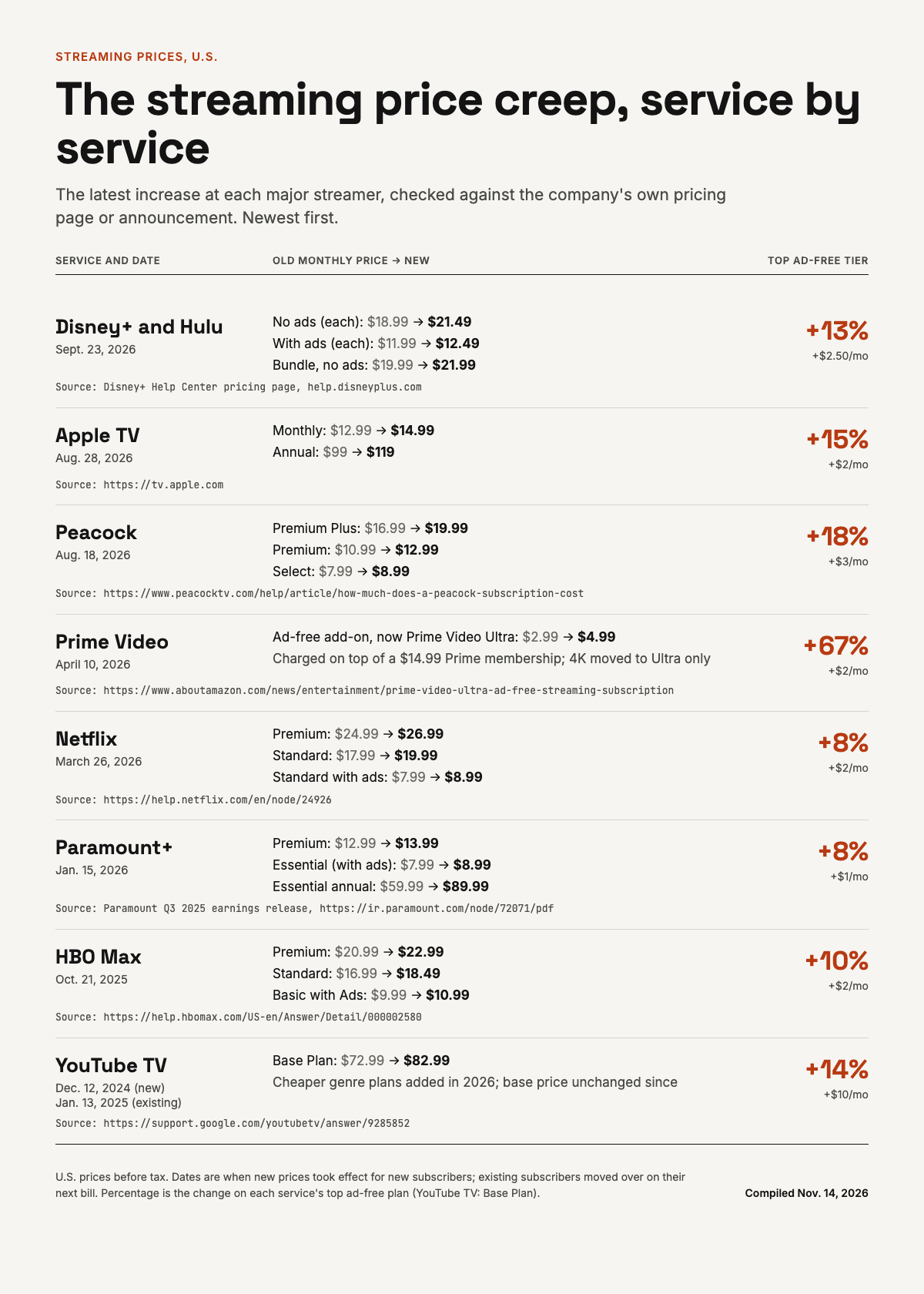
Prices, as you can see on the graphic below, have been going up.
Over the past three months, Peacock, ESPN Unlimited, Apple TV, and Disney all announced price increases. Those moves followed earlier hikes from Netflix and Prime in March.
The climb has been underway for years. Peacock’s ad-supported premium tier, for example, has more than doubled from $5.99 a month in July 2023 to $12.99 today.
Shutterstock
A la carte TV may not be what people hoped for
In the old bundled cable world, you paid for every channel in your package, including the ones you did not want. If you love the Travel Channel, but I only watched sports, I still paid a few cents each month to subsidize your favorite stations, and you did the same for mine.
Streaming services made it possible to only pay for programming you wanted, but that cost consumers in two ways.
First, people dropped their cable subscriptions, which meant that channels took in less money in carriage fees. That gave them less money to spend on programming, which in turn gives people fewer reasons to stay subscribers.
ALSO READ: Why Netflix reportedly walked away from Xbox licensing deal
Second, streamers have to charge more than what we used to pay for even a high-priced cable channel because they have fewer overall subscribers (in most cases). Yes, I get a lot of what I want from Disney, for example, but I’m arguably paying more per show I like than back in the cable bundle days.
Deloitte’s 2025 Digital Media Trends survey found:
- Traditional cable and satellite subscribers spend an average of $125 per month.
- Subscribers spend an average of $69 per month on four paid streaming services combined.
- Streaming subscribers’ spending increased 13% year over year, from $61 to $69.
- Almost half (47%) say they pay too much for streaming services.
The gap, however, is shrinking.
“Despite heavy competition and maturity of the streaming business, there is still room for streaming platforms to make revenue gains — at the expense of pay TV — when it comes to consumer subscriptions,” MediaPost reported.
“With streaming at 36% of the video wallet, we continue to believe that a large share of legacy pay TV spend can still migrate without increasing total household spending,” Brian Wieser, media analyst and founder of Madison and Wall, told the media site in December 2025.
Shutterstock
Streaming sites are vulnerable
Services like Netflix and Paramount+ face another risk, since they aren’t tied to other products the way Apple TV, Amazon Prime — and to an extent, the Disney bundle — are.
The longer-term challenge for paid streaming is the growth of free entertainment on YouTube, ad-supported video-on-demand services, and social media.
My son, who’s 22 and has access to all the streaming services, mostly watches YouTube videos.
“Nielsen data shows that YouTube and The Roku Channel gained market share faster than any other streaming platforms over the past year. YouTube’s growth alone exceeded the combined gains of the major paid subscription services,” Media Play News reported.
YouTube has been growing quickly, according to Nielsen’s July Gauge report, released Sept. 10.
- YouTube viewing rose 6% from June. Pushing its share of all TV time to a record 14.2%.
- Streaming as a whole had a big month, accounting for 49% of total TV, followed by Broadcast, which held 19.5% and Cable at 18.7%.
- For scale, Disney’s streaming services captured 4.7% of TV, while Peacock took 2.6%.
RTM Nexus CEO Dominick Miserandino thinks it’s all about engagement and delivering programming that keeps consumers using your app.
“I think about dropping a service whenever I realize I’ve not been watching it for a few months. I think it’s not so much the price point. But I think it’s whenever the price point increases that makes you start to wonder about that equation,” he told TheStreet.