Costco has traditionally been very careful when it comes to spending on its stores, its website, and anything that takes away from offering lower prices.
CEO Ron Vachris bragged about the company’s strategy during its fourth-quarter earnings call.
“We delivered top-line sales growth of over 10% and expanded our market share by deepening member loyalty and capturing a larger share of wallet. This success was anchored by our agile item-driven model. Our buyers stayed ahead of member trends, quickly adjusting our assortment to offer high-quality, relevant products at the lowest prices,” he said.
The company has traditionally made about two-thirds of its annual profits from membership fees, opting to sell items at razor-thin margins. Essentially, members pay $65 for a Gold Star membership or $130 for an Executive card, which comes with 2% cash back up to $1,250 a year, in exchange for low prices.
In most cases, Costco is very careful when it comes to spending money on anything other than its core needs and lowering prices. There has, however, been one notable exception — special dividends.
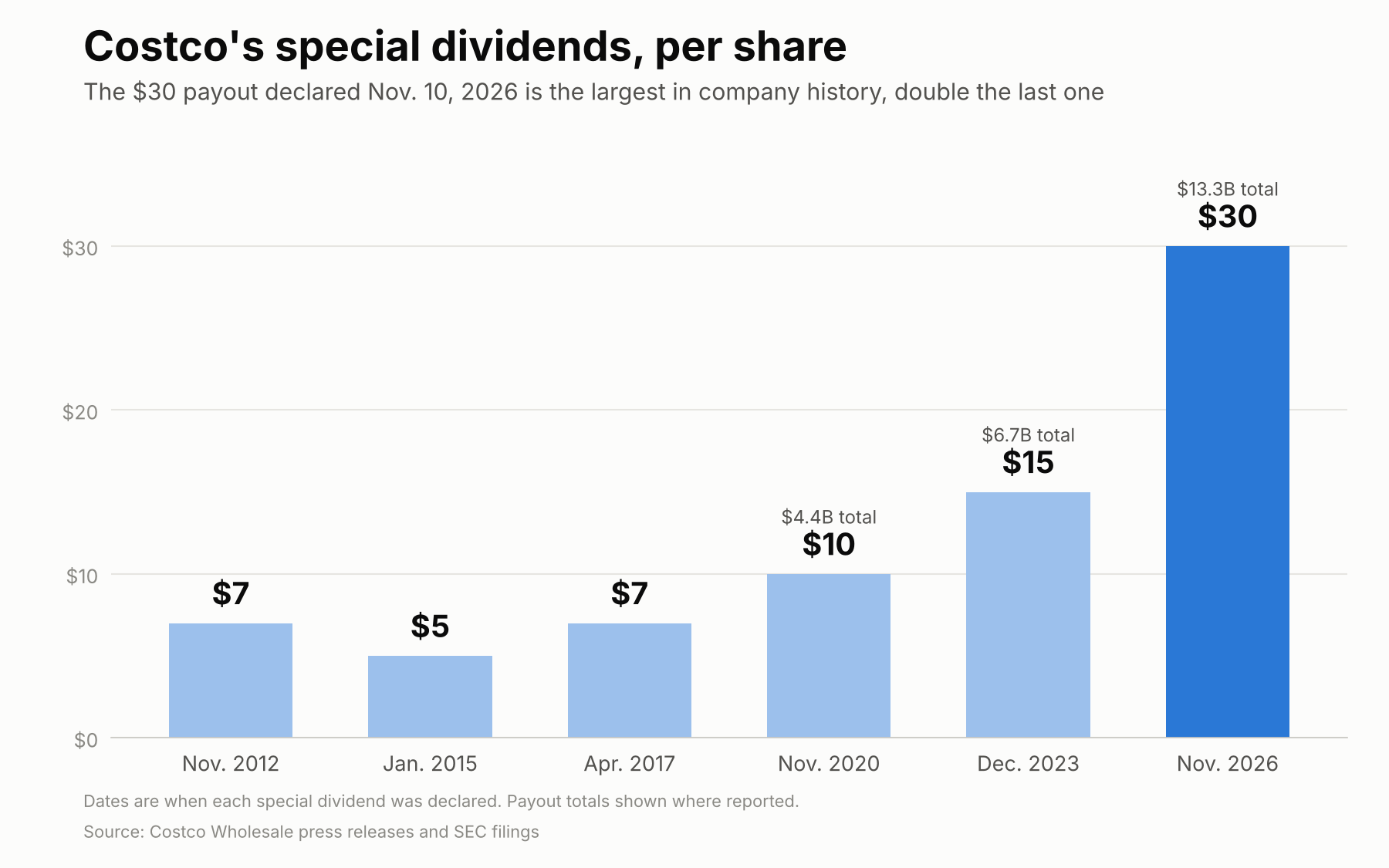
The chain has, on multiple occasions, returned money to shareholders outside of its quarterly dividend payment. It shared plans to do that again, with a record $30 payment to shareholders on Dec. 4, according to a press release.
Costco’s dividend is its largest ever
Costco’s Board of Directors declared a special cash dividend of $30 per share on Costco common stock.
“It is payable on December 4, 2026, to shareholders of record as of the close of business on November 24, 2026. The total amount of the payment will be approximately $13.3 billion,” the company shared.
The warehouse club had $20.2 billion in cash and cash equivalents at the end of its fiscal year on Aug. 30, 2026, as well as $1.09 billion in short-term investments, for $21.3 billion in all, according to its fourth-quarter earnings release.
That means the special dividend will use 62% of Costco’s cash on hand.
More Costco:
- Walmart takes aim at Costco with a new shopping perk
- Aldi cuts prices in a move that could pressure Costco
- Costco makes a seasonal food court change
It’s a situation that may be off-putting to members, according to RTM Nexus CEO Dominick Miserandino.
“You don’t walk into Costco hoping the shareholders got a great deal. You walk in hoping you did,” he told TheStreet.
He sees the size of the payout as being a potential problem with members who expect the company to invest in lower prices, especially while the economy is struggling.
“I don’t have a problem with Costco rewarding investors, especially when the company is doing so well. But there’s a balance. The moment Costco starts putting shareholders ahead of the people pushing those giant shopping carts around, it risks losing what made it special in the first place,” he added.
TheStreet
Costco’s prices called into question
While Costco does not claim to have the lowest prices on every item, a number of recent reports show areas where it has given up the price lead, or at least seen its rivals get closer:
- Checkbook, Chicago: Costco’s prices were, overall, about 20% higher than Sam’s Club and even 3% higher than Walmart. Last updated November 2025. The warehouse club trailed on fresh produce in particular.
- Checkbook, Seattle: Costco has lost much of its price edge. The warehouse club’s prices were only 6% lower than WinCo’s and 9% lower than Walmart’s. Last updated November 2025.
- Star Tribune/Checkbook, Minnesota: Aldi’s per-unit prices were even lower than Costco and Sam’s Club.
- Ground beef: FinanceBuzz says it’s hard to beat Walmart’s prices — including its price for ground beef, which is $5.48 per pound for 73% lean/27% fat beef. Its list also has Grocery Outlet winning on olive oil and Walmart on peanut butter.
- Chicken thighs: A one-pound pack of chicken thighs costs $1.99 at Trader Joe’s. Costco’s chicken thighs are $2.23 a pound, according to another Finance Buzz report.
It should be noted, however, that a comprehensive Consumer Reports study on groceries did show Costco having the lowest overall prices.
Sam’s Club, which is owned by Walmart, was not included in the Consumer Reports research.
That doesn’t make the examples above less true. It just suggests that Costco members should not assume that every item they’re buying at the warehouse club will be the cheapest.
I’m not sure this is a good look for Costco at a time when many Americans are struggling, but it’s probably not that big a problem because many members won’t know it happened.
Costco members have every right to question whether more of this cash should have gone to lower prices, but that will only hurt the chain if those same members start to feel they’re not getting good value for their membership.
Related: Costco solves a problem Sam’s Club hasn’t figured out yet