No human would ever opt to interact with artificial intelligence (AI) customer service, yet more and more companies have made it part of their process.
In fact, recent experiences I have had with T-Mobile and Uber Eats show that using AI is part of an overall disdain for customers. Instead of actually solving problems, both of these companies — and countless others that are just as guilty — try to manage results.
Even when you finally get a human being, that person has no power to actually fix anything. They’re people, but they’re humans being forced to work from scripts filled with soothing words, with no actual ability to fix anything.
“The vast majority of Americans (90%) prefer humans to AI for customer service, claiming humans better understand their needs, provide more thorough explanations and more options, and are less likely to frustrate,” according to a SurveyMonkey survey.
Despite this, AI is cheaper, so its use continues to grow, despite very few consumers actually liking it.
T-Mobile uses AI chat
A few days ago, T-Mobile delivered my new iPhone to a previous address, despite that not being the address specified in my order. Using the chat feature on the company’s app, I was routed into an AI hell that kept repeating the same answers or tried to direct me to UPS.
My case was complicated, as the order was signed for, but my old building denied having the package.
At some point, the AI offered me a person who was in no way helpful. They didn’t call UPS and said that they called the building, but that nobody answered.
My call to the building was immediately picked up and, of course, they denied having the package.
T-Mobile’s solution was canceling my order, making me place a new one, and offering no delivery date for the back-ordered phone. Common sense would prioritize my order, but the AI can only answer basic questions, and the actual person has only been taught to placate customers, not help them.
Uber Eats has even worse AI
AI can’t solve problems. It can only work within the parameters the company sets.
When I order food and it does not arrive or gets delivered to the wrong address, refunding my money isn’t solving the problem.
Making sure my food gets delivered, or offering me similar food from a different restaurant, would be the solution.
I don’t order from Uber Eats because I’m worried about money — it’s an expensive choice compared to cooking or picking up takeout — I order because I’m hungry.
The AI help, however, doesn’t expedite a replacement or even offer that as an option. It processes a refund, or a partial refund if only some items are missing. This might be legally sufficient, but it doesn’t make me less hungry.
When my fries arrive without my burger, giving me some money back isn’t a solution any human would find tolerable. The correct response would be replacing the full meal, since the fries would be cold by the time the missing burger arrives.
Fixing the problem would require a human to interact with the driver and restaurant. That’s more expensive than just processing a refund, which is better for Uber Eats, but a slap in the face to its customers.

Shutterstock
Companies know that AI customer service sucks
Using AI for customer service is ignoring the idea of serving your customers. It’s like the entire business world has become your Internet Service Provider (ISP), placing you on an endless hold while directing you to its website, which you can’t access because your internet is out.
Companies know that consumers hate AI customer service because they track their Net Promoter Score (NPS). The NPS is a simple question: “How likely would you be to recommend this service or product to a friend, with answer options ranging from 0 (Not at all likely) to 10 (Extremely likely).
“Among those who had a customer experience with an AI chatbot, just 10% fell into the category of ‘promoters’ who had a positive experience, and 76% ended up being detractors. Among those who had a customer experience with a human, 38% ended up as promoters and just 32% as detractors,” SurveyMonkey shared.
TheStreet
Companies that care use people
Back in my days running a large toy store, any customer could call and speak to me. That meant sometimes having to deliver bad news.
When we sold a gas-powered radio-controlled car, for example, the salesperson and the checkout clerk would tell every customer that if the engine broke, which happens a lot when people put the wrong fuel and oil mix in, the warranty had to go through the manufacturer, not the store.
Inevitably, however, when someone broke their engine, they would bring it to the store and, if it was an easy repair, we’d make it. When it wasn’t, we would help them ship it back to the manufacturer and help them get their warranty processed.
That’s time-consuming and expensive, but it’s actually putting in the work to serve your customers.
Using AI instead of people is penny-wise and pound-foolish.
Actual customer service builds bonds and loyalty. T-Mobile and Uber Eats know that, but are more than willing to sacrifice those things in order to pad their bottom lines.
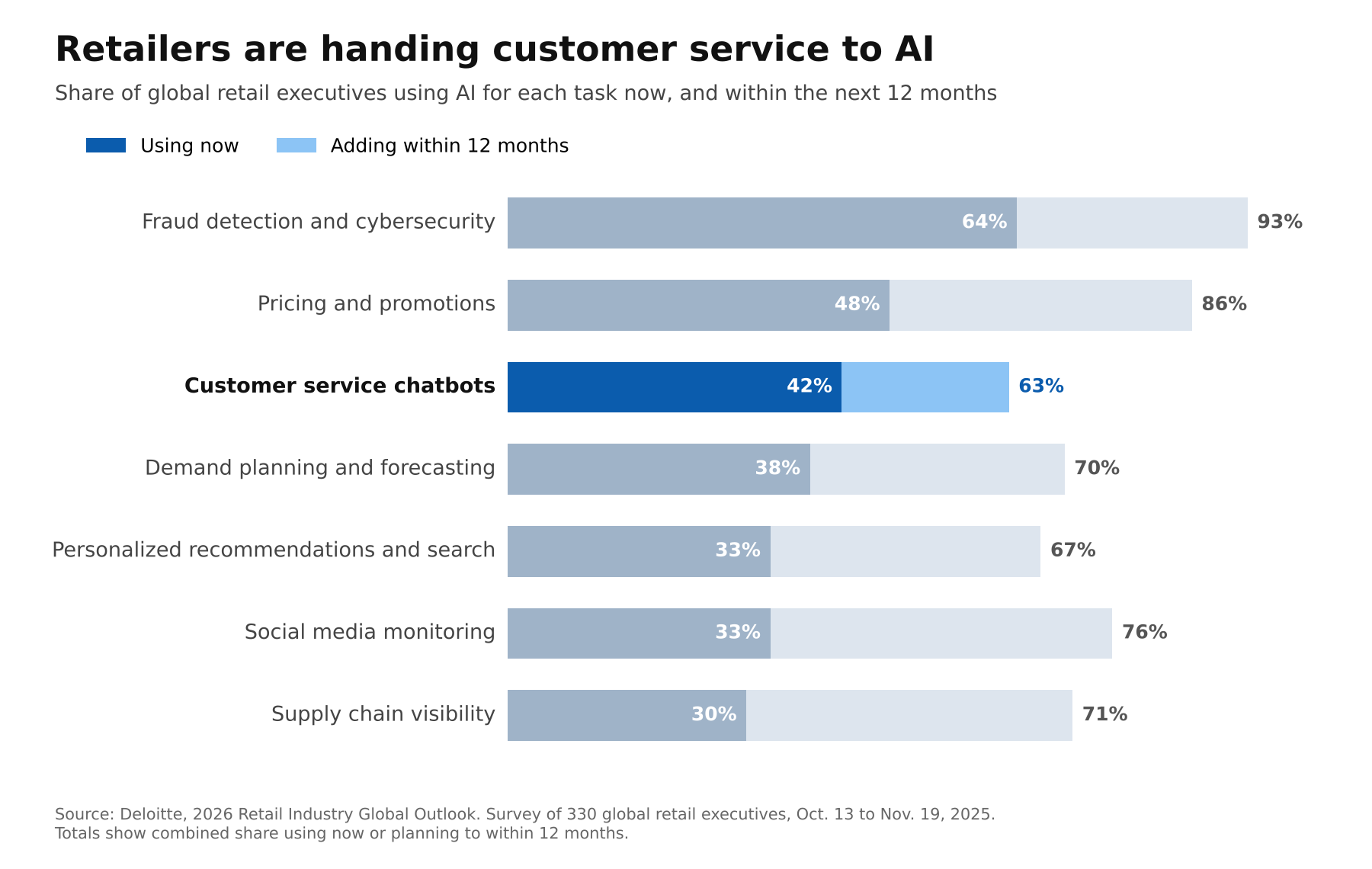
It’s actually probably unfair to single out two companies, given that an estimated 42% of large retailers use AI-powered customer service chatbots, according to Deloitte’s 2026 Retail Industry Global Outlook.
That number will grow to 63% over the next 12 months, even though consumers don’t actually want AI customer service.
Let AI forecast demand and handle backend tasks. Don’t have robots do jobs best performed by humans.
It doesn’t work, and it angers customers.
Yes, it’s cheaper, and people will put up with it because it’s becoming the default everywhere. But doing something you know your customers don’t want because it’s better for you is a long-term strategy that eventually comes back to burn you — something the cable companies have learned firsthand in recent years.
Related: Target gives shoppers something Walmart and Kroger can’t