Forget December. Financial markets are bracing for an extended stretch of restrictive U.S. monetary policy well into 2027 as stubborn inflation is forcing Federal Reserve officials to map out a path of further interest-rate increases beyond next month’s policy meeting.
For investors, businesses and consumers, the emerging consensus on Wall Street signals hopes for interest-rate relief in 2027 have all but evaporated.
Minutes from the Federal Open Market Committee October meeting released Nov. 18, along with some very pointed public remarks from top Fed officials, show the U.S. central bank is becoming increasingly alarmed that price pressures are moving away from its 2% target.
But within those pointed public Fed remarks, there’s a wide range of opinion within its ranks as to the best approach to lower price pressures.
In fact, when the FOMC held its benchmark short-term interest rate steady in October, the minutes show several participants describing the pause as a “close call” despite the 10-2 vote.
This is setting the stage for a contentious Dec. 8-9 FOMC meeting which I predict will be chock full of hawkish, divisive discussion — what Chairman Kevin Warsh likes to refer to as “a good family fight” — over the size of the widely expected December rate hike plus the depth of the prolonged tightening cycle heading into 2027.
Nearly all the policymakers agreed in October that additional rate hikes, consistent with the Fed’s “dot plot” projections in September, will likely be appropriate over time to prevent sticky and persistent inflation from tariffs, trade wars, the Iran War, and the artificial-intelligence demand becoming entrenched across other sectors of the economy.
Now I wish I could tell you who said what at the October gathering but Fed rules prohibit the naming of individuals in the FOMC meeting minutes. We do know that the pause vote was 10-2, with Federal Reserve Governor Lisa Cook and Cleveland Fed President Beth Hammack preferring a 25-basis-point-hike because of inflation.
But otherwise, the policymakers and the Fed staff remain anonymous.
Hence, the Fed Speak turns from word salad to word slop in deciphering the meeting’s hawkish tone in its October minutes with quotes like:
“Many participants observed that demand for products associated with the A.I. build out was continuing to strain supply and raise prices of technology-related consumer goods, and several judged that price pressures were increasingly extending beyond industries directly affected by data center construction.”
And:
“Some participants expressed concern that more widespread price pressures in the context of a prolonged period of above-target inflation could increase the risk of elevated inflation becoming entrenched in the inflation expectations of households and businesses.”
Nevertheless, the hawkish shift in expectations reflects mounting anxiety inside the central bank over broad-based inflation drivers such as shelter costs and food prices in the hotter-than-expected October CPI.
A couple of participants warned in the October minutes that rate increases exceeding a traditional 25 basis-point hike could be warranted if inflation fails to cool.
TheStreet
Internal divide over Fed rate path increasingly vibrant
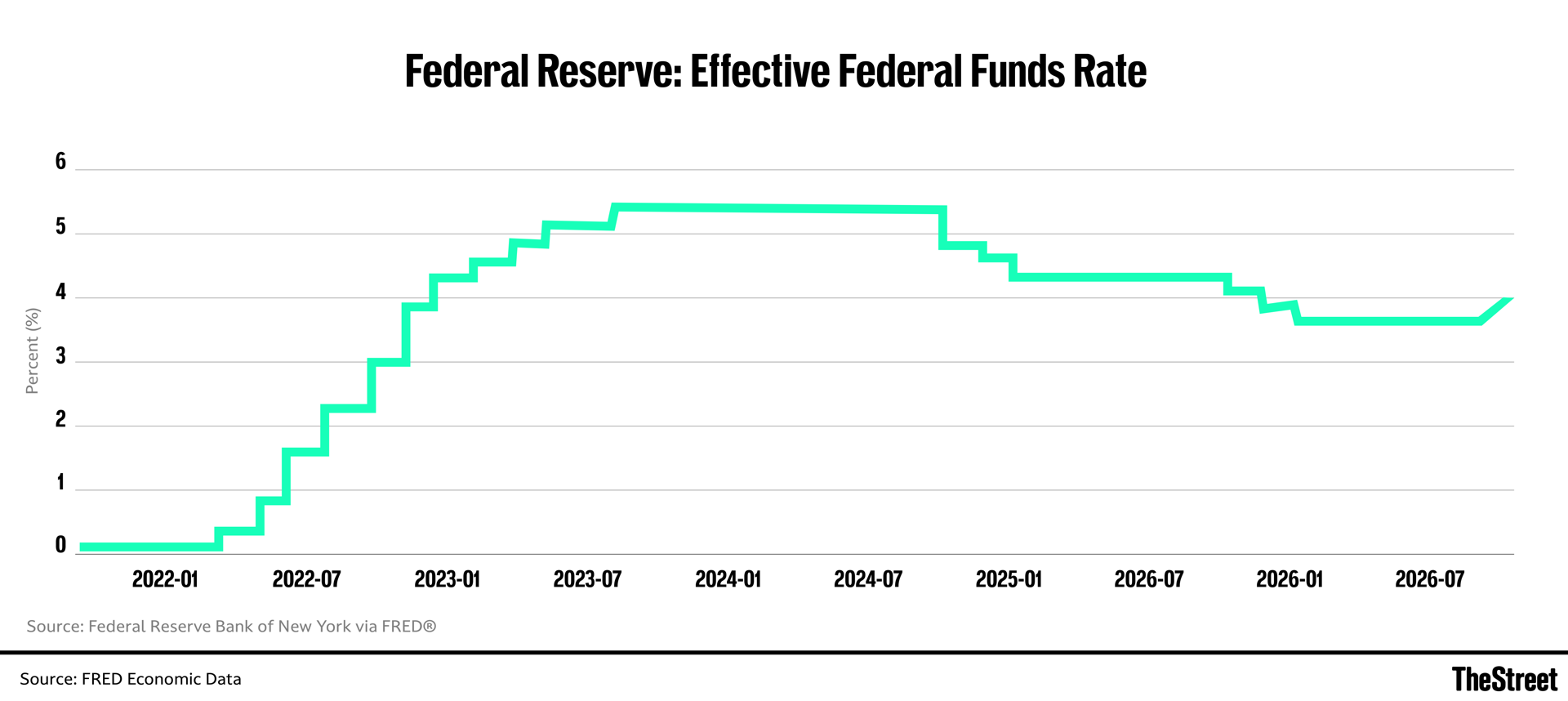
Fed Governor Christopher Waller doubled down on his comments earlier this month that rising price pressures call for a jumbo 50-basis-point rate hike in December, moving the target range up to 3.75%-4%.
“You might need to, like, shock people,” he said in a Nov. 18 CNBC interview.
Waller said he was “very, very concerned about inflation. It’s kind of headed in the wrong direction, and it’s spreading out,’’ calling for the Fed to take “more aggressive actions” unless his colleagues establish clear forward guidance signaling another hike in January.
Forward guidance is a communication tool that the Fed used to signal the future path of monetary policy and interest rates to the public and financial markets in order to influence economic behavior and manage expectations.
Warsh dropped the long-standing tradition of providing forward guidance after taking over as chairman in May.
Fed Governor Michael Barr said in Nov. 18 prepared remarks that he supports raising interest rates to combat inflation but did not give a timeline nor a metric to do so.
“But inflation is too high, making it hard for American families to make ends meet. Many families are struggling. And that’s why it is so important for the Fed to bring inflation back down to our target of 2% in a timely way,’’ Barr said. “If the economy evolves as I currently forecast, I expect it will be appropriate to raise rates further to achieve that goal on behalf of the American people.’’
New York Federal Reserve President John Williams, a voting member of the FOMC, agrees with many of his Fed colleagues that they “have work to do” to lower persistent inflation but steered away from the jumbo rate hike Waller supports.
Related: Fed rate hikes could stretch into 2027 as darker threats loom
As I reported, Williams said Nov. 17, there is currently no need for “dramatic action” when the policymaking FOMC meets Dec. 8-9.
San Francisco Fed President Mary Daly offered a more measured approach on Nov. 18, advocating for deliberate steps of increases rather than abrupt jumps.
Daly, who will become a voting member of the FOMC with the January 2027 meeting, said she supports further tightening of policy but that officials must move thoughtfully to avoid inflicting unnecessary damage on interest-sensitive sectors, particularly the depressed U.S. housing market.
A look ahead toward 2027 Fed rate bets
The CME Group’s FedWatch Tool projects roughly a 100% probability of a rate hike at the FOMC December meeting, a 75.4% probability of another in January 2027 and roughly a 100% probability of a third consecutive increase in March 2027.
Increases in the benchmark federal funds rate impact short-term borrowing rates for home equity loans, credit cards and student loans. Indirectly, a Fed rate hike increases mortgage rates and the yields on Treasury bonds.
Warsh has repeatedly said that the Fed is committed to its dual mandate: use interest rates and balance-sheet policy to keep prices stable and the labor market at full employment.
BofA estimates the funds rate will hit 4.5% to 4.75% after three consecutive 25 basis-point hikes in December, January and March, with the potential for additional increases that could see the target range hit 5% next year.
In addition to BofA, Citi and Standard Chartered have acknowledged a stronger case for the half-point increase, but all three big banks say the evidence is not yet sufficient to make it their base case.
Regardless of whether the Fed opts for a quarter-point or half-point move in December, Wall Street is rapidly repricing the trajectory for 2027.
It’s becoming increasingly clear that interest-rate cuts are off the table for 2027 unless the resilient U.S. economy suffers a sharp contraction or a severe labor-market shock.
And as for the Fed’s expected “good family fights” over monetary policy at the December FOMC meeting, if it’s anything like my family’s marathon Monopoly games on Christmas afternoon: Duck under the dining room table and cover!
Related: BofA warns new Fed rate-hike cycle packs a very nasty twist