For millions of American workers looking to supercharge their retirement accounts ahead of 2027, higher contribution ceilings offer a tempting opportunity to shelter more cash from the IRS. Yet personal finance author Dave Ramsey and financial services giant Fidelity warn that savers who misunderstand the five-year rule risk walking straight into a costly tax and penalty trap just as they prepare to retire.
The danger is particularly acute for workers in their mid-to-late 50s who are pivoting from traditional pre-tax savings to Roth accounts.
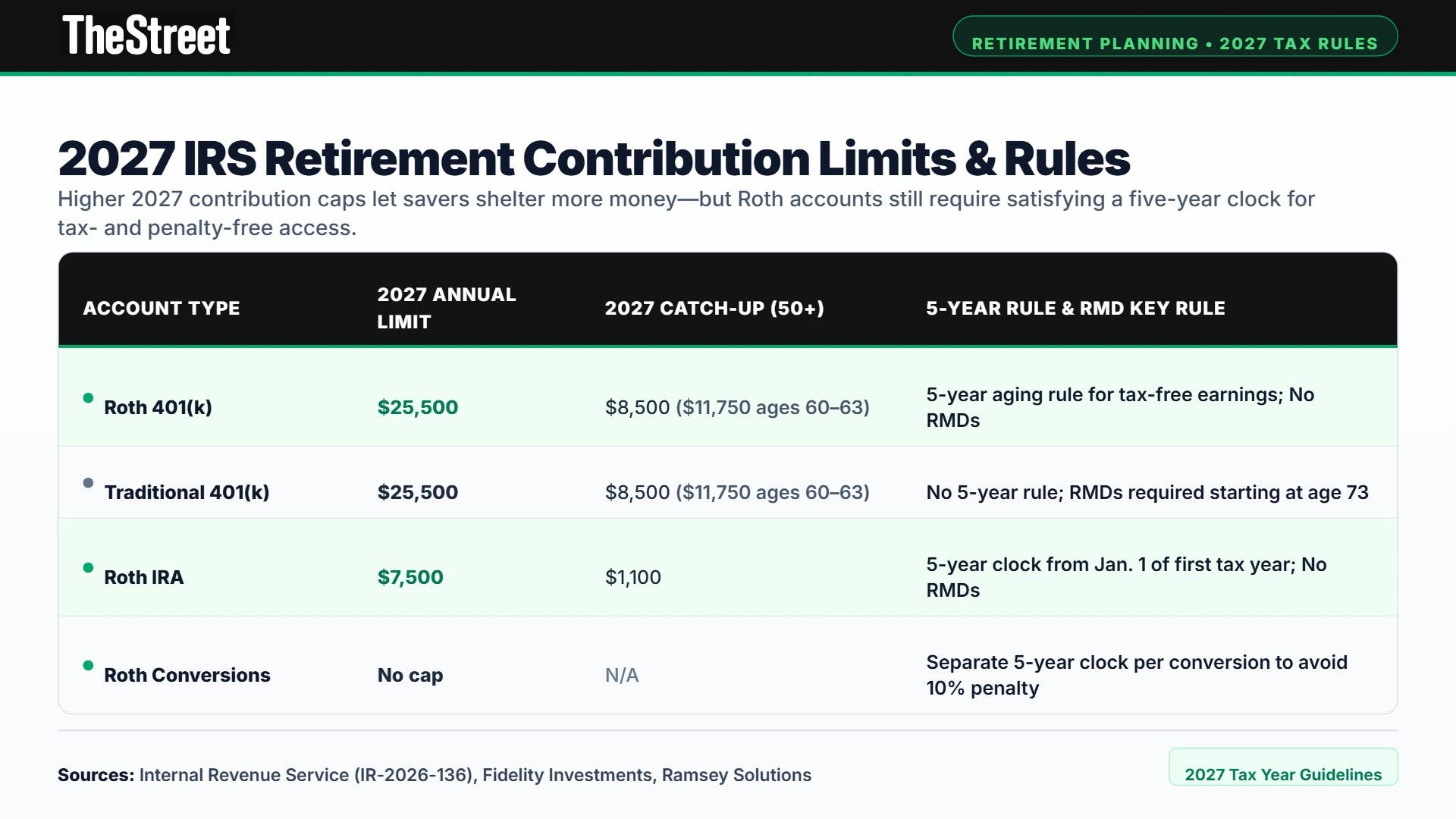
With the Internal Revenue Service raising the annual contribution limit for employees in 401(k), 403(b), governmental 457 plans, and the federal Thrift Savings Plan to $25,500 for 2027 — and bumping catch-up contributions for savers age 50 and older to $8,500, or $11,750 for those ages 60 through 63 — many older workers are pouring record sums into Roth plans.
While both traditional and Roth 401(k)s allow penalty-free access starting at age 59½, Roth accounts carry an extra hurdle: the account must satisfy a five-year aging period before investment earnings can be withdrawn completely tax-free.
“Now, if you’re still decades away from retirement, that five years is nothing to worry about,” Ramsey Solutions wrote. “But if you’re approaching 59 1/2 and thinking about opening a Roth 401(k), be aware that if you make withdrawals within those first five years, you’ll pay a penalty.”
Why Dave Ramsey favors Roth 401(k)s over traditional plans
Despite the five-year waiting period, Ramsey remains an outspoken champion of Roth retirement accounts over their traditional counterparts. The core difference comes down to when the IRS collects its share.
Traditional 401(k)s and IRAs use pre-tax dollars, lowering taxable income today while leaving every dollar of principal, employer match, and investment growth exposed to future tax rates upon withdrawal. Roth accounts reverse that equation, taxing contributions upfront so retirement withdrawals grow and come out tax-free.
“The tax-free growth and tax-free withdrawals that come with a Roth 401(k) are simply too good to pass up,” Ramsey Solutions noted. “Anytime you can legally minimize your tax burden, that decision makes itself.”
Ramsey also highlights another major advantage for Roth savers: freedom from Required Minimum Distributions (RMDs). “If you have a traditional 401(k), the IRS requires you to start making withdrawals from your account beginning at age 73 (they want that tax money, baby),” Ramsey Solutions explained.
“Thanks to the SECURE 2.0 Act, Roth 401(k)s no longer have RMDs. If you’re the original account owner, you can leave your Roth 401(k) untouched for as long as you want.”
For workers debating whether to give up an immediate paycheck tax break, Ramsey argues that long-term certainty outweighs short-term relief.
“Imagine finally stepping into retirement, then watching your $1 million nest egg get whittled down by hundreds of thousands of dollars because of taxes. We bet you’d miss $100,000 in retirement a lot more than $100 in a paycheck today,” Ramsey Solutions wrote.
“Plus, you’ll have peace of mind from knowing the tax bill has already been handled.”
IRS, Fidelity Investments, Ramsey Solutions
Fidelity breaks down how the 5-year clock works — and resets
While Ramsey focuses on the big-picture case for Roth investing, Fidelity points out that the fine print of the five-year rule trips up many savers — especially those using Roth IRAs, where the 2027 annual contribution limit remains $7,500 (plus a $1,100 catch-up for savers 50 and older).
“The 5-year rule for Roth IRAs means that at least 5 years must elapse between the beginning of the tax year of your first contribution to a Roth account and withdrawal of earnings,” Fidelity explained. “If fewer than 5 years have passed before you make a withdrawal of earnings, the withdrawal is considered a nonqualified distribution and may be subject to either taxes or penalties (or both).”
More Retirement:
- Annuities can be a retirement safety net to prevent outliving savings
- Vanguard flags a retirement fear built into 401(k) plans
- Suze Orman has a serious retirement warning for 2027
Crucially, Roth IRA contributions themselves can always be withdrawn tax- and penalty-free at any time. The five-year clock restricts investment earnings — and operates on a strict calendar.
Because the IRS starts the five-year clock on January 1 of the tax year for which a contribution is made, savers who fund a prior-year Roth IRA before the April tax-filing deadline can effectively shave months off the waiting period.
However, Roth conversions follow a stricter standard.
“The Internal Revenue Service (IRS) requires a waiting period of 5 years before withdrawing balances converted from a traditional IRA to a Roth IRA, or you may pay a 10% early withdrawal penalty on the conversion amount in addition to the income taxes you pay in the tax year of your conversion,” Fidelity warned.
“Important to know: The 5-year rule is counted separately for each conversion. The same rules apply to so-called backdoor Roth IRAs.”
What 2027 IRS retirement changes mean for your strategy
Higher 2027 IRS thresholds also expand eligibility for savers looking to open or fund Roth accounts before their retirement clock winds down.
For 2027, the IRS increased the Roth IRA income phase-out range to between $158,000 and $173,000 for single filers and heads of household, and between $250,000 and $260,000 for married couples filing jointly.
Meanwhile, workplace Roth 401(k) plans carry no income caps at all, allowing high earners to contribute up to the full $25,500 limit.
“With the new adjustment in place now, the IRS is giving taxpayers and employers the information needed to make retirement planning decisions for the year ahead,” IRS Chief Executive Officer Frank J. Bisignano said in a statement.
Even when the five-year requirement hasn’t been met, Fidelity notes that exceptions — including turning age 59½, disability, death, or up to $10,000 for a first-time home purchase — can waive the 10% early withdrawal penalty, though income taxes on earnings may still apply.
For savers eyeing 2027’s higher limits, opening and funding a Roth account early starts the clock — ensuring retirement gains stay out of reach of avoidable IRS penalties.
Related: Charles Schwab, Fidelity at odds over how much to save in 401(k)