Retirement savers who leave a job and roll an old 401(k) into an individual retirement account (IRA) often assume their money keeps right on growing in the stock market.
But Vanguard warns that millions of savers are falling into a costly trap — while Fidelity Investments frames the cash sitting in those accounts in a notably different way. Charles Schwab takes a different angle entirely.
First, it’s important to focus on what actually happens behind the scenes when workplace retirement savings move into an IRA.
Unlike 401(k) plans, where federal rules allow employers to funnel contributions automatically into target-date funds, IRAs have no default market investment — leaving transferred dollars parked in cash unless an investor steps in.
Vanguard flags a ‘billion-dollar blind spot’ in rollover IRAs
Vanguard treats uninvested rollover money as an urgent behavioral failure that quietly erodes decades of compounding returns.
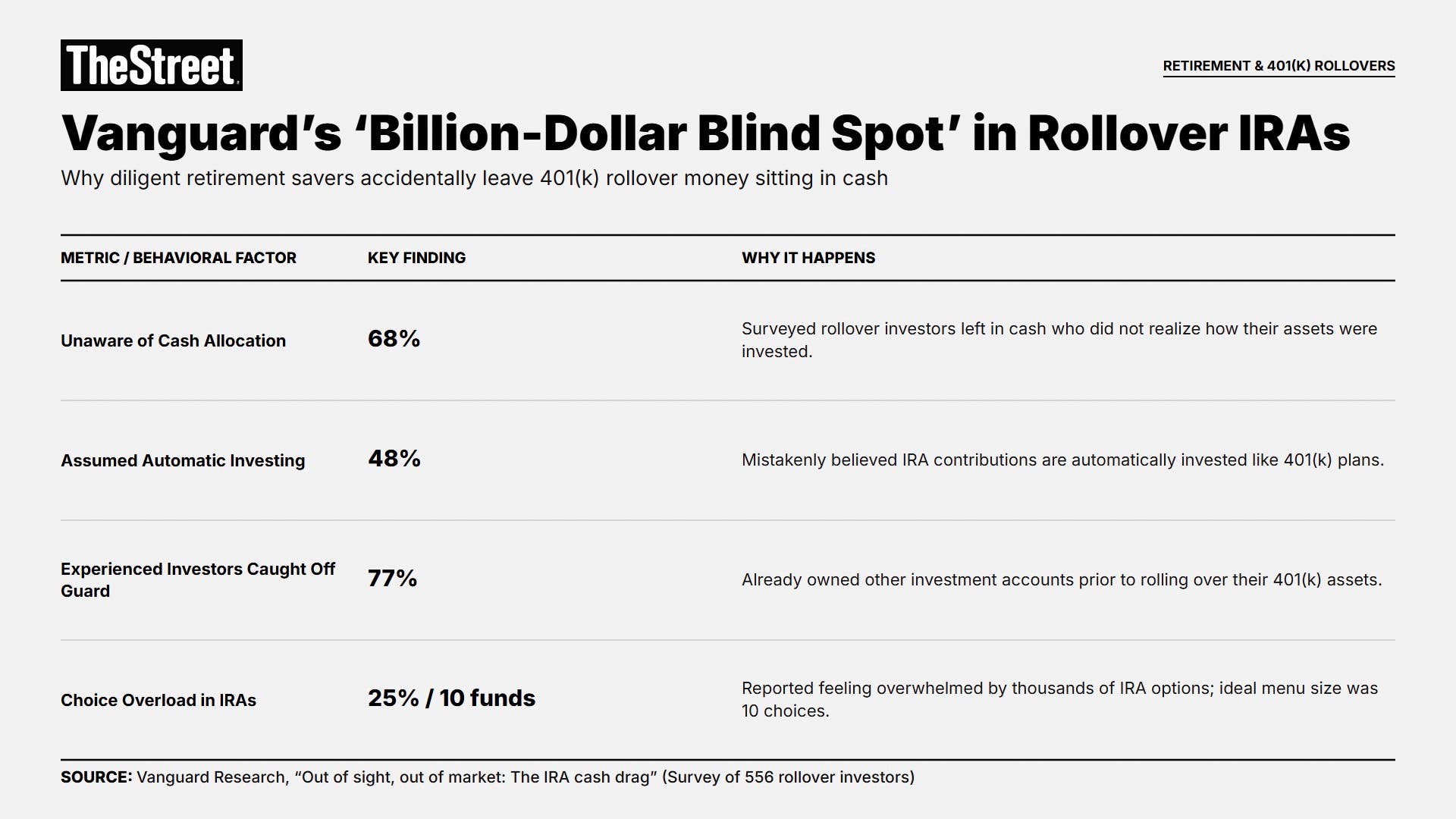
According to Vanguard’s research on IRA cash drag, 68% of surveyed rollover investors who remained in cash did not realize how their assets were invested, and 48% mistakenly believed IRA contributions are automatically invested.
Even seasoned investors fell into the trap: 77% already owned other investment accounts prior to rolling over their 401(k) assets.
“IRA cash is a billion-dollar blind spot,” Andy Reed, head of investor behavior research at Vanguard, wrote. “Many IRA holders want to invest their retirement savings in the stock market and think that they’re invested following a rollover. In reality, they’re sitting in money market funds.”
Vanguard’s data shows that savers who leave rollover funds in cash are twice as likely to do so unintentionally as deliberately. Part of the culprit is sudden choice overload: while a 401(k) plan typically offers a curated lineup of funds, an IRA opens the door to thousands of investments.
One in four rollover cash investors told Vanguard they felt overwhelmed by the sheer number of options, saying their ideal menu would hold just 10 choices.
“Choice overload is a real risk for IRA investors,” Nathan Zahm, head of client experience alpha at Vanguard, wrote. “Easing the mental burden by curating options or offering advice can be a big help to investors who might otherwise stay in cash forever. Better yet, a policy change allowing target-date funds to be a default option could solve this problem at scale.”
Vanguard
Fidelity reframes the rollover pause as a planning checkpoint
Fidelity Investments agrees that uninvested rollover cash is a widespread pitfall — even citing the same 68% figure — but takes a noticeably different view of the moment a rollover lands in an account.
Rather than treating the transition primarily as a regulatory flaw that needs a default fund fix, Fidelity’s rollover IRA guidance casts the cash landing spot as an opportunity for savers to step back, reassess their goals, and take advantage of the wider menu that Vanguard warns can paralyze investors.
“Some people think they’re still invested after a rollover. In reality, most of your investments may have been sold and you’re starting fresh,” Kenny Davin, CFP and vice president and Fidelity branch leader in Ft. Lauderdale, Fla., wrote.
More Retirement:
- Annuities can be a retirement safety net to prevent outliving savings
- Vanguard flags a retirement fear built into 401(k) plans
- Suze Orman has a serious retirement warning for 2027
Fidelity also highlights a key mechanical difference on its own platform: while uninvested money waits for an investor’s next move, cash in a Fidelity IRA core position earns interest automatically rather than sitting completely idle.
Still, Fidelity urges savers not to linger there, calling a rollover a “planning checkpoint” and advising investors either to recreate their old 401(k) mix or use digital planning tools and managed accounts to put the money back to work.
“Personal finance is more personal than finance—it’s an art and a science. The science shows if you’re on track; the art is what you’re actually willing to do,” Davin wrote.
Charles Schwab sees cash as a deliberate portfolio tool
Charles Schwab approaches the cash question from a different angle altogether, treating cash not merely as accidental dead weight, but as one of three core asset classes alongside stocks and bonds.
In Schwab’s guidance on reallocating cash, the firm notes that high money market and certificate-of-deposit yields around 5% enticed many investors to deliberately hold larger cash reserves before Federal Reserve rate cuts pushed yields closer to 4%.
“Cash serves two roles in a portfolio. The first is to reduce overall portfolio risk. The second is to meet liquidity needs, whether for current spending or future investments,” Charles Schwab wrote in its cash allocation guide.
Where Vanguard warns that idle cash threatens long-term retirement readiness, Schwab emphasizes matching cash levels to an investor’s risk tolerance and time horizon.
When cash balances grow beyond near-term spending needs — particularly for investors with a horizon of five to seven years or longer — Schwab recommends gradually rebalancing excess reserves rather than trying to time the market.
“If your cash allocation has increased beyond your near-term needs, it may be a good time to consider your reallocation choices. Holding onto too much cash may rob your portfolio of the higher long-term return potential offered by bonds and stocks,” Schwab wrote.
For savers unsure how to deploy excess cash, Schwab points to a classic 60% stock and 40% bond blend as a starting point — a reminder that whether cash is an accidental rollover blind spot or an intentional safety buffer, leaving too much on the sidelines carries a real long-term price.
Related: Charles Schwab, Fidelity at odds over how much to save in 401(k)