For decades, Black Friday was one of America’s biggest holiday shopping traditions. Shoppers would spend Thanksgiving night waiting outside their favorite stores or wake up before sunrise to secure some of the year’s best deals.
Today, that tradition looks very different. What was once a single day of major discounts has expanded into weeks of promotions, with retailers increasingly launching holiday sales well before Thanksgiving. As a result, the excitement surrounding the traditional Black Friday shopping rush has gradually changed.
The shift is also reflected in how Americans shop. On Black Friday in 2025, 85.7 million Americans made purchases online, compared with 80.3 million who shopped in person, according to a survey by the National Retail Federation (NRF). The figures highlight the growing importance of online shopping during one of the busiest retail periods of the year.
Still, Black Friday remains an important opportunity for consumers looking to save on holiday purchases. And despite concerns that discounts are not as impressive as they once were, new data show that several major retailers are offering substantial markdowns this year.
Best places to shop on Black Friday
Although several retailers increased their average advertised discounts, others pulled back on promotions compared with the previous year.
Data from WalletHub covering more than 2,250 advertised deals across 11 major U.S. retailers show that some companies are offering substantially higher markdowns, while others have reduced their average discounts.
These are the average discounts by retailer in 2026 and their reported year-over-year changes:
- JCPenney: 74.33%, up 0.34%
- Macy’s (M): 56.50%, up 27.08%
- Target (TGT): 38.47%, up 31.02%
- Kohl’s (KSS): 37.47%, down 17.45%
- Best Buy (BBY): 30.88%, up 8.05%
- Walmart (WMT): 30.57%, up 7.11%
- BJ’s (BJ): 30.51%, down 2.40%
- The Home Depot (HD): 30.33%, down 14.87%
- Amazon (AMZN): 29.25%, down 1.28%
- Newegg (NEGG): 23.15%, down 19.62%
- Costco (COST): 17.75%, up 17.70%
JCPenney leads the rankings with an average discount of 74.33%, making it the retailer with the steepest overall markdowns among the companies analyzed. Macy’s follows with an average discount of 56.50%, while Target takes third place at 38.47%.
However, the year-over-year figures reveal another interesting trend: Some retailers have become more aggressive with their promotions, while others have scaled back.
Target recorded the largest reported increase in average discounts, at 31.02%, followed by Macy’s at 27.08% and Costco at 17.70%. Meanwhile, Newegg experienced the steepest decline, with its average discount falling 19.62%, followed by Kohl’s, which recorded a 17.45% decrease.
Despite the increases at several retailers, the overall average discount across the 11 retailers declined slightly, falling from 37.17% in 2025 to 36.29% in 2026.
Retailers offering the best Black Friday discounts by category
While overall retailer rankings provided a useful starting point, the biggest savings also depend on what consumers plan to purchase.
A retailer offering the highest average discount overall might not necessarily have the best promotions on specific product categories. WalletHub’s category breakdown highlights which stores are offering the steepest markdowns across different types of merchandise.
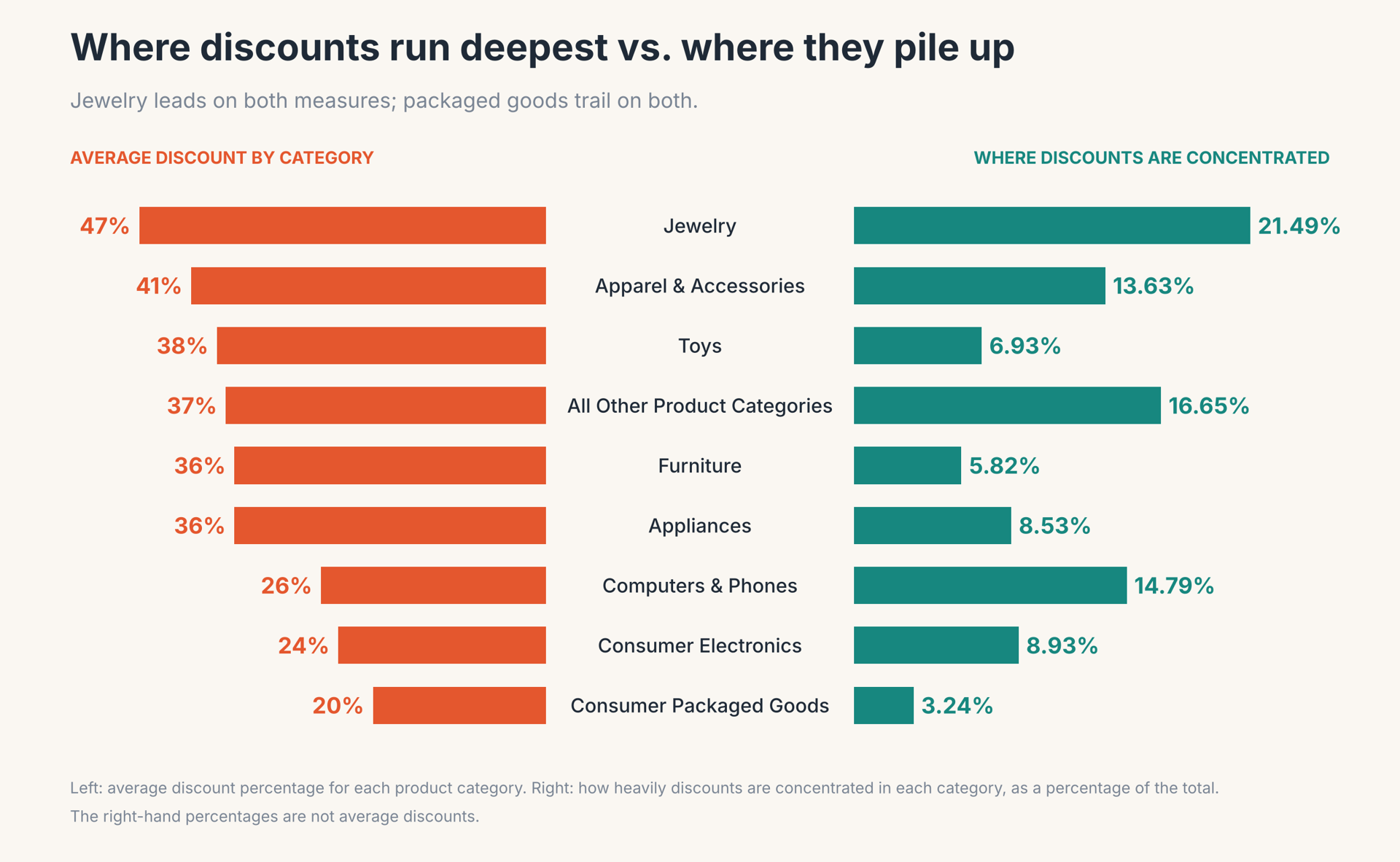
These are the highest average discounts by product category in 2026:
- Apparel and accessories: Macy’s, 65.02%
- Computers and phones: Best Buy, 30.88%
- Consumer electronics: BJ’s, 36.67%
- Consumer packaged goods: Amazon, 23.04%
- Toys: Macy’s, 59.86%
- Appliances: JCPenney, 62.18%
- Furniture: Target, 45.46%
- Jewelry: JCPenney, 74.55%
- All other product categories: JCPenney, 68.52%
Fernanda Tronco/WalletHub
The category breakdown shows that different retailers stand out depending on what shoppers are looking for.
JCPenney stands out in the category rankings, offering the highest average discounts on appliances, jewelry, and other product categories. Meanwhile, Macy’s leads in apparel and accessories as well as toys, making it a strong option for consumers shopping for clothing and gifts.
These differences highlight why comparing retailers before making a purchase can be worthwhile. Rather than assuming one store offers the best deals across the board, consumers can use category-specific discounts to narrow down where to shop.
Is it still worth shopping on Black Friday?
Despite the changes in how retailers approach the holiday shopping season, Black Friday remains an important opportunity for consumers looking to save money.
The latest discount figures suggest that several major retailers are offering higher average markdowns than they did a year ago. However, the size of an advertised discount does not necessarily determine whether a product is a good deal.
Here’s some of my previous coverage of more retail news:
- Bath & Body Works closes dozens of stores in an attempt to win back shoppers
- TikTok takes on Amazon and Walmart with new strategy
- Department-store chain closing half its locations after 188 years in business
Consumers should compare prices across retailers, check historical pricing when possible, and consider whether an advertised promotion provides genuine savings before making a purchase.
The NRF’s latest holiday shopping findings also suggest that consumers remain highly engaged during the season.
“This year’s record turnout reflects a highly engaged consumer who is focused on value, responds to compelling promotions, and seizes upon the opportunity to make the winter holidays special and meaningful,” said NRF CEO Matthew Shay.
Ultimately, Black Friday may no longer look like the one-day shopping event it once was, but the desire to find a good holiday bargain has not disappeared.
Consumers who compare prices and focus on the categories with the steepest markdowns may still find worthwhile Black Friday deals, even as the traditional shopping holiday continues to evolve.
Related: Department-store chain closing half its locations after 188 years in business